Importance of Vyas Puja
Meaning and definition of Vyas Puja
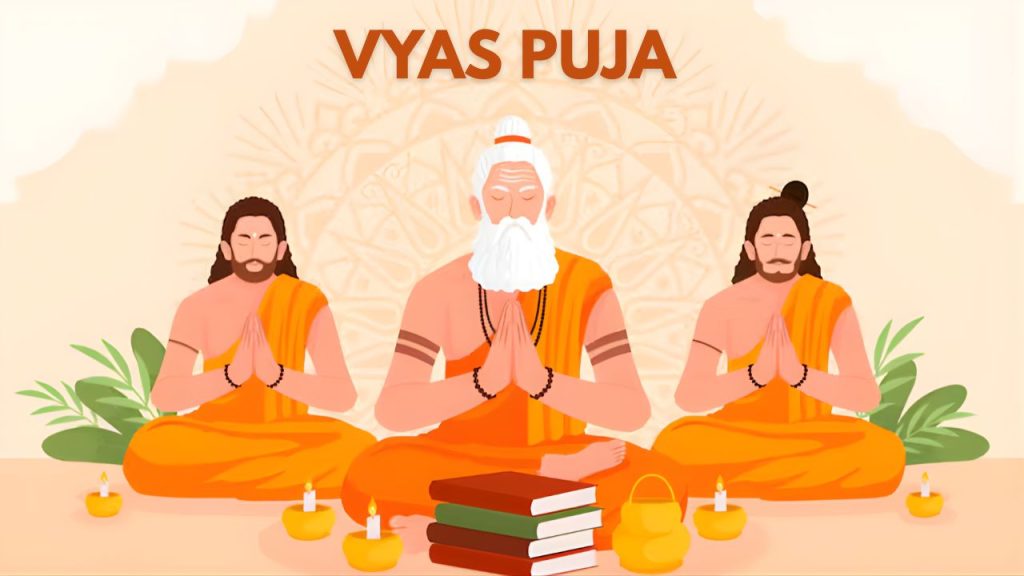
Vyas Puja is a sacred day of immense spiritual significance. It is observed to pay homage to Sage Ved Vyasa, the divine sage revered as the spiritual architect of Sanatan Dharma. This puja is not merely a ritual; it’s a heartfelt celebration of wisdom, gratitude, and the unbroken lineage of spiritual teachings passed down through generations.
The term “Vyas” refers to “one who has classified or differentiated,” and “Puja” means “worship.” Hence, Vyas Puja is the ceremonial worship of the sage who categorized the Vedas, scripted the Mahabharata, and composed the Puranas for the spiritual upliftment of humanity. It is a time to recognize the efforts of those enlightened souls who dedicated their lives to preserving and sharing eternal truths.
The act of performing Vyas Puja is a declaration of gratitude toward the Guru Tattva, the principle of the Guru, which flows through all true teachers and guides. By offering prayers, devotees align themselves with this divine principle, acknowledging that actual knowledge remains unattainable without a Guru.
Connection with Guru Purnima and Ashadha Purnima
Vyas Puja is intimately connected to Guru Purnima, which falls on the full moon day (Purnima) of the Ashadha month (June–July). This day marks the birthday of Sage Vyasa, making it a dual celebration of the Guru’s presence in our lives and the birth of one of the most outstanding spiritual teachers known to humanity.
Ashadha Purnima is not just any full moon; it carries a heightened spiritual charge. The moon symbolizes clarity, peace, and enlightenment. When the moon is full in Ashadha, it mirrors the fullness of wisdom bestowed by a faithful Guru. Celebrating Vyas Puja on this day honors the Guru and the cosmic energies that amplify spiritual growth.
Guru Purnima thus becomes the most appropriate occasion to express devotion, respect, and allegiance to the Guru, acknowledging their unparalleled role in transforming lives. The connection with Vyas Puja lends it historical weight and spiritual depth, making this day a beacon of divine guidance.
Honoring Sage Vyasa, the compiler of the Vedas
Sage Vyasa is not a mere historical figure. He is revered as a divine incarnation, often considered a form of Lord Vishnu sent to guide humankind through wisdom. His monumental task of classifying the Vedas, including the Rig, Yajur, Sama, and Atharva, laid the foundation for all spiritual learning in the Vedic tradition.
In addition, he compiled the Mahabharata, an epic that weaves together ethics, dharma, human dilemmas, and the path to liberation. He is also credited with authoring 18 major Puranas and the Brahma Sutras, texts that offer profound philosophical insight into the nature of existence. Honoring him during Vyas Puja is a collective spiritual acknowledgment of his efforts to ensure that divine wisdom would never be lost. His work simplified complex spiritual concepts, making them accessible to seekers across all walks of life.
Spiritual significance in Hindu tradition
The spiritual significance of Vyas Puja transcends rituals. It represents the transmission of divine wisdom, the kind that liberates souls, awakens consciousness, and connects the seeker with eternal truth. In the Hindu tradition, the Guru is not seen as a mere teacher but as a living embodiment of the Divine.
Performing Vyas Puja is a spiritual act of inner purification. It reminds one to bow down to external teachers and the inner Guru, the higher self that guides through intuition, clarity, and stillness. The puja becomes a mirror, reflecting the devotee’s humility and longing for enlightenment. Vyas Puja also reinforces the Guru-Shishya tradition, a relationship based on trust, surrender, and transformation. The spiritual path is rarely walked alone. A Guru lights the way, and this day reminds everyone to honor that sacred connection.
Relevance in modern-day religious observance
Traditions like Vyas Puja are more relevant than ever. Amid daily chaos, this observance offers a spiritual pause, a reminder to reflect, realign, and reconnect with timeless truths. The Guru’s guidance, whether navigating spiritual dilemmas or handling worldly challenges, remains indispensable.
Modern religious observance isn’t about strict rituals; it’s about reviving meaningful experiences. Vyas Puja encourages seekers to cultivate gratitude, humility, and reverence, values often lost in material pursuits. Even in contemporary spiritual communities, Vyas Puja is a day of recommitment to self-discovery and introspection. It inspires people to seek wisdom, walk the path of righteousness, and pass on knowledge, just as Vyasa did.
Historical and Scriptural Foundations
Life and legacy of Sage Ved Vyasa
Sage Ved Vyasa was born to Sage Parashara and Matsyagandha Satyavati, embodying divine and earthly lineage. His birth on Ashadha Purnima is considered a cosmic event that aligned knowledge, clarity, and dharma energies. His life was a luminous example of devotion to truth, scholarship, and divine mission.
Vyasa’s legacy goes far beyond his literary contributions. He was an eternal visionary who saw the need to preserve Vedic wisdom for future generations. Living in an age when oral tradition was the norm, he realized the importance of documentation and thus began the sacred task of codifying spiritual knowledge. His life story is not just about scripture, it’s about living Dharma. From guiding the Pandavas and Kauravas and composing sacred texts to mentoring disciples such as Vaisampayana and Suka, his influence has shaped the spiritual DNA of Bharatiya culture.
Compilation of the Mahabharata and the 18 Puranas
Sage Vyasa’s authorship of the Mahabharata, a text of over 100,000 verses, stands as a literary and spiritual marvel. Known as the fifth Veda, the Mahabharata is more than a historical epic; it’s a manual for life, offering solutions to moral, social, and spiritual conflicts.
Additionally, the 18 Puranas, including the Bhagavata Purana, Vishnu Purana, and Shiva Purana, offer deeper insights into the cosmic order, divine incarnations, and righteous living. Each Purana has a unique theme, making the infinite truths of Sanatan Dharma digestible to people of different temperaments and levels of understanding. These works form the spiritual backbone of Hindu thought. They are chanted, studied, discussed, and lived through festivals, rituals, and life decisions.
Division of the Vedas for easier comprehension
Initially, the Vedas were a vast, undivided ocean of knowledge. Recognizing the challenge for future generations to grasp the intricacies of such a voluminous body, Sage Vyasa systematically divided it into four parts: the Rigveda, Yajurveda, Samaveda, and Atharvaveda, each focusing on specific aspects of life and worship.
This division wasn’t a dilution but a strategic segmentation for effective preservation and practical application. The Rigveda dealt with hymns and prayers, the Yajurveda focused on rituals, the Samaveda was aligned with music and intonations, and the Atharvaveda addressed topics such as medicine, health, and worldly wisdom. By creating dedicated Shakhas (branches) and appointing disciples to preserve each, Vyasa ensured the eternal survival of Vedic wisdom, which continues to be studied today.
Role in preserving Sanatan Dharma
Sage Vyasa’s contributions are foundational to Sanatan Dharma, the eternal religion. His work ensured that the divine essence of dharma was preserved, adapted, and passed on to each new era. Much of Vedic knowledge might have faded into obscurity without his classifications, compositions, and commentaries. Sanatan Dharma is not bound by time, place, or community. It flows wherever truth, compassion, and duty are upheld. Vyasa made this dharma accessible to Brahmins, scholars, and all sincere seekers, democratizing spiritual wisdom. His role was not merely that of a compiler but of a bridge between divine and human realms, a role only an enlightened sage could perform.
Mentions in scriptures like the Vishnu Purana and the Bhagavata
Sage Vyasa is glorified across various scriptures. In the Vishnu Purana, he is described as one of Lord Vishnu’s 24 avatars. His task was to restore dharma during the spiritual decline, a mission accomplished through wisdom, not warfare. The Bhagavata Purana has a beautiful narrative in which Vyasa feels an inner void despite his vast literary achievements. Upon the guidance of Narada Muni, he wrote the Bhagavatam, a scripture centered on Bhakti (devotion) and the divine play of Lord Krishna. This transformation from knowledge to love marks the pinnacle of spiritual evolution. Such references in the scriptures elevate Vyasa’s identity from sage to divine luminary, whose impact spans yugas (ages) and civilizations.
Symbolism and Spiritual Meaning
Vyasa as the embodiment of divine wisdom
Sage Vyasa is more than a historical sage; he is the living embodiment of divine wisdom. His presence in the spiritual world symbolizes the higher intelligence that governs creation and evolution. In every mantra he composed, every verse he wrote, and every scripture he preserved, the energy of the cosmos flows. The word “Vyasa” means “divider” or “organizer.” He didn’t just divide the Vedas; he made cosmic truths accessible to human minds. His efforts shaped the infinite into finite words, helping generations explore spirituality in structured ways.
He’s often considered an incarnation of Lord Vishnu, manifesting to preserve dharma in an age when knowledge was becoming inaccessible. His mission was rooted in compassion, ensuring that truth reached all who were ready for it, regardless of caste, age, or status. Thus, Vyasa represents the light of realization, the subtle force that guides seekers from intellectual knowledge to inner transformation. Remembering him during Vyas Puja invokes that divine light within.
Representation of guru-shishya parampara
The Guru-Shishya Parampara is one of the most revered spiritual traditions in Indian culture. It represents the sacred bond between the Guru (teacher) and the Shishya (disciple), where wisdom is passed down through words, experience, presence, and inner connection. Sage Vyasa stands at the head of this unbroken lineage. From him, countless disciples learned and carried forward the legacy of Vedic and spiritual wisdom. This parampara is not limited to external teaching; it is an energetic transmission that awakens the seeker’s inner light.
Celebrating Vyasa during Vyas Puja also celebrates every Guru who has carried this flame, from the ancient rishis to the modern-day masters. It’s a tribute to the chain of enlightened beings who help uplift human consciousness, one heart at a time. In this symbolic lineage, every Guru represents Vyasa himself, an expression of the original wisdom that first flowed through him.
The Guru as a guide from darkness to light
A Guru is not merely a teacher of scriptures but a spiritual torchbearer who guides seekers from the darkness of ignorance to the light of self-realization. The Sanskrit verse, “Guru is Brahma, Guru is Vishnu, Guru is Maheshwara,” reflects this powerful truth. Darkness symbolizes confusion, fear, attachment, and ego. The Guru doesn’t just give information; they help dissolve these inner obstacles. By walking with the disciple, pointing to blind spots, and encouraging deeper insight, the Guru empowers the inner journey.
This is why Vyas Puja is more than a day of rituals. Bowling to the Guru’s role in dispelling the inner night is a soulful occasion. Just as Vyasa clarified the spiritual paths of millions, the modern Guru continues to guide lost souls toward light. This transformation isn’t intellectual, it’s energetic. Once the light of awareness is kindled, it burns, illuminating the path for others to follow.
Celebrating the transmission of sacred knowledge
Knowledge becomes sacred when it transforms the heart. What makes the teachings of Vyasa so divine is their depth and how they were transmitted through direct experience with integrity, humility, and clarity. Celebrating Vyas Puja is a celebration of that transmission, a divine relay through which truth has flowed from one enlightened heart to another for thousands of years. It’s like watching a sacred river that originates in the Himalayas and continues to quench spiritual thirst to this day.
This transmission isn’t limited to scriptures. It includes mantras, meditation techniques, life principles, moral values, and energetic presence. It encompasses not just what is taught but how it is lived. This transmission still happens in satsangs, online discourses, retreats, and one-on-one guidance. The sacred is alive, flowing, and evolving, just as Vyasa intended. Vyas Puja reminds everyone to become worthy vessels of that sacred wisdom.
Full moon of Ashadha symbolizing enlightenment
The full moon of Ashadha, under which Vyas Puja is observed, holds profound spiritual significance. In Vedic cosmology, the full moon represents completion, clarity, and divine illumination. It marks the peak of spiritual potential, where darkness is fully overcome. Ashadha Purnima, Vyasa’s birthday, and Guru Purnima’s celebration become portals of immense spiritual opportunity. Just as the moon fully reflects the sun’s light, the disciple fully reflects the Guru’s wisdom on this day, if the heart is receptive.
The moonlight on this night is often associated with Soma, the nectar of immortality, which symbolizes divine bliss and higher consciousness. Many spiritual seekers experience profound inner shifts, insights, and heightened intuition during this full moon. Thus, Vyas Puja becomes a night of surrender, clarity, and transformation, a cosmic alignment between human aspiration and divine grace.
Rituals and Observances on Vyas Puja Day
Guru Paduka Puja and ceremonial worship
One of the most powerful and symbolic rituals of Vyas Puja is Paduka Puja, the worship of the Guru’s sandals. These aren’t mere objects; they represent the divine footprints of those who have walked the path before, guiding seekers with each step. This ritual begins with reverently placing the Padukas (sandals or symbolic footprints) on a clean altar, adorning them with flowers, sandal paste, turmeric, and kumkum. Devotees then offer deepa (lamp), dhupa (incense), naivedya (food), and arati (light) in a complete puja sequence. Bowing to the Padukas is not just physical, it’s an expression of inner surrender. It acknowledges that the path to truth has already been laid, and all one needs is to walk with faith and reverence. In temples, ashrams, and spiritual homes, Paduka Puja becomes a profoundly emotional moment. Devotees feel the Guru’s presence, blessings, and grace flow abundantly, often accompanied by tears of devotion and waves of peace.
Offerings of fruits, flowers, and sacred texts
Offerings made during Vyas Puja are more than symbolic; they reflect gratitude, surrender, and the desire for inner purification. Fruits represent the ripened results of sincere effort; flowers symbolize the beauty of devotion, and sacred texts signify a thirst for wisdom. Each offering is done with mindfulness, often accompanied by mantras or prayers. When offered with devotion, even a single flower carries the power of a thousand rituals. It’s not the size but the intention of the heart that matters.
Sacred texts such as the Bhagavad Gita, Upanishads, or Guru Gita are placed on the altar, sometimes wrapped in silk cloth, symbolizing their divine status. Some even offer handwritten verses or spiritual reflections as personal offerings of understanding and dedication. This entire ritual deepens the bond with the Guru and reaffirms the disciple’s role in preserving and living the teachings.
Chanting of Guru Stotra and Veda mantras
Chanting is central to Vyas Puja observances. The Guru Stotra, verses that glorify the Guru, are recited with deep devotion, each syllable invoking divine energy. The vibrations cleanse the atmosphere, uplift the spirit, and anchor the mind in sacredness. Vedic mantras, such as the Purusha Sukta, Rudram, or Guru Gayatri, are also chanted to honor the universal principle of the Guru. These aren’t just prayers; they are energetic blueprints designed to open subtle channels and elevate consciousness.
In many traditions, group chanting is done in the presence of the Guru or at sacred spaces. The collective recitation creates a powerful spiritual field, enabling participants to experience profound meditative states and a sense of unity. The chanting culminates in an inner stillness, when the ego dissolves, and only the Guru’s presence remains.
Recitation of Vyasa Ashtottara Shatanamavali
One of the special recitations during Vyas Puja is the Vyasa Ashtottara Shatanamavali, a list of 108 names of Sage Vyasa, each highlighting a unique attribute or divine accomplishment. These names are not mere praises; they serve as keys to meditative contemplation.
Each name is like a mantra, inviting reflection on Vyasa’s qualities, his compassion, brilliance, scholarship, detachment, divine mission, and spiritual might. Devotees chant these names while offering flowers or grains, anchoring each virtue into their consciousness. This practice also serves as a spiritual mirror, encouraging introspection and the aspiration to embody similar qualities. In essence, the chanting becomes a journey from reverence to self-transformation.
Discourse on spiritual scriptures and life lessons
No Vyas Puja celebration is complete without a spiritual discourse, also known as Satsang. This is when Gurus, spiritual teachers, or senior disciples share insights from scriptures, commentaries, and personal experiences with the Guru. Such talks often draw from the Bhagavad Gita, the Mahabharata, or the Puranas, focusing on timeless values such as truth, humility, courage, and compassion. These lessons are not theoretical; they are woven into real-life examples, making ancient wisdom relevant to modern challenges.
The essence of these discourses is to awaken not just the intellect but the heart. As listeners absorb these teachings, many feel a profound shift within, a rekindling of spiritual resolve, purpose, and clarity. Vyas Puja thus becomes a living classroom, where every word sown is a seed of transformation.
Role of Gurus and Disciples
Disciples expressing gratitude and devotion
Gratitude is the foundation of every genuine Guru–Shishya relationship. When a disciple expresses devotion and reverence toward the Guru, it’s not out of obligation; it flows from the heart, like a river returning to its source. And Vyas Puja offers a sacred space for this expression. Devotees may offer flowers, perform Paduka Puja, write poems, sing bhajans, or sit in silent meditation near the Guru. Each act becomes a living prayer, an acknowledgment of the transformation and light the Guru has brought into their life.
This devotion isn’t transactional. It is unconditional and deeply personal. It’s about honoring the fact that someone chose to walk alongside, illuminate the path, and never give up, even when the disciple struggled or stumbled. Relationships often carry expectations; the pure love between Guru and disciple is a rare and divine connection. On Vyas Puja, every bow, chant, and tear becomes a heartfelt thank-you whispered to the universe for sending the Guru into one’s life.
Renewal of commitment to spiritual path
Life is full of distractions, and even the most sincere spiritual aspirant can drift from the path. Vyas Puja acts as a potent reminder, a moment of realignment. It invites disciples to pause, reflect, and renew their vows toward inner growth, purity, and realization. This is not about perfection. It’s about sincerity. Vows taken during Vyas Puja might include waking up early for meditation, practicing compassion, observing truthfulness, or dedicating time to scriptural study.
Such commitments are not imposed; they rise from within, fueled by the inspiration that the Guru’s life and presence ignite. Seekers take sankalpa (spiritual resolution) before the Guru or their symbolic representation in many ashrams and spiritual centers. It becomes a moment of inner awakening, where the disciple says, “I’m ready to walk deeper, live truer, and love more selflessly.”
Gurudakshina – symbolic offerings and service
In ancient tradition, Gurudakshina was the offering made by the disciple to the Guru in return for spiritual knowledge. But it was never about material value; it was about intention. On Vyas Puja, Gurudakshina becomes a symbol of gratitude expressed through action. This offering can take many forms, including seva (selfless service), a financial contribution to the Guru’s mission, or even a pledge to live by the Guru’s teachings. The most profound Gurudakshina, however, is inner transformation, when the disciple lives with love, awareness, and a sense of purpose.
Many offer seva during Vyas Puja by organizing the event, preparing prasad, managing logistics, or helping fellow disciples. Others may offer music, writing, teaching, or art skills dedicated to spreading the Guru’s message. What matters is not what is given but how it’s given, with love, humility, and reverence. The Guru doesn’t need anything, but every sincere offering helps purify the disciple’s heart and deepen the bond between them.
Importance of humility and surrender
Humility is the gateway to divine wisdom, and surrender is its path. Without these qualities, spiritual knowledge becomes intellectual; with them, it becomes transformational. Vyas Puja is a powerful reminder of these essential virtues. To approach a Guru is to let go of arrogance, be teachable, and recognize that the ego cannot find truth; it must bow before it. Humility allows the disciple to listen, reflect, and receive. It’s a quiet strength that says, “I don’t know everything, and I’m ready to learn.”
Surrender doesn’t mean blind following; it means trusting the Guru’s intention and wisdom, even when the journey feels uncertain. It’s about opening the heart, letting go of control, and allowing transformation to unfold. On Vyas Puja, when one bows before the Guru or their symbolic Padukas, it’s not just a physical act; it’s a declaration of surrender. It says, “Take this being, guide it, shape it, and lead it to the highest truth.” And in that surrender, something magical happens. The disciple no longer walks alone. The Guru walks within, lighting up every step of the journey.
Vyas Puja in Different Traditions
Vyas Puja holds a unique and universal place within the diverse traditions of the Indian spiritual landscape. While rooted in the common aim of honoring knowledge and spiritual guidance, today’s expressions and rituals vary beautifully across the Vedantic, Yogic, and Bhakti traditions, as well as within diverse sects such as Advaita, Vaishnava, and Shaiva. This pluralistic celebration showcases the inclusive nature of Sanatan Dharma, where the teacher-disciple bond transcends boundaries of path or lineage.
Celebrations in Vedantic, Yogic, and Bhakti Traditions
Vyas Puja is not merely an occasion to worship a historical sage in the Vedantic tradition. It becomes a deep philosophical reaffirmation of jnana (knowledge) as the supreme path to moksha (liberation). Here, the rituals are often accompanied by discourses on the Brahma Sutras, which Ved Vyasa himself authored. These gatherings serve as a stage for seekers to reflect on the non-dualistic truth of the Self and the oneness of all existence.
Yogic traditions, particularly those following the Patanjali Yoga Sutras or the Nath lineage, observe Vyas Puja through silence, meditation, and the transmission of esoteric practices from teacher to student. This tradition emphasizes the importance of the living Guru, seen as a reflection of Vyasa, guiding the aspirant inward through discipline and sadhana. The essence here is subtle but transformative.
In the Bhakti tradition, Vyas Puja celebrates divine love and devotion. Bhajans, kirtans, and heart-touching stories about saints and sages are shared, focusing on surrender and the Guru’s grace. Here, devotion becomes the vehicle to transcend the ego, with Vyasa symbolizing the link between the soul and the Supreme. This expression of Vyas Puja touches the emotional and devotional core of the human experience.
Observances in Advaita, Vaishnava, and Shaiva Sects
Vyas Puja is a solemn and reflective practice within the Advaita school of thought, founded by Adi Shankaracharya. The rituals honor the lineage of Gurus, beginning with Narayana and continuing to Vyasa, Shankaracharya, and one’s own Guru. These observances include Vedic chanting, scriptural readings, and philosophical debates that delve into the essence of non-duality. The atmosphere is rich with intellect and reverence.
Vaishnava traditions, especially those following Sri Ramanuja or Madhvacharya, view Vyasa as an incarnation of Lord Vishnu. Thus, the day is marked with grandeur, abhisheka (ritual bathing), floral offerings, and public readings of the Bhagavad Gita and the Puranas. Devotees feel spiritually nourished as they participate in collective worship, reinforcing the role of Vyasa in spreading bhakti and divine knowledge.
In the Shaiva sects, Vyasa is revered as a compiler of texts and as one who preserved the sacred Shaivite narratives within the Puranas. Ashrams perform special Rudrabhishekams and chant hymns from the Shiva Purana. The Guru is honored with deep reverence as the living embodiment of Lord Shiva, who grants liberation through wisdom and grace.
Distinct Rituals in Ashrams and Mathas Across India
Ashrams and traditional mathas (monastic institutions) uniquely flavor the Vyas Puja observances. From the banks of the Ganges to the hills of Karnataka and the spiritual heart of Tamil Nadu, each institution follows its Guru Parampara (lineage) and honors Vyasa through specific rituals. These include Padapuja (worship of the Guru’s feet), alankaram (decorating the Guru’s seat), and Guru Arati.
Discourses and storytelling sessions are held to reflect on Vyasa’s contributions. Students often present essays, songs, and dramatic performances. Some mathas organize Sanskrit chanting competitions or Vedic recitation marathons to inspire the younger generation to engage with their spiritual heritage. The ambiance is rich with cultural vitality and spiritual fervor.
Commemoration by Saints like Adi Shankaracharya
Saints like Adi Shankaracharya revolutionized the significance of Vyas Puja by establishing Guru worship as the heart of spiritual life. Through his compositions, such as the Guru Ashtakam, and his revival of the four mathas, he linked every seeker to the spiritual current originating from Vyasa. In Shankaracharya’s tradition, Vyasa is the eternal Guru, the guiding light of scriptural wisdom. His institutions meticulously observe Vyas Puja with rituals that uphold the highest Vedic and spiritual standards. The saints that came after him continued this legacy, ensuring that every generation, regardless of background or geography, can access the grace and wisdom of Vyasa through the Guru.
Vyas Puja in the International Spiritual Community
Vyas Puja is no longer confined to the boundaries of India. From the yoga studios of New York to the meditation centers of Europe and Australia, the day is marked with heartfelt devotion and spiritual learning. International spiritual communities use this day to honor their teachers, reflect on sacred texts, and build global unity through the Guru’s grace. Workshops, live-streamed discourses, and online satsangs unite thousands of spiritual seekers. It’s a testament to how the light of Vyasa continues to guide humanity, transcending language, nationality, and culture.
Contemporary Relevance of Vyas Puja
In an era marked by rapid change, digital distraction, and emotional disconnection, the timeless wisdom behind Vyas Puja provides a powerful anchor. While the rituals and chants may appear ancient, their relevance is profoundly modern. They offer tools for inner clarity, discipline, and connection, things many yearn for today.
Need for Spiritual Mentorship in Modern Life
Modern life offers an abundance of information but little wisdom. Social media, artificial intelligence, and instant gratification have expanded access to knowledge, but they cannot replace lived wisdom or inner guidance. That’s where the relevance of a spiritual mentor becomes crystal clear. The Guru, like Sage Vyasa, doesn’t just offer information. The Guru transforms a seeker from confusion to clarity, chaos to inner peace. The concept of the Guru can extend beyond the traditional robe-clad figure. A mentor, teacher, or guide who nurtures inner growth plays a similar role. Vyas Puja reminds everyone to acknowledge these influences and embrace mentorship as a sacred relationship.
Reclaiming Lost Values Through Ancient Wisdom
The modern world often struggles with ethical dilemmas, fractured families, and a disconnect from timeless values. Vyas Puja invites us to reconnect with our roots and rediscover values such as respect, humility, gratitude, and truth. These aren’t just spiritual ideals, but survival tools for a balanced and fulfilled life. The ancient teachings compiled by Vyasa help navigate modern confusion with clarity and insight. Celebrating Vyas Puja centers on these texts and principles, enabling individuals to reassess what truly matters in life and how to live purposefully.
Role of Vyas Puja in Cultural Education and Dharma
As globalization expands, preserving cultural identity becomes crucial. Vyas Puja provides children, youth, and families with a beautiful opportunity to remain connected to dharma, the righteous path. Through stories, rituals, and family gatherings, a living sense of cultural pride is passed down from one generation to the next. It’s not about blind tradition. It’s about cultural education that builds awareness of India’s intellectual and spiritual legacy. Schools, community centers, and temples use this occasion to teach young minds about dharma, values, and inner excellence.
Building Gratitude and Respect for Teachers
In an era where authority is often questioned and respect diluted, Vyas Puja teaches the importance of reverence, not out of fear, but out of gratitude. Honoring the Guru, in any form, nurtures humility. It reminds everyone that progress is never a solo journey. Every step forward has been made possible because someone else lit the path. Whether it’s a schoolteacher, a parent, a life coach, or a spiritual master, Vyas Puja becomes a symbolic gesture to express heartfelt thanks. In doing so, it fosters emotional intelligence and a deeper human connection.
Fostering Inner Transformation and Discipline
At its core, Vyas Puja isn’t just about worship. It’s a call for transformation. Through the remembrance of Vyasa and the Guru’s wisdom, one is encouraged to cultivate sadhana (practice), tapas (discipline), and Viveka (discernment). These are life skills often missing in a distraction-heavy environment. The rituals and silence of the day act as a spiritual detox. They redirect attention inward, promote mindfulness, and inspire a disciplined approach to living. These virtues can transform lives in a world increasingly driven by automation and instant gratification.
Festivals and Events Around Vyas Puja
Vyas Puja is a quiet spiritual observance and a cultural celebration that brings people together across regions, generations, and spiritual paths. It lights up temples, ashrams, homes, and hearts with devotion, music, learning, and community bonding. These celebrations reflect the vibrant heartbeat of India’s spiritual legacy, while continuing to grow in popularity worldwide.
Guru Purnima Celebrations in Temples and Ashrams
Temples and ashrams become sanctuaries of devotion and discipline during Vyas Puja, particularly on Guru Purnima. The day begins early with the purification of spaces and ceremonial decoration of the Guru’s seat or image. Traditional rituals, such as Padapuja, the worship of the Guru’s feet, are performed with flowers, sandalwood paste, incense, and deep devotion. In many ashrams, disciples offer fruits, clothes, garlands, and Dakshina (offerings) to express gratitude. The Guru often delivers a special Upadesha (spiritual discourse), reminding seekers of the deeper purpose of life and the responsibilities of a student on the spiritual path.
Silence and service form the backbone of these observances. Residents of the ashram may take a vow of Mauna (silence), while some volunteer in the kitchen or garden as acts of seva (selfless service). The day is filled with a sacred atmosphere of stillness, sincerity, and joy.
Bhajan, Kirtan, Satsang, and Yajna Events
Music, when offered in devotion, becomes a spiritual practice. That’s why bhajans and kirtans are integral to Vyas Puja celebrations. Throughout the day, ashrams and spiritual centers organize soulful musical gatherings where devotees sing the glories of the Guru, Sage Vyasa, and divine wisdom. These aren’t performances; they are expressions of gratitude and surrender. Singing together as a community builds a collective vibration that elevates everyone’s consciousness. It also allows even newcomers to participate in the joy of devotion.
Satsangs, spiritual discourses by the Guru or senior disciples, enrich the mind with wisdom and clarity. Often accompanied by yajnas (fire rituals), these events purify the environment and the minds of those participating. Offerings are made to the sacred fire while sacred mantras are chanted, creating an atmosphere of divine presence and peace.
Public Discourses by Spiritual Leaders
Vyas Puja serves as a powerful occasion for spiritual leaders to address the community, often through public discourses organized in town halls, temples, or large open spaces. These talks don’t just interpret scriptures; they make ancient truths accessible and relevant to modern life. Listeners receive practical guidance on living with integrity, managing emotional challenges, and nurturing a deeper connection with the divine. Often, these discourses become life-changing for attendees, igniting a sincere desire to walk the spiritual path with commitment.
These events also serve as a bridge between generations. Elders pass down the values of reverence and learning, while youth connect with the living relevance of ancient teachings. When the community gathers to hear spiritual wisdom, a collective elevation of consciousness occurs.
Community Gatherings and Collective Worship
In many places, Vyas Puja becomes a festive community event where people gather for rituals, shared meals, storytelling, and group meditation. The sense of belonging and togetherness is palpable. The celebration serves as a reminder that leading a spiritual life involves working alongside others and is not a solitary endeavor. Collective pujas, chanting sessions, and shared readings of the Bhagavad Gita, Mahabharata, or Puranas fill the day with devotion and learning. Many communities organize annadanam, the sacred offering of free food, inviting everyone to partake, regardless of caste, creed, or background. This reinforces the inclusive spirit of dharma and the values taught by Vyasa.
Participation by Devotees and Spiritual Seekers Globally
Vyas Puja has now transcended geographical and cultural boundaries. Across continents, devotees come together in yoga studios, spiritual centers, or online communities to honor their Gurus and reflect on the teachings of Vyasa. In the U.S., Canada, the U.K., Australia, and the Middle East, spiritual organizations host global satsangs, interactive talks, and live-streamed rituals. From silent meditation retreats in Costa Rica to Sanskrit chanting workshops in Europe, the spirit of Vyas Puja continues to touch hearts worldwide. For those unable to attend in person, technology serves as a medium for devotion, enabling live participation in Guru Purnima celebrations from anywhere in the world.
Astrological and Cosmic Significance
Behind Vyas Puja’s spiritual and cultural vibrance lies a deeper cosmic intelligence. The universe operates on rhythms of stars, planets, and celestial energies that deeply influence life on Earth. Vyas Puja, observed on Ashadha Purnima, aligns with powerful lunar and seasonal cycles that open a window for spiritual growth and inner alignment.
Occurrence on Ashadha Purnima – Full Moon Energy
Vyas Puja is celebrated on Ashadha Purnima, the full moon day of the Ashadha month in the Hindu lunar calendar. This full moon is considered one of the most spiritually charged in the year. The moon, fully illuminated and closest to Earth’s energetic frequency, symbolizes enlightenment, completeness, and clarity, the gifts a Guru imparts to a disciple. This full moon is not only visually stunning but energetically potent. It influences the mind and subtle body, helping seekers experience more profound meditation, emotional balance, and mental focus. Observing spiritual practices under this full moon enhances receptivity to divine guidance and inner wisdom.
Alignment with Chaturmasya – Sacred Four Months
Ashadha Purnima also marks the beginning of Chaturmasya, a four-month period considered highly auspicious for spiritual discipline. This period includes the rainy season in India, symbolizing inner cleansing and seclusion. As nature pauses to rejuvenate during the monsoon, spiritual seekers turn inward for contemplation and austerity. The alignment of Vyas Puja with the start of Chaturmasya is no coincidence. It sets the tone for introspection, discipline, and transformation. Many spiritual aspirants take vows during this time to fast, read scriptures, reduce distractions, and deepen their practice.
Start of Introspective and Spiritual Disciplines
As Vyas Puja ushers in Chaturmasya, it serves as a spiritual reset button. It’s a chance to pause and evaluate personal growth. Are distractions taking over? Is the connection with inner peace getting lost? Vyas Puja becomes a checkpoint to recommit to one’s spiritual journey. Many undertake vrata (vows), such as observing silence on certain days, limiting indulgences, or engaging in daily scriptural study. These simple disciplines often yield profound results, calming the mind, sharpening awareness, and opening the heart to spiritual truths.
Energetic Influence of Lunar and Solar Harmonies
The cosmic dance between the sun and moon reaches a moment of harmony on Ashadha Purnima. Lunar energies represent the mind, intuition, and emotion; solar energies symbolize awareness, discipline, and willpower. When both harmonize during the full moon, it creates a potent blend of emotional depth and intellectual clarity. This balance is ideal for learning, devotion, and meditation, all of which are central to Vyas Puja. The day naturally supports the Guru-disciple energy exchange. Seekers feel more aligned to absorb higher truths and experience inner shifts, not just symbolically but energetically.
Ideal Time for Vows, Fasting, and Sadhana
Many traditions observe Vyas Puja with upavasa (fasting), not as a punishment but as a way to heighten awareness and reduce worldly distractions. Fasting on this day is said to cleanse the body and purify the subtle energies. It also prepares the mind for sadhana (spiritual practice), enhancing depth and sincerity. Taking new vows on this sacred day, like reading a chapter of the Bhagavad Gita daily, chanting a specific mantra, or giving up a bad habit, receives energetic support from the universe. The spiritual momentum built on Vyas Puja continues to guide the seeker throughout Chaturmasya.
Upholding the Legacy of Vyasa
Vyas Puja is far more than a cultural tradition. It’s a spiritual lighthouse, guiding individuals through the fog of daily life into a deeper, more meaningful existence. It invites everyone to connect with the timeless values of wisdom, devotion, and inner growth that have been passed down through the Guru-Shishya tradition.
Continuing the Guru-Shishya Tradition in Modern Times
The ancient Guru-Shishya parampara (teacher-student lineage) remains as relevant as ever. The form may change, with online classes, books, and Zoom satsangs, but the essence is untouched. There is a deep need for one-on-one mentorship, where wisdom is transmitted with compassion and clarity. By celebrating Vyas Puja, this sacred lineage is honored and preserved. Every time a teacher is thanked or a spiritual lesson is practiced, the legacy of Vyasa continues.
Integrating Vyas Puja Values Into Daily Life
The values of Vyas Puja can shape everyday life rather than limiting these teachings to one day. Speaking truth, showing gratitude to mentors, reading sacred texts, serving others selflessly, and maintaining inner silence uplift the individual and society. When these values are woven into daily habits, life reflects dharma. The mind becomes more stable, relationships more meaningful, and goals more aligned with inner peace.
Revering Knowledge, Truth, and Dharma
At the heart of Vyas Puja lies a profound reverence for knowledge, truth, and dharma, the pillars of a purposeful life. Honoring Vyasa is honoring the source of timeless wisdom that helps navigate life’s storms with clarity and grace. Whether through the pages of the Mahabharata or the silent guidance of a teacher, the essence remains the same: walk the path of light, stand by the truth, and serve with humility.
Inspiring Future Generations to Honor Gurus
The true success of any tradition lies in its ability to inspire the next generation. Vyas Puja offers a beautiful opportunity to introduce young minds to the richness of Indian spiritual culture. Children watching elders offer prayers, sing bhajans, and speak kindly of their teachers will carry those impressions for life. Schools and families can make it a day of storytelling, interactive learning, and gratitude exercises that inspire reverence and wisdom from an early age.
Vyas Puja as a Timeless Celebration of Divine Wisdom
In essence, Vyas Puja is a celebration that transcends time and space. Calendar dates, geographical borders, or religious labels do not bind it. It’s a call to remember, remember the wisdom that guides, the teacher that uplifts, and the divine within that waits patiently to be discovered. Celebrating Vyas Puja is more than tradition; it’s a soul-level affirmation that guidance and growth are always possible.