Understanding the Essence of Vaikasi Visakam
Vaikasi Visakam is not just another date on the Tamil calendar; it’s a spiritually charged, emotionally uplifting, and culturally vibrant festival celebrated by millions, especially in South India. If you’ve ever stood among the sea of devotees during this occasion, you’ve probably felt the energy surge in the air; it’s intense, sacred, and truly unforgettable.
This festival takes place in the Tamil month of Vaikasi (which falls between May and June), when the Visakam Nakshatra (Vishakha star) aligns with the Purnima (Full Moon). Interestingly, this also overlaps with Jyeshtha month in the Sanskrit lunar calendar, making it significant across Tamil and pan-Indian spiritual timelines.
The astronomical aspect adds another layer of wonder. Visakam is considered one of the most auspicious of the 27 nakshatras. When it aligns with the full moon, it amplifies the energy of clarity, courage, and divine light, which aligns beautifully with the birth energy of Lord Murugan (also called Kartikeya or Subramanya).
Why is this so important? Because Lord Murugan was born under this very star. For devotees, this day is not just about celebration; it’s a divine call to reconnect with values like wisdom, valor, purity, and devotion. Rooted deeply in Tamil Hindu culture, Vaikasi Visakam resonates with a community that honors tradition and spiritual evolution.
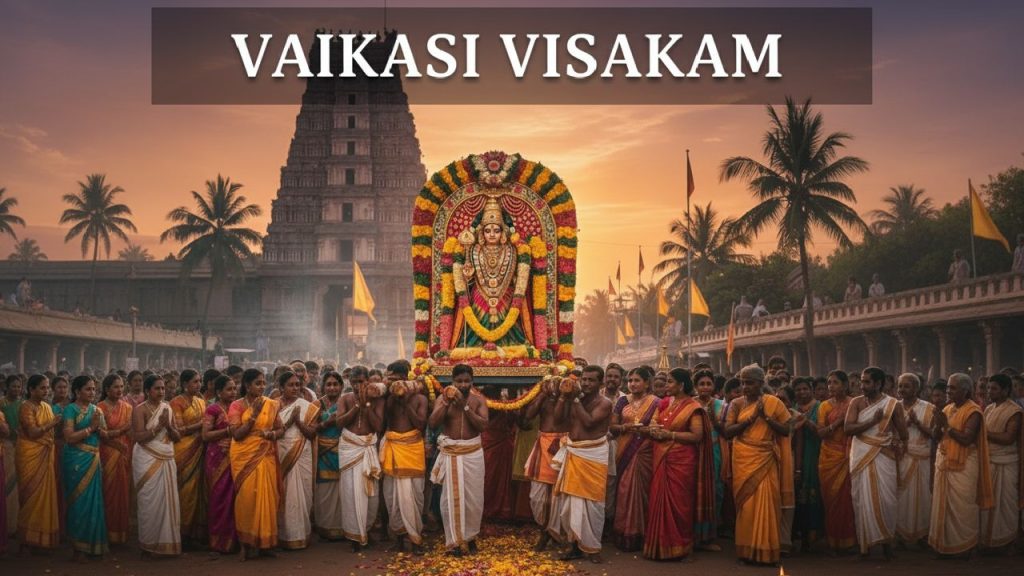
In South Indian traditions, this day brings families and communities together. Temples overflow with devotion, and streets are often filled with vibrant processions, devotional songs, and the unmistakable aroma of fresh flowers and incense. It’s more than a ritual, a lived, collective spiritual experience.
Mythological Origins of Vaikasi Visakam
The story of Vaikasi Visakam is as grand and divine as the celebration itself. The mythology surrounding Lord Murugan’s birth is rich with symbolism and cosmic significance, offering us awe-inspiring tales and timeless lessons.
Birth story of Lord Murugan from Lord Shiva’s third eye
According to ancient texts and popular tradition, Lord Murugan was born from the blazing third eye of Lord Shiva in response to the gods’ plea to save the world from the tyranny of the asura (demon) Surapadman. This birth wasn’t regular; it was divine, purposeful, and filled with cosmic fire.
From Shiva’s third eye emerged six sparks of light carried by Agni (the fire god) and Vayu (the wind god) to the sacred Saravana Poigai, a celestial lake. There, these six sparks transformed into six beautiful babies.
Role of the six Krittikas in nurturing Murugan
The Krittikas, celestial mothers representing the Pleiades star cluster, lovingly nurtured the six babies. Their nurturing love symbolizes the maternal divine force in the universe. Later, Goddess Parvati lovingly embraced them all, merging them into a single six-faced form; thus, Lord Murugan became Shanmukha, the six-faced warrior god.
Murugan’s mission to destroy the demon Surapadman
Murugan’s birth had a clear cosmic purpose: to defeat the formidable demon Surapadman, who had become a threat to dharma (righteousness). Armed with the Vel (divine spear) gifted by his mother, Murugan embarked on his mission, ultimately defeating the demon in a battle that symbolized the triumph of good over evil.
Symbolism of divine wisdom, valor, and dharma
Murugan’s character is a timeless emblem of divine wisdom, unwavering valor, and righteous dharma. His stories remind us that inner strength, clarity of purpose, and faith can help us overcome even the darkest forces within and around us.
Importance of Visakam nakshatra in divine narratives
The Visakam star, under which Lord Murugan was born, is associated with spiritual awakening, divine mission, and inner purification. Its presence in this story reinforces its identity as a nakshatra of power and purity. Leadership, fearlessness, and spiritual wisdom often shine strongly for those born under this star.
Religious Significance of Vaikasi Visakam
Vaikasi Visakam is not merely a festive observance; it’s deeply woven into the fabric of spiritual devotion and self-transformation for devotees of Murugan worldwide. Its religious importance lies in its ability to renew faith, intensify bhakti (devotion), and provide a powerful platform for inner change.
Recognized as the birthday of Lord Murugan
First and foremost, Vaikasi Visakam marks the divine birth of Lord Murugan, the younger son of Lord Shiva and Parvati. Unlike ordinary birthdays, this one is celebrated as a cosmic event, marking the birth of a deity who embodies courage, clarity, and a commitment to righteousness.
Celebrated with special rituals in Murugan temples
On this sacred day, temples dedicated to Murugan, especially in South India, come alive with spiritual fervor. You’ll find elaborate rituals, including abhishekams, vel pujas, and flower offerings. The atmosphere is filled with devotional chanting, drums, and traditional musical instruments that elevate the spiritual energy of the space.
Connection to the Skanda Purana
The significance of Vaikasi Visakam is well-documented in the Skanda Purana, one of the largest Mahapuranas in the Hindu tradition. This sacred text offers rich narratives of Murugan’s life, divine exploits, and spiritual teachings. Reading or listening to these stories on this day is considered highly meritorious.
Observed as a powerful day for spiritual initiation and penance
Many seekers use Vaikasi Visakam as a day for spiritual initiation. It’s believed that meditating, chanting, and surrendering at the feet of Lord Murugan on this day can clear karmic debts and open pathways to higher consciousness. Some devotees take vows of penance, such as walking on fire or carrying a kavadi, as expressions of gratitude and surrender.
Seen as a time for devotees to overcome ego and material desires
Murugan’s battle with Surapadman isn’t just a myth; it’s a metaphor for the inner battle we all fight with our ego, desires, and ignorance. Vaikasi Visakam serves as a powerful reminder that we can transcend these limitations and strive toward a more spiritually fulfilling life through devotion and inner discipline.
Observances and Rituals on Vaikasi Visakam
The day of Vaikasi Visakam is rich in vibrant rituals, sacred chants, and collective energy that unite millions in devotion. The observances are not just symbolic; they’re transformative practices that bring us closer to the divine presence of Murugan.
Early morning abhishekam (ritual bathing) of Murugan idols
The first central ritual is the early morning abhishekam, where the idols of Murugan are bathed in milk, honey, sandalwood paste, turmeric, and rose water. This sacred purification act is believed to cleanse the minds and souls of devotees. Even as a silent observer, watching this ritual is often a profoundly emotional experience.
Processions and alankaram (decorations) in temples
Murugan is lovingly decorated with garlands, jewels, silk attire, and vibrant flowers. Temples often organize grand processions, where the deity is taken on a chariot or palanquin, accompanied by nadaswaram (traditional music) and devotional dancers. It’s a spiritual spectacle that fills the streets with joy and reverence.
Offering of special naivedyams (sacred foods)
On this day, devotees prepare and offer special prasadams (naivedyams) such as panchamirtham (a mix of five sacred ingredients), payasam, and tamarind rice. These offerings symbolize devotion and bring communities together over shared meals and blessings.
Chanting of Skanda Shashti Kavasam and other hymns
Chanting powerful hymns like Skanda Shashti Kavasam, Subramanya Bhujangam, and Kandar Anubhuti energizes the day. These chants are believed to offer protection, health, and spiritual strength. Even reciting or listening to them once on this day is considered highly beneficial.
Fasting and prayer practices for blessings and health
Many devotees observe fasts, ranging from fruit diets to complete water-only fasts, as a form of tapas (penance). The idea is to purify the body and mind to receive divine energy. Alongside, people engage in deep prayer, japa (mantra repetition), and introspection, seeking Murugan’s blessings for clarity, health, and inner strength.
Cultural and Regional Variations in Celebration
Vaikasi Visakam is not limited to temple rituals or individual practices. Across regions and communities, it becomes a cultural mosaic of colors, traditions, music, and collective devotion that transcends geographic boundaries.
How Tamil Nadu celebrates Vaikasi Visakam with grandeur
In Tamil Nadu, particularly in cities such as Chennai, Madurai, and Coimbatore, Vaikasi Visakam is celebrated with massive processions, temple fairs, and week-long spiritual discourses. Temples like Vadapalani Murugan Temple in Chennai witness lakhs of devotees today.
Murugan temples in Palani, Tiruchendur, and Swamimalai
The Arupadai Veedu (Six Abodes of Murugan), particularly Palani, Tiruchendur, and Swamimalai, serve as focal points of the celebration. Devotees walk barefoot for miles, carry kavadi, and even pierce their bodies as an act of devotion. The spiritual ambiance is intense and humbling.
Observances in Sri Lanka, Malaysia, and Singapore
Countries like Sri Lanka, Malaysia, and Singapore enthusiastically observe Vaikasi Visakam outside India. Temples in Kuala Lumpur, Jaffna, and Little India (Singapore) organize grand chariot processions and cultural events, uniting the Tamil diaspora in shared devotion.
Community celebrations, including processions and music
Besides temple rituals, local communities often organize bhajan sessions, spiritual dramas, children’s competitions, and devotional music concerts. It becomes a festival of learning, bonding, and joyous expression of faith.
Impact on local economies and tourism during the festival
The celebrations also boost local economies, especially in temple towns. Flower sellers, artisans, caterers, and transport services witness a surge in demand. For tourists, it presents a rare opportunity to experience the pinnacle of Tamil spirituality and cultural richness.
Astrological Importance of Visakam Nakshatra
Vaikasi Visakam aligns with the Visakam (Vishakha) Nakshatra, a spiritually significant constellation deeply rooted in Vedic astrology. Falling under the influence of Jupiter (Guru) and partly Mars, this star is a powerhouse of transformation, clarity, and divine ambition. It’s no coincidence that Lord Murugan, the eternal youth and spiritual warrior, is said to have been born under this nakshatra. The energies flowing through the cosmos on this day are believed to help you break through internal stagnation and step into clarity, courage, and purpose.
Meaning and attributes of the Vishakha constellation
Vishakha is the sixteenth nakshatra in the lunar zodiac and spans the Libra-Scorpio axis. It’s symbolized by a triumphal archway or a potter’s wheel, both symbols of creation, growth, and movement toward destiny. Ruled by Jupiter, the planet of wisdom and expansion, and partially influenced by Mars (action and fire), this nakshatra embodies dual forces, spiritual wisdom and passionate drive. This duality often leads to meaningful transformations in life. The archway represents a gateway to enlightenment, while the potter’s wheel signifies shaping and refining one’s life path.
Traits of individuals born under this nakshatra
People born under Visakam are known to be determined, ambitious, and intellectually sharp. They possess a spiritual spark and a warrior-like energy, a reflection of Murugan himself. They’re often seen as driven leaders who intensely focus on their goals. At their best, they strike a balance between ambition and compassion, and knowledge and action. However, this nakshatra can make one overly aggressive or impatient if misaligned. However, with awareness and spiritual practice, they can transform their intensity into a light for others.
Energies believed to be strong on this day (courage, clarity, focus)
Vaikasi Visakam vibrates with heightened cosmic energy. The spiritual currents are strong in courage, inner clarity, and focused awareness. Whether you’re beginning a new spiritual journey, facing a personal challenge, or seeking emotional stability, this day provides cosmic assistance. The celestial alignment helps clear mental fog, break karmic cycles, and sharpen intuitive insights. It’s a perfect day to stand firm in your truth and make empowered decisions.
Spiritual impact of planetary alignments during Vaikasi Visakam
Planetary placements on this day often include favorable aspects between Jupiter and the Moon. Jupiter brings wisdom and higher learning, while the full moon amplifies emotional and spiritual receptivity. This rare combination creates a fertile ground for deep introspection and transformative revelations. It’s also an excellent time for spiritual initiations, soul searching, and aligning your path with divine will. If you’ve felt stuck, the stars align to offer a cosmic nudge forward.
Recommended spiritual activities on this nakshatra
There’s a natural pull toward the divine on Vaikasi Visakam. Chanting mantras like “Om Saravanabhava” or “Subramanya Swamy Namaha” is highly recommended. Meditate during the Brahma Muhurta (early morning twilight), light a ghee lamp, and offer Lord Murugan milk, honey, or sandalwood. Performing abhishekam (ritual bathing) of a Murugan idol or visiting a Murugan temple enhances spiritual merit. Fasting or consuming sattvic food can purify the mind and body, allowing for the reception of divine energy more openly.
Vaikasi Visakam in Spiritual Practice
When we think of Vaikasi Visakam, we often focus on grand rituals and colorful processions. But its true power lies in the quiet inner space it opens within us, a gateway to spiritual awakening. This day doesn’t just invite worship but transformation. It encourages you to pause, reflect, and reconnect with your higher self under the guidance of Lord Murugan, the embodiment of wisdom and divine discipline.
An ideal day for spiritual awakening and inner purification
There’s something truly sacred about Vaikasi Visakam. The alignment of the full moon with the Visakam nakshatra creates an energy vortex ideal for inner cleansing. It’s believed that on this day, the veils between the material and spiritual realms are thin. If you’re struggling with emotional baggage, negative thought patterns, or spiritual stagnancy, this is the day to release them. Whether through a sacred bath, meditation, or fasting, every small act of devotion helps cleanse your inner landscape and invites divine light.
Murugan as the Guru – symbolism of jnana (wisdom) and discipline
Lord Murugan isn’t just a deity, He’s a guru. He represents Jnana Shakti, the power of wisdom. Armed with the Vel (spear), He pierces through the illusions of the mind and the distractions of the senses. His youthful form teaches us that age is no bar to knowledge and that discipline doesn’t have to come from rigidity; it can be joyful, vibrant, and courageous. When we invoke Murugan on Vaikasi Visakam, we invite blessings and transformation led by truth, self-control, and purpose.
Relevance of mantra chanting and meditation
Mantras carry vibrational energy. On Vaikasi Visakam, chanting Lord Murugan’s mantras, especially “Om Saravanabhavaya Namah”, is deeply purifying. These sacred sounds activate spiritual centers in the body, particularly the throat and heart chakras, enabling you to speak your truth and act compassionately. Paired with meditation, mainly focusing on the image of Murugan or the flame of a lamp, your mind can move from chaos to stillness. Even 30 minutes of focused practice can lead to lasting inner peace.
Observing silence (mauna) and introspection
Choosing silence becomes a revolutionary act. Mauna, the practice of silence, is deeply recommended on Vaikasi Visakam. When you don’t speak, you listen, not to others, but to your soul. In this quiet space, old patterns become visible, and clarity dawns. Journal your thoughts, walk in nature, or sit in stillness. This is the day to listen to the voice within, and to recognize that voice as divine.
Pilgrimage to Murugan temples for spiritual merit
Devotees have made pilgrimages to sacred Murugan shrines, such as Palani, Tiruttani, Swamimalai, and Thiruchendur, on Vaikasi Visakam for centuries. These temples are spiritual powerhouses, vibrating with devotion and divine energy. Even if you can’t travel physically, connecting with these temples through virtual darshan or visualizing them in meditation can open channels of grace. Pilgrimage reminds us that devotion is both a journey and a destination; every step taken in faith brings us closer to inner freedom.
Symbolism and Philosophical Teachings
Vaikasi Visakam isn’t just a festival; it’s a doorway to a more profound understanding. Lord Murugan, in His divine form, is rich with philosophical symbolism. Every element of His iconography, from His youthful appearance to His weapons, is a metaphor for inner transformation. Let’s explore how these symbols speak directly to our spiritual journey.
Murugan is a symbol of divine knowledge and youth
Murugan’s eternal youth is not about age but awareness. He represents freshness of perception, the courage to question, and the eagerness to learn. As the son of Shiva (consciousness) and Parvati (energy), Murugan is the perfect blend of intellect and devotion. His youthful form reminds us that actual knowledge keeps us ever-curious and ever-humble. He shows us that you don’t need decades of study to touch divine wisdom, just purity of heart and clarity of mind.
The six faces (Shanmukha) represent six attributes or senses
One of the most profound symbols of Murugan is His six faces, each representing a sense: sight, hearing, smell, taste, touch, and intuition. These faces remind us of the need to master our sensory experiences rather than being controlled by them. When the senses are aligned with the spirit, they become doorways to bliss rather than distractions. Meditating on Shanmukha helps us integrate all aspects of ourselves, the physical, mental, and spiritual.
Victory over Surapadman is a triumph over inner demons
The story of Murugan slaying the demon Surapadman isn’t just mythology; it’s an allegory. Surapadman symbolizes ego, ignorance, and attachment. When Murugan defeats him, it signifies the triumph of higher consciousness over base instincts. We fight our Surapadman, our fears, doubts, and false beliefs. Vaikasi Visakam calls you to face those inner demons, not with aggression, but with truth and unwavering clarity.
Peacock as a symbol of ego tamed by wisdom
Murugan rides a peacock, an animal known for its beauty and pride. In spiritual terms, the peacock represents the ego. By making the peacock His vehicle, Murugan shows us that wisdom doesn’t destroy the ego; it tames it. A healthy ego can be a service, creativity, and courage tool. Under divine control, the peacock dances not for attention but as an expression of divine joy.
Spear (Vel) as divine knowledge piercing ignorance
The Vel, Murugan’s mighty spear, is perhaps the most potent symbol. It’s not a weapon of destruction but of awakening. It cuts through illusion and ignorance like light breaking darkness. When you invoke Murugan’s Vel, you ask for insight, the courage to confront your shadows, and the strength to rise above them. It’s a call to rise into your higher self, fierce, focused, and free.
Impact on Devotees’ Lives
For millions of devotees worldwide, Vaikasi Visakam is not just an annual observance; it’s a profoundly personal journey. Murugan’s stories, rituals, and divine presence have changed lives, guided families, and nurtured generations. Let’s explore how this sacred day touches hearts and shapes lives.
Stories of transformation and miracles attributed to Lord Murugan
Across Tamil Nadu, Sri Lanka, Malaysia, and other parts of the world, devotees share real-life stories of healing, protection, and unexpected blessings received through Murugan’s grace. The testimonies are endless, from illnesses cured at the foot of Palani Hills to people finding peace during personal crises through a simple Vel puja. These aren’t just miracles but reflections of deep faith and surrender.
Devotees seeking protection, courage, and wisdom
Murugan is the Deva Senapati, commander of the divine forces. As such, He is invoked for protection, not just physical, but spiritual. Students pray to Him for knowledge, seekers for wisdom, and warriors of life for strength. When you bow before Murugan on Vaikasi Visakam, you’re asking not for ease but for the courage to walk your path with clarity, strength, and grace.
Importance for students, soldiers, and spiritual aspirants
Murugan’s appeal spans beyond age or occupation. Students seek His blessings for clarity and success in their studies. Soldiers, police officers, and those in demanding fields invoke Him for bravery and strategy. Spiritual seekers see Him as a guide through the complexities of the inner world. His energy is disciplined yet compassionate, perfect for anyone on a path that demands focus and integrity.
Family traditions are passed down through generations.
Vaikasi Visakam is often a cherished family tradition. Elders pass down the stories, songs, and customs to the young. Entire households come together to cook special prasadam, clean altars, decorate with kolams, and light lamps. These rituals bind families, keeping culture alive and hearts connected through shared devotion.
Social harmony and service as part of celebrations
Many Murugan devotees use this occasion to give back. Free food distribution (annadanam), donation drives, temple cleaning, and community prayers are organized. The focus isn’t just on personal prayer but collective upliftment. Vaikasi Visakam becomes a celebration of unity, of hearts, homes, and humanity.
Enduring Relevance of Vaikasi Visakam
Festivals like Vaikasi Visakam offer us something deeply grounding: a moment to reconnect with what truly matters. It’s more than just tradition; it’s a living, breathing force of culture, spirituality, and inner transformation.
Why it remains spiritually and culturally important in modern times
Vaikasi Visakam is a timeless reminder that spirituality doesn’t belong to the past; it serves as a compass for the future. Its values of discipline, devotion, wisdom, and courage are precisely what we need. The deeper we sink into disconnection, the more we need the soul’s language, and this festival speaks it fluently.
Bridging mythology with contemporary spiritual life
The myths of Murugan aren’t just tales; they’re archetypes. Every time you read about His battles, you’re reminded of your own. The stories serve as spiritual metaphors that teach, heal, and empower. Vaikasi Visakam becomes deeply relevant when seen through this lens, offering tools for psychological resilience and inner harmony.
A day to renew devotion and connect with divine energy
You don’t have to be a ritual expert to feel the energy of this day. Lighting a lamp, chanting a mantra, or sitting in sincere silence, these small acts can connect you to divine consciousness. Vaikasi Visakam provides a sacred space for you to renew your spiritual vows and align with your higher self.
Importance of preserving traditional values and rituals
As we embrace modernity, we mustn’t lose touch with our roots. These rituals are not just cultural artifacts; they’re spiritual technologies. They carry the wisdom of centuries, the devotion of millions, and the power to transform lives. Passing them on isn’t just a matter of heritage; it’s a form of healing. This Vaikasi Visakam, don’t just observe, immerse. Visit a Murugan temple, chant His name, perform a small act of kindness, or sit with your heart open to grace. You’ll find that in doing so, you’re not just celebrating a festival, you’re awakening a divine force within yourself.