Significance of Chaturdashi in the Hindu Lunar Calendar
Chaturdashi, the 14th lunar day or tithi in the Hindu lunar calendar, holds a distinct and spiritually charged place in both the waxing (Shukla Paksha) and waning (Krishna Paksha) phases of the moon. Among these, Chaturdashi in Shukla Paksha, the brighter half of the month, is particularly revered for its high vibrational energy and alignment with divine consciousness. In the Shukla Paksha, Chaturdashi falls just one day before the Full Moon (Purnima), making it a time of culmination, transition, and introspection. This is the moment when the moon is nearly full, symbolizing an almost complete spiritual realization and awareness. It creates the perfect atmosphere for meditative reflection and inner cleansing.
What makes Chaturdashi during the month of Shravana even more special is its unique placement in a sacred timeframe. Shravana is one of the holiest months in the Hindu calendar, marked by rituals, worship, and divine observances, primarily centered around Lord Shiva. When Chaturdashi aligns with this sacred month, it amplifies the spiritual potency manifold. This post explores the religious, cultural, metaphysical, and cosmic significance of Chaturdashi in the Shukla Paksha of Shravana. From Vedic astrology to Ayurvedic wellness, from ancient Puranic legends to modern observances, every dimension of this auspicious day will be explored to offer a holistic understanding of its value in life today.
Astronomical and Panchang Significance of Chaturdashi
Chaturdashi is astrologically significant as it is the penultimate day in the moon’s cycle before it reaches complete fullness on Purnima. This makes it an energetic high point where the lunar force is nearly at its peak. The spiritual influence of the moon is associated with mental clarity, inner light, and receptivity to divine guidance. In terms of the Panchang (Hindu Vedic almanac), each tithi has specific energetic qualities. A subtle tension marks Chaturdashi; it’s the final preparatory stage before spiritual fullness. Think of it as the moment just before dawn when the light is about to break in its full glory. It’s a time when thoughts, emotions, and karmic energies are at a threshold.
The alignment of planetary forces also plays a vital role. When Chaturdashi coincides with favorable nakshatras (lunar mansions) or planetary transits, particularly those involving the Moon, Jupiter, or Saturn, it creates a unique portal for spiritual upliftment. Many astrologers consider this tithi to be ideal for deep meditation, cleansing rituals, and setting intentions. This period is highly regarded for selecting auspicious muhurtas, those windows of divine timing for spiritual acts, ceremonies, and important decisions. When Chaturdashi falls in Shravana, the cosmic resonance is even stronger due to the sacred vibrations already present throughout the month.
Scriptural References and Puranic Mentions
The spiritual magnitude of Chaturdashi is richly documented in Hindu scriptures, particularly the Skanda Purana and Shiva Purana. These ancient texts narrate powerful stories of divine interventions, cosmic battles, and heavenly blessings that occurred on this auspicious tithi.
According to the Skanda Purana, Lord Shiva, considered the cosmic transformer, performed the divine Tandava dance on a Chaturdashi night, signifying the destruction of ignorance and the rise of spiritual awareness. This event makes the day sacred for seekers aiming to overcome inner darkness and align with divine wisdom. The Shiva Purana also speaks of Parvati’s intense penance during the month of Shravana, particularly on Chaturdashi, to unite with Shiva. It’s believed that this led to the acceptance of her devotion and the ultimate divine union, making it a day for those seeking harmony, both worldly and spiritual.
Chaturdashi has also been associated with Lord Vishnu’s various leelas and divine manifestations, especially those involving cosmic protection and restoration of Dharma. Such references give this tithi a multidimensional divine relevance, not limited to any one deity or tradition. During Shravana, these stories are remembered with deep devotion, recited in temples, and integrated into rituals. The scriptural backdrop transforms Chaturdashi into more than just a date on a calendar; it becomes a living, spiritual opportunity.
Chaturdashi and Worship of Lord Shiva
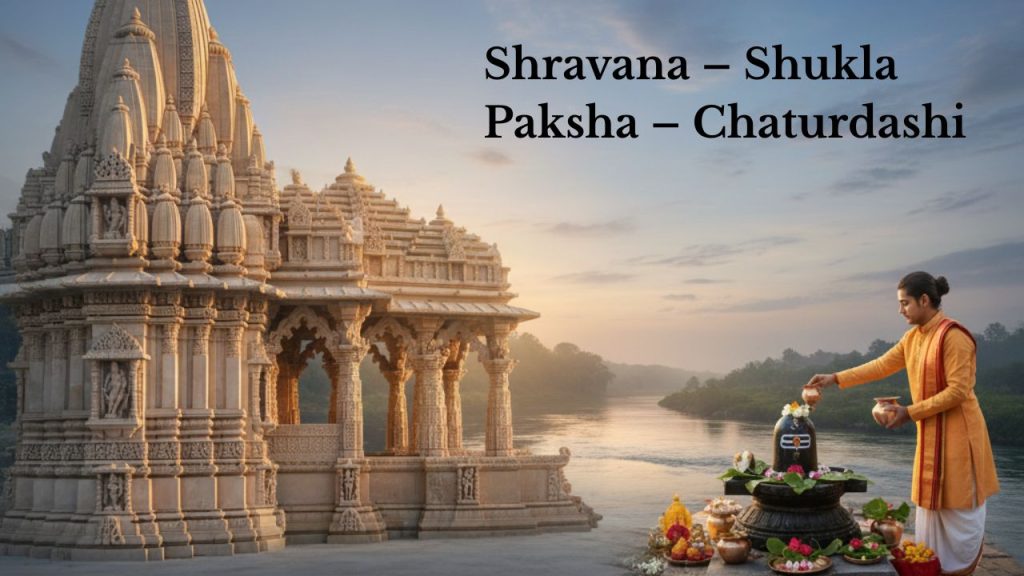
Chaturdashi is widely regarded as one of the most auspicious days for worshipping Lord Shiva. While Maha Shivaratri, which also falls on a Chaturdashi (in Krishna Paksha), is globally celebrated, the Chaturdashi in Shukla Paksha, especially during Shravana, also carries a deep devotional vibration dedicated to Shiva. Devotees observe this day with sacred abhishekams (ritual bathing of Shiva Lingam) using water, milk, honey, and bilva leaves. Chanting the Maha Mrityunjaya Mantra, a prayer for healing, longevity, and liberation, is a common practice. Some engage in continuous recitations of the Rudra Path (sections from the Yajurveda) to invoke Shiva’s divine grace.
In Shravana, the entire month is already immersed in Shiva’s presence. Mondays are primarily dedicated to him, and temples see a surge of devotees. When Chaturdashi aligns with this sacred period, it acts like a spiritual catalyst, fueling inner devotion, enhancing divine experiences, and manifesting blessings swiftly. The symbolism is powerful: Shiva is the destroyer of ignorance, the ultimate yogi, and the benevolent guardian of time and transformation. Honoring him on Chaturdashi allows one to dissolve ego, cleanse the mind, and open the heart to divine love and light.
Spiritual Practices and Vratas Observed
Chaturdashi is not just a day of ritual, but a personal doorway to transformation. The most widely observed practice is the Chaturdashi Vrat, a sacred fast undertaken by seekers for physical purification, emotional balance, and spiritual progress. Fasting on this day is believed to align the body’s rhythm with cosmic vibrations, making it easier to meditate, reflect, and release both physical and emotional toxins. Devotees consume only fruits, milk, or water, and refrain from heavy meals, worldly pleasures, and negative speech. Another powerful practice is the observance of mauna, or complete silence. Silence, when consciously held, becomes a bridge to the soul. It quietens the mind, enhances awareness, and allows one to tune into subtler energies that are otherwise masked by constant chatter.
Mantra chanting is also significant, particularly the Om Namah Shivaya and Maha Mrityunjaya Mantra. Repeating these sacred syllables creates spiritual vibrations that purify the atmosphere and the inner self. Meditating on Lord Shiva’s form or simply sitting in quiet contemplation are advantageous practices. When these observances are performed during the month of Shravana, their impact is magnified. It’s said that a single day’s sincere spiritual practice in Shravana is equal to months of effort in other periods. Chaturdashi thus becomes a perfect checkpoint for self-purification and divine alignment.
Cultural Celebrations and Regional Traditions
Beyond temples and personal rituals, Chaturdashi also carries cultural richness and local traditions that vary across India. In some regions, small fairs and community events are organized on this day, especially if it falls on a weekend or aligns with other festivals in Shravana.
In Maharashtra, Karnataka, and parts of Tamil Nadu, special bhajans, devotional dance performances, and night-long vigils dedicated to Lord Shiva are held in community temples. These events are often accompanied by collective abhisheka ceremonies, drawing hundreds of devotees. Folk traditions also come alive with storytelling, music, and chanting. Songs that praise Shiva’s cosmic dance, Parvati’s devotion, or mythological tales linked to Chaturdashi are passed down orally, keeping cultural memory alive across generations.
In rural areas, collective cooking of prasad, decorating the Shiva lingam with flowers, and processions with sacred chants are everyday. These cultural dimensions create a feeling of community bonding, where spirituality becomes a shared celebration rather than a solitary endeavor. Such practices make Chaturdashi in Shravana not only a personal spiritual milestone but also a vibrant cultural festival that brings people together in devotion and joy.
Chaturdashi’s Role in the Shravana Month’s Energy Cycle
Each tithi in the lunar cycle carries its energy, and Chaturdashi, being the 14th, symbolizes culmination, purification, and transition. In the Shukla Paksha of Shravana, this energy is at its most potent, making it a day of profound spiritual opportunity.
The Shravana month is already saturated with divine frequency, thanks to its association with Lord Shiva, Guru Purnima, and various fasts and festivals. Chaturdashi marks the end of this cycle, providing an opportunity to reflect on and integrate all spiritual practices undertaken throughout the month. Energetically, this tithi prepares the seeker for the Full Moon, a moment of revelation, gratitude, and spiritual expansion. Just as the moon is almost fully illuminated, so too is the soul, having passed through the waxing phase of effort, purification, and devotion.
This tithi is often used to release lingering emotional baggage, unfinished intentions, or mental clutter, creating space for divine light to enter. It’s an invitation to renew, realign, and embrace clarity before Purnima. Chaturdashi becomes the sacred pause before the crescendo, the calm before the wave of spiritual fullness. This positioning is crucial in the energy cycle of Shravana, serving as the gateway to divine culmination.
Health, Wellness, and Ayurvedic Beliefs
In Ayurveda, the ancient science of life and wellness, lunar days are considered to influence bodily rhythms, mental states, and overall health. Chaturdashi is primarily associated with detoxification, as the body is believed to be most receptive to cleansing on this day. Practices such as fasting, drinking warm herbal teas, eating light meals, or consuming ghee are commonly recommended. These rituals not only support digestion but also synchronize internal systems with lunar energies.
Ayurvedic philosophy also associates Chaturdashi with the concept of soma, the lunar nectar that nourishes the consciousness. As the moon approaches fullness, the soma is said to be at its most potent. Fasting and meditative practices on this day help conserve and harness this subtle energy for wellness and vitality.
Mental clarity, emotional stability, and a sense of lightness are everyday experiences for those who observe the tithi with mindfulness. Over time, these practices can support a more sattvic (pure, harmonious) lifestyle, which is the cornerstone of long-term health in Ayurveda. In Shravana, when the atmosphere is already charged with spiritual and natural purity, observing Chaturdashi through Ayurvedic principles brings a deeper layer of holistic wellness, connecting body, mind, and spirit seamlessly.
Symbolic and Metaphysical Interpretation of Chaturdashi
On a metaphysical level, Chaturdashi holds deep symbolic significance. It represents the penultimate step before complete spiritual awakening, symbolized by the full moon, or Purnima. This is the tithi of surrender, purification, and ego dissolution. The number fourteen itself holds symbolic power. It suggests a moment of tension, neither empty nor full. It’s the final trial, the shedding of what no longer serves, to make space for divine fullness. In yogic terms, it can be seen as the time when the kundalini energy is nearly at the crown chakra, just before enlightenment. Emotionally and spiritually, Chaturdashi asks for release, forgiveness, detachment, and inner healing. It’s a moment to let go of pride, attachments, fears, and resentments, stepping into light with an open heart.
Chaturdashi also serves as the bridge between the personal and the universal. When observed consciously, it enables one to transcend the limited self and experience the essence of atma, merging with paramatma, as the individual soul unites with the cosmic soul. In the sacred environment of Shravana, this symbolic process becomes a profound and experiential one. One doesn’t just read or hear about transformation; one begins to live it.
Contemporary Relevance and Observance
The spiritual observance of Chaturdashi is witnessing a quiet revival. Many individuals, especially youth, are turning back to lunar traditions as a way to reconnect with inner peace and natural rhythms. Online communities now host virtual pujas, guided meditations, and group chanting sessions during Chaturdashi in the month of Shravana. Social media is filled with shared intentions, fast updates, and spiritual reminders, making it easier than ever to stay engaged and informed. The simplicity of observing Chaturdashi, whether through a short mantra session, mindful silence, or a day of fasting, makes it accessible even in urban lifestyles. It offers a break from noise, a return to essence, and a moment of reflection in a world that rarely pauses for thought.
The values promoted by Chaturdashi, detachment, clarity, healing, and devotion, are timeless. In modern life filled with stress and distractions, these values provide balance, purpose, and a sense of connection. By observing Chaturdashi during Shravana, a bridge is formed between the ancient and the contemporary. It’s a way of bringing sacredness into daily life, of grounding oneself in timeless wisdom while walking the path of the present.