Importance of Yama Deepam in Kartika
Yama Deepam, often referred to as the “lamp of Yama,” holds profound cultural and spiritual importance in Hindu tradition. The word itself carries a powerful meaning—dedicated to Yama, the God of Death, it signifies a prayer for protection, longevity, and peace. Observed on Krishna Paksha Trayodashi during the Kartika month, this ritual has been an integral part of Diwali celebrations for centuries. Its timing is significant because it occurs just before Naraka Chaturdashi and Lakshmi Puja, forming an essential prelude to the Festival of Lights.
Lighting the Yama Deepam is not just an act of ritual; it is a symbol of reverence, hope, and spiritual protection. When a lamp is lit in Yama’s honor, it is believed to ward off untimely death, safeguard family members, and invite health and prosperity into the home. In this way, it becomes a gesture of respect toward the natural cycle of life and death while simultaneously acknowledging the unseen cosmic forces that govern existence.
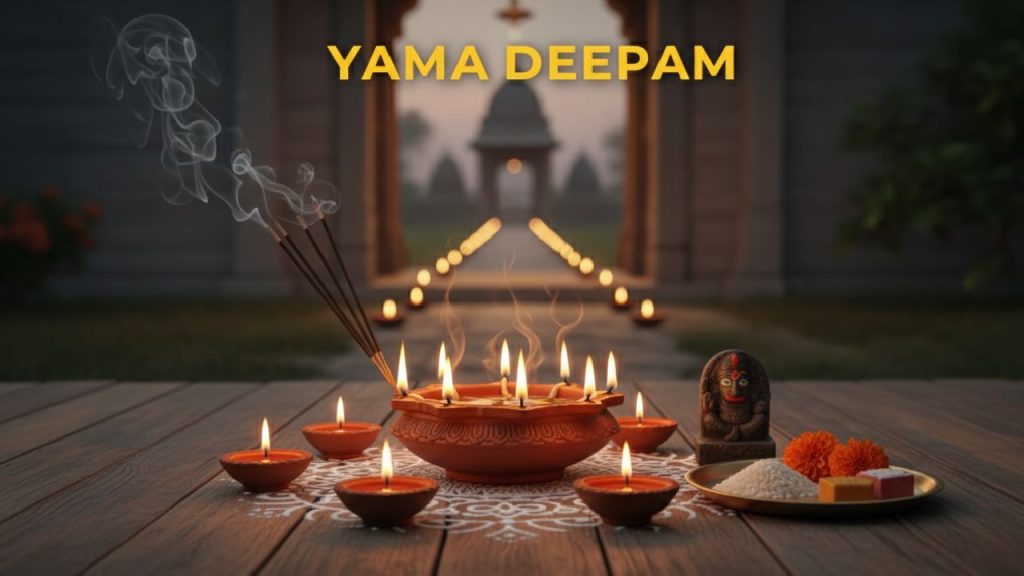
This observance also has a strong cultural element. Families gather at dusk to light the lamp, often using sesame oil and a cotton wick, placing it outside the entrance of the house facing south—the direction associated with Yama. This simple yet profound act reminds everyone that light always prevails over darkness, and faith provides strength even in the face of life’s most significant uncertainties.
In modern times, the significance of Yama Deepam continues to hold relevance. It serves as a reminder that protection, humility, and reverence toward higher powers are timeless values. While festivals often highlight joy and celebration, Yama Deepam emphasizes safety, spiritual grounding, and a connection with eternal truths.
The literal meaning of Yama Deepam (lamp dedicated to Yama, the God of Death)
The literal meaning of Yama Deepam instantly communicates its purpose. The word “Yama” refers to the God of Death, while “Deepam” translates to lamp or light. Together, it becomes a lamp dedicated to Yama, not in fear, but in respect and acceptance of the role he plays in the universe. Unlike many rituals that focus on invoking blessings for wealth or prosperity, Yama Deepam directly addresses one of life’s most inevitable truths—mortality.
Lighting this lamp does not symbolize submission to death, but rather recognition of its presence as part of the natural cycle of existence. By dedicating a lamp to Yama, devotees acknowledge that death is not an end but a passage. It creates an atmosphere of acceptance, helping remove fear and uncertainty associated with it. Instead of resisting or fearing death, the ritual encourages people to embrace life with mindfulness and gratitude.
Symbolically, the lamp embodies light guiding the soul away from darkness. It reminds families that even in the face of mortality, hope, wisdom, and faith provide direction. When the flame flickers at the entrance of a home, it represents the belief that the household is protected and no untimely harm will befall its members.
This meaning continues to resonate even today, offering people not just a ritual to perform, but a philosophy to live by. It emphasizes that every life is valuable and that protection comes when respect is given to the universal order maintained by divine forces like Yama.
Position in the Hindu lunar calendar (Krishna Paksha Trayodashi in Kartika month)
Yama Deepam is observed during the sacred month of Kartika, on Krishna Paksha Trayodashi—the thirteenth day of the waning moon. This timing is not arbitrary but deeply rooted in Hindu tradition. Kartika month is considered one of the holiest times of the year, filled with rituals that emphasize purification, devotion, and spiritual discipline.
The waning phase of the moon itself carries symbolic meaning. As the moon decreases in light, it represents the fading of material attachments and ego, preparing individuals to embrace humility and faith. Trayodashi, being a transitional day, is regarded as highly auspicious for rituals meant to remove obstacles, cleanse negativity, and seek protection from unseen forces.
Placing Yama Deepam within this context highlights its purpose. It is not just about lighting a lamp; it is about aligning with cosmic rhythms. Observing this ritual on this particular day is believed to maximize its protective power, ensuring that families remain safe and secure throughout the year. The calendar placement also links Yama Deepam to the larger Diwali celebration. Occurring just before Naraka Chaturdashi, it sets the stage for the triumph of light over darkness, reminding people that spiritual safety is as essential as festive joy.
Connection with Diwali festivities and Naraka Chaturdashi
Diwali is often described as the festival of lights, symbolizing joy, prosperity, and the victory of good over evil. Yama Deepam, performed at the very beginning of the Diwali cycle, establishes a foundation of protection before the celebratory rituals begin. It reminds families that light must not only brighten homes but also guard against unseen dangers.
Its connection to Naraka Chaturdashi is vital. Naraka Chaturdashi commemorates the victory of Lord Krishna over Narakasura, a demon who symbolized darkness, ignorance, and suffering. Just as Krishna liberated the world from oppression, Yama Deepam serves as a symbolic shield, protecting homes and families from death, harm, or untimely misfortune.
By linking with Diwali, Yama Deepam highlights the balance between celebration and caution. While Diwali fills homes with joy, laughter, and lights, Yama Deepam grounds this celebration with a sense of safety and spiritual awareness. Together, they create a holistic experience—protection first, followed by prosperity.
Overview of spiritual, cultural, and protective significance
At its core, Yama Deepam combines three layers of importance—spiritual, cultural, and protective. Spiritually, it reminds people that life and death are natural cycles. It brings acceptance, faith, and a sense of peace of mind. Culturally, it strengthens traditions passed down through generations, offering families a way to come together and connect with their roots.
Protectively, the ritual addresses one of humanity’s greatest fears—death. Lighting the lamp symbolizes safeguarding loved ones from premature departure. It creates an environment of hope and comfort, ensuring families can move into Diwali celebrations with a sense of security. This multifaceted significance is what makes Yama Deepam unique. It is not only about rituals but also about meaning—about living with awareness, reverence, and a constant reminder that life, though uncertain, is also sacred and protected.
Historical and Mythological Origins
The observance of Yama Deepam is not merely a ritualistic tradition; it is rooted in profound mythological and historical narratives that give it deep spiritual meaning. Ancient scriptures and folklore provide rich explanations of why this lamp is lit, who it honors, and what protection it promises. These stories are not only symbolic but also serve as moral lessons for everyday life, teaching humility, respect for divine order, and awareness of life’s impermanence.
The origins of Yama Deepam can be traced back to the Puranas, where Yama, the God of Death, is described as the cosmic judge who ensures that every soul experiences the fruits of its karma. Honoring him with light was believed to safeguard families from premature death and untimely misfortunes. The act of lighting the lamp at dusk, outside the southern entrance, emerged as a direct offering to Yama, who is associated with the south direction in Hindu cosmology.
Through these mythological accounts, Yama Deepam establishes itself not just as a protective act but as a form of devotion that emphasizes balance—recognizing death while celebrating life. This duality makes it a unique practice during the auspicious Kartika month and a significant beginning to the Diwali season.
Story of King Hima and his wife’s devotion to lighted lamps
One of the most widely shared legends associated with Yama Deepam is the story of King Hima. According to this tale, King Hima’s horoscope predicted that he would die of a snake bite on the fourth day of his marriage. Fearful yet devoted, his wife resolved to protect him with unwavering faith and determination. That night, she placed numerous oil lamps around their palace and illuminated every corner with their radiance.
She also ensured that her husband did not fall asleep. To keep him awake, she sang songs, narrated stories, and engaged him in conversation throughout the night. At the same time, she placed heaps of gold ornaments and jewels near the door as an offering to Yama, symbolizing her respect and devotion.
When Yama arrived in the form of a serpent, the glow of the countless lamps blinded him, and the brilliance of the gold offerings distracted him. Instead of entering, he left quietly, sparing King Hima’s life. Since then, the act of lighting a lamp in Yama’s honor has been associated with protection from untimely death.
This legend underscores a vital value: devotion, faith, and consistent practice of light can protect one even against the darkest of forces. It is a reminder that rituals are not superstitions, but symbolic acts of faith that build inner strength and resilience in times of fear.
Yama’s promise to protect devotees who observe this ritual
Another significant aspect of the mythology surrounding Yama Deepam is Yama’s own promise to devotees. According to sacred texts, Yama once declared that whoever lights a lamp in his honor on Kartika Krishna Trayodashi would not face untimely death. Instead, their lives would be blessed with protection and longevity.
This promise forms the very foundation of why families continue to observe this ritual generation after generation. Lighting the lamp outside the home, facing south, becomes not just a symbolic act but also a reaffirmation of trust in Yama’s divine protection. It establishes a bond between the devotee and the deity—a relationship built not on fear, but on respect and acknowledgment of divine justice.
The beauty of this promise lies in its simplicity. It does not require elaborate rituals, expensive offerings, or complex procedures. A single lamp lit with sesame oil and a cotton wick, accompanied by sincere devotion, is enough to invoke Yama’s blessings. This accessibility is one of the reasons why Yama Deepam has remained a widely observed practice, even in modern times. The promise also carries a deeper meaning. It reminds people that divine protection is always within reach, provided there is faith and humility. By honoring Yama, individuals also honor the natural laws of karma, balance, and cosmic justice.
Role of Yama as the cosmic judge of karma and death
Yama holds a unique position in Hindu philosophy. Unlike gods associated with prosperity, love, or creation, Yama represents one of life’s most inevitable aspects—death. Yet, his role is not to punish arbitrarily but to act as the cosmic judge of karma. He ensures that every soul experiences the results of its actions, maintaining order and justice in the universe.
In this way, Yama is not an antagonist but a necessary force. Lighting a lamp in his honor during Yama Deepam is a recognition of this role. It is an acknowledgment that life is finite, that actions have consequences, and that balance is maintained through divine oversight. By showing reverence to Yama, families express their willingness to live righteously and accept the laws of karma.
This perspective also transforms the way death is viewed. Instead of fear, it brings respect and acceptance. The lamp lit in Yama’s name is a reminder that death is not an end, but a passage overseen by a divine guardian who ensures justice and fairness for every soul.
Symbolism of lighting a lamp to prevent untimely death
The symbolism of the lamp in Yama Deepam is profound. Fire, in Hindu tradition, is a purifier and a protector. A lamp lit with sesame oil is believed to have special spiritual properties, as sesame seeds are considered sacred and connected to ancestors and departed souls. By lighting this lamp, families symbolically illuminate the path of protection and ward off negativity.
Placing the lamp outside the main entrance, facing south, carries its own meaning. The south direction is associated with Yama, and offering light in that direction is akin to directly showing reverence. It is a way of requesting Yama to bless the household with safety and shield its members from untimely death.
The lamp also becomes a metaphor for human life. Just as a flame flickers yet continues to shine, life is fragile yet enduring when nurtured by faith. Lighting this lamp thus becomes a prayer not just for longevity but for a meaningful, illuminated journey of life.
Spiritual Significance
Yama Deepam is deeply spiritual because it connects the visible act of lighting a lamp with the invisible reality of life, death, and the soul’s journey. Spiritually, it is about embracing the inevitability of mortality, not with fear, but with reverence, humility, and hope. It reminds people that while material possessions are temporary, spiritual practices leave a lasting impact.
This ritual acts as a guide for cultivating awareness. By honoring Yama, one also honors the principles of truth, justice, and acceptance. Lighting the lamp becomes more than just a tradition—it becomes a practice of mindfulness, teaching people to live consciously, value their relationships, and prepare for life’s uncertainties with grace.
The spiritual importance of Yama Deepam also lies in its ability to instill courage. Fear of death is universal, yet this ritual transforms that fear into faith. The simple flame of a lamp provides comfort and assurance, reminding families that divine protection is always with them.
Lighting the path of the soul beyond life
The concept of the soul’s journey after death is central to Hindu philosophy. Death is not considered an end but a transition from one state of existence to another. Yama, as the guide and judge, ensures that this passage is just and fair. Lighting a lamp during Yama Deepam is symbolic of illuminating this path for the soul.
It is believed that just as a traveler needs light to navigate darkness, the soul requires divine illumination to move safely into the next realm. The lamp lit in Yama’s honor represents this guiding light. It assures families that their prayers will help protect the soul’s journey and prevent it from being lost in darkness.
This symbolism also provides comfort to the living. Knowing that loved ones are guided and protected brings peace to grieving hearts. It serves as a bridge between the seen and unseen worlds, reinforcing the idea that light connects life with eternity.
Honoring Yama to ensure longevity and well-being
Honoring Yama during Yama Deepam is not about fearing death, but about acknowledging its certainty while seeking blessings for a long and healthy life. By performing this ritual, families express their respect for the divine laws that govern existence, while humbly requesting protection from untimely harm.
This act of reverence translates into a spiritual shield. Lighting the lamp is believed to extend life by symbolically warding off hostile forces. It ensures that individuals can live out their whole lifespan, free from the threat of premature death. In this way, Yama Deepam becomes both a prayer for longevity and a practice of gratitude for the gift of life.
At a deeper level, honoring Yama also teaches acceptance. It reminds people that longevity is valuable only when life is lived with purpose and awareness. The ritual encourages families to lead lives rooted in dharma—righteousness and balance—so that their journey is both meaningful and long.
Belief in removing fears of death and darkness
Fear of death is one of humanity’s most natural and universal fears. Yama Deepam directly addresses this by transforming fear into faith. Lighting the lamp in Yama’s honor symbolizes courage, protection, and the removal of anxieties surrounding mortality.
Darkness itself is often associated with the unknown, danger, and uncertainty. A lamp shining in the night becomes a reminder that even the darkest fears can be dispelled with faith. The ritual reassures families that divine protection surrounds them, bringing mental peace and emotional comfort.
This belief also empowers individuals to live more fully. When fear of death no longer dominates, people can focus on living with joy, purpose, and awareness. Yama Deepam thus becomes not just a ritual of protection but also a practice of liberation from fear.
Cultivating humility and remembrance of life’s impermanence
One of the most profound spiritual lessons of Yama Deepam is the reminder of impermanence. Life, like the flame of a lamp, is fragile and temporary. Recognizing this truth fosters humility, encouraging individuals to value each moment and treat others with compassion.
Lighting the lamp in Yama’s honor becomes a symbolic acknowledgment that no one is beyond the laws of nature and karma. It instills a sense of equality and humility, reminding people that wealth, power, and status hold no meaning in the face of death.
At the same time, this remembrance of impermanence is not meant to create fear, but to inspire purposeful living. By embracing mortality, individuals are encouraged to live with integrity, gratitude, and love. Yama Deepam thus becomes a ritual of spiritual grounding, guiding people toward meaningful lives.
Rituals of Yama Deepam
Yama Deepam is observed with simple yet highly symbolic rituals that carry deep meaning. Unlike elaborate ceremonies, it involves minimal steps that are accessible to all households. Yet, each action is rooted in centuries of tradition and reflects profound cultural wisdom.
The central act is lighting a lamp with sesame oil and a cotton wick, placing it outside the main entrance, and facing it toward the south. This lamp is lit at dusk, symbolizing the transition from light to darkness, and thus the need for divine protection. Families also recite prayers or mantras dedicated to Yama, seeking his blessings for longevity and safety. These rituals are more than symbolic gestures—they are practices of mindfulness. Each step, from preparing the oil to placing the lamp, is an act of devotion, reminding families of their faith and connection to the divine.
Placing the lamp outside the main entrance, facing south
Placing the lamp outside the main entrance is central to the Yama Deepam ritual. The entrance is not just a physical threshold but also a spiritual gateway. By positioning the lamp there, families symbolically protect the boundary of their homes, ensuring that no opposing force enters.
Facing the lamp southward holds special significance, as the south direction is associated with Yama. Offering light in his direction is an act of respect and acknowledgment. It is believed that by honoring him in this way, he blesses the household with protection and ensures the longevity of its members. This simple act also symbolizes openness—inviting divine protection into the home and creating an environment of safety and positivity. It is a reminder that while walls and locks protect physically, faith and devotion safeguard spiritually.
Using sesame oil (til oil) and wicks for lighting
Sesame oil is not chosen randomly; it holds exceptional sacred value in Hindu traditions. Considered auspicious and purifying, it is often used in rituals connected to ancestors and protective practices. Lighting a lamp with sesame oil during Yama Deepam symbolizes purity, strength, and ancestral blessings.
The cotton wick represents the soul, while the oil represents life’s material foundation. When lit, the flame becomes a symbol of the soul shining brightly despite the limitations of the material world. This deep symbolism transforms the simple act of lighting a lamp into a robust spiritual offering. By using sesame oil, families also align themselves with the cosmic rhythm of Kartika, a month associated with purification and spiritual discipline. The lamp becomes both an offering and a protective shield, safeguarding life with divine energy.
Performing prayers and mantras dedicated to Yama
Alongside lighting the lamp, families often recite prayers or mantras dedicated to Yama. These invocations are expressions of reverence, seeking Yama’s blessings for health, safety, and longevity. They transform the ritual from a physical act into a spiritual dialogue with the divine.
Mantras, when chanted with devotion, are believed to generate vibrations that harmonize the environment. They bring peace to the household, dispel negative energies, and invoke divine protection. This practice also instills mindfulness, helping families focus their thoughts and intentions on safety and gratitude.
The prayers themselves are not just about asking for protection—they are acknowledgments of Yama’s role in maintaining balance and justice in the universe. By honoring him, devotees align themselves with these principles, fostering spiritual growth.
Observing customs at dusk for maximum effect
The timing of the ritual is significant. Yama Deepam is traditionally observed at dusk, the transitional period between day and night. This timing reflects the symbolism of light overcoming darkness. Just as the sun sets and night approaches, the lamp shines to ensure that protection and positivity remain present.
Observing the ritual at dusk also carries psychological meaning. It marks the end of daily activities and creates a moment of mindfulness for families to gather, pray, and reaffirm their faith. The calm of twilight provides the perfect backdrop for a ritual rooted in peace and protection. By lighting the lamp at this specific time, families also connect with the cosmic energies of the universe, making the ritual more potent. It ensures that the prayer is not just symbolic, but also energetically aligned with nature’s cycles.
Connection with Diwali Celebrations
Yama Deepam holds a special place within the larger framework of Diwali celebrations. While Diwali is widely recognized for its emphasis on joy, wealth, and prosperity, Yama Deepam provides the foundation of protection upon which these festivities rest. It reminds families that before celebrating abundance, one must first ensure safety and security.
The placement of Yama Deepam at the beginning of Diwali rituals highlights its significance. It acts as a spiritual shield, ensuring that families can celebrate the festival of lights without fear of negativity or untimely harm. This balance of protection and celebration creates a holistic approach to Diwali.
Yama Deepam also reflects the inclusive nature of the festival. By honoring Yama alongside Lakshmi and other deities, families acknowledge that prosperity and protection are inextricably linked. This interconnectedness enriches the meaning of Diwali, transforming it from a festival of lights into a festival of balance and harmony.
Yama Deepam is the beginning of Diwali rituals.
Yama Deepam is considered the first step in Diwali celebrations. Lighting the lamp in Yama’s honor sets the tone for the days that follow, symbolizing that protection and safety are secured before joy and abundance are invited. This sequencing reflects profound cultural wisdom: one must first establish a strong foundation before building prosperity.
By observing Yama Deepam, families spiritually cleanse their environment, preparing it for the joyous rituals of Naraka Chaturdashi, Lakshmi Puja, and Govardhan Puja. It creates a flow of continuity, where each ritual builds upon the previous one, culminating in the whole celebration of Diwali.
This placement also reinforces the idea that light is not just for celebration but also for protection. The lamp lit for Yama becomes the first flame in the chain of Diwali lights, reminding families that divine safeguarding is the bedrock of all festivities.
Symbol of protection before the festival of lights
Yama Deepam serves as a powerful symbol of protection that precedes the grand illumination of Diwali. Just as warriors secure their defenses before celebrating victory, families light this lamp to secure divine protection before filling their homes with lights and festivities.
This symbolism is deeply reassuring. It assures families that their homes are guarded, their loved ones are safe, and no negativity will disrupt the upcoming celebrations. With this assurance, they can fully embrace the joy, laughter, and togetherness of Diwali without fear.
The protective symbolism of Yama Deepam also carries a timeless lesson. It teaches that true prosperity is not just about wealth or abundance, but about safety, longevity, and peace of mind. Without protection, even the brightest celebrations lose their meaning.
Role in cleansing negativity and inviting positivity
One of the subtle but profound roles of Yama Deepam is the cleansing of negativity. Lighting a lamp with sesame oil is believed to dispel negative energies, protect against harm, and create a positive aura around the home. This purification is essential before Diwali, a festival dedicated to the victory of good over evil.
By removing negativity, Yama Deepam prepares the environment for the blessings of Lakshmi, the goddess of wealth and prosperity. It ensures that the home is not only filled with material abundance but also with peace, harmony, and divine energy. This role of cleansing and inviting positivity also reflects a universal principle: before new beginnings, one must clear away old burdens. Yama Deepam becomes a symbolic act of release, making way for light, joy, and renewal.
Unity of family rituals and collective prayer for safety
Another critical aspect of Yama Deepam is its role in uniting families. The ritual is simple enough for everyone—from elders to children—to participate in together. Families gather at dusk, prepare the lamp, and light it collectively, reinforcing the bonds of unity and shared faith.
This collective act of prayer creates a sense of belonging and togetherness. Each member contributes, whether by preparing the oil, arranging the wick, or offering prayers. This shared responsibility deepens family connections and creates lasting memories tied to faith and tradition.
The unity fostered by Yama Deepam extends beyond the household. It strengthens cultural identity, reminding communities that shared rituals and beliefs hold people together. By collectively praying for safety and longevity, families contribute to a culture of mutual care and protection.
Astrological and Cosmic Relevance
Yama Deepam is not just a cultural or religious ritual; it is deeply tied to the cosmic and astrological framework that governs human life. Ancient seers and scholars of Hindu philosophy emphasized that the placement of rituals within the lunar calendar has immense significance. Every action, every offering, and even the timing of lighting a lamp aligns with planetary influences and universal energies.
The thirteenth day of Krishna Paksha in Kartika month, when Yama Deepam is observed, is considered especially potent for invoking protection and dissolving negative karmic influences. This day aligns with cosmic forces that balance light and darkness, reminding humanity of the eternal rhythm between life and death. When families light the lamp for Yama, they are not merely following tradition—they are harmonizing themselves with the natural and cosmic order.
By aligning spiritual practices with planetary positions, Yama Deepam ensures that prayers carry maximum potency. It reassures families that divine justice is not abstract but deeply integrated into the structure of the cosmos. The ritual thus becomes both a spiritual and astrological safeguard, protecting life and promoting balance and harmony.
Trayodashi’s association with planetary alignment
The thirteenth day of the waning moon, known as Trayodashi, has profound astrological importance. In Vedic astrology, this tithi is seen as a transitional day that brings balance between waning energy and spiritual renewal. Unlike other days that are associated with material progress or wealth, Trayodashi is uniquely suited for rituals that focus on protection, purification, and longevity.
On Kartika Krishna Trayodashi, the planetary positions are believed to favor rituals that neutralize malefic influences and strengthen one’s spiritual shield. This makes it the most powerful day for lighting a lamp dedicated to Yama, whose role is directly connected with the cycle of life and death.
By choosing this specific day, the ritual becomes more than symbolic. It aligns with cosmic timing, ensuring that the energy of the universe supports the prayer for protection. Families thus not only honor tradition but also harmonize with the larger rhythms of creation.
Importance of the south direction in Hindu traditions
The south direction holds a special place in Hindu cosmology and traditions. It is associated with Yama, the God of Death, who rules over this quarter of the universe. Placing the lamp facing south during Yama Deepam is a direct offering to Yama, symbolizing reverence and acknowledgment of his divine role.
In Vastu Shastra, the ancient science of architecture, the south direction is considered powerful and sensitive. It is often avoided for entrances, but when honored with light and devotion, it becomes a source of protection and strength. By facing the lamp southward, devotees invite Yama’s blessings and ensure that his energy guards the household. This ritual placement also conveys humility. Instead of ignoring or fearing the south, families illuminate it with light, transforming a direction associated with mortality into one that radiates divine protection and peace.
Influence of lighting sesame oil lamps on energy flow
Sesame oil is considered sacred because of its unique energetic properties. According to Ayurveda and Vedic traditions, sesame is believed to possess a grounding and stabilizing energy that calms the mind and strengthens the body. When used in lamps, it creates a protective aura that dispels negativity and aligns the environment with positive vibrations.
Lighting a sesame oil lamp during Yama Deepam harmonizes energy flow within and around the home. The lamp becomes not just a physical flame but also a spiritual beacon, anchoring stability and protection. The energy radiating from this lamp is believed to cleanse the household, neutralize harmful influences, and connect the family to divine forces. The choice of sesame oil also reflects wisdom. Unlike other oils, it burns steadily, symbolizing a long and uninterrupted life. Its fragrance and glow create an atmosphere of calm and reassurance, enhancing the spiritual significance of the ritual.
Link with karmic balance and cosmic protection
At its core, Yama Deepam is deeply tied to the concept of karma. Yama, as the cosmic judge, ensures that every soul faces the consequences of its actions. Lighting a lamp in his honor symbolizes acceptance of this truth and a prayer for balance and fairness in life.
The ritual is also a request for cosmic protection. By acknowledging Yama’s role, devotees invite his grace to safeguard them from premature death or untimely suffering. The lamp becomes a bridge between human intention and cosmic justice, ensuring that families remain aligned with divine order.
This link with karmic balance also teaches an important lesson. Protection is not only about rituals but also about living rightly. Yama Deepam reminds people that proper safety comes from righteous actions, humility, and respect for universal laws.
Regional Traditions and Practices
While Yama Deepam is observed across India, its practices and interpretations vary from region to region. These regional differences reflect the diversity of cultural traditions, yet the underlying essence remains the same—honoring Yama and seeking protection from untimely death.
From northern states where it is linked closely to Diwali customs, to southern traditions that emphasize ancestral connections, Yama Deepam weaves itself into the fabric of local culture in unique ways. Each practice, whether elaborate or simple, carries the same message: light for protection, devotion for peace, and unity for strength. This diversity not only enriches the festival but also demonstrates the adaptability of tradition. Yama Deepam thrives because it can be observed by anyone, anywhere, in ways that reflect their cultural identity.
Different ways of observing Yama Deepam across India
In North India, Yama Deepam is often tied directly to Diwali. Families light the lamp outside their homes, integrating it into the larger sequence of Diwali rituals. It serves as the starting point, after which the celebrations of Naraka Chaturdashi and Lakshmi Puja unfold.
In South India, particularly in Tamil Nadu and Andhra Pradesh, Yama Deepam is emphasized as a distinct observance. Here, families focus not only on lighting the lamp but also on offering prayers to ancestors, connecting the ritual to Pitru Tarpan practices. This reflects a cultural emphasis on remembering and honoring lineage.
In Maharashtra and Gujarat, the ritual is often accompanied by drawing rangolis at the entrance and decorating the lamp with flowers. These artistic additions highlight the aesthetic beauty of the practice while reinforcing its spiritual purpose. Each variation, though different in form, preserves the essence of Yama Deepam—protection, reverence, and light.
Ritual variations in South India vs. North India
In North India, Yama Deepam is closely linked with the collective spirit of Diwali. Lamps are lit alongside fireworks, sweets, and family gatherings, blending the protective ritual seamlessly with celebratory customs. The focus is on creating a spiritual shield before inviting abundance and joy.
In South India, the observance takes on a more solemn and ancestral tone. Families often wake early, bathe with oil, and prepare sesame offerings for both Yama and their forefathers. The lamp is placed at the threshold not only as a shield but also as a bridge between the living and the departed.
This contrast reflects the broader cultural outlook—while northern traditions highlight collective celebration, southern practices emphasize remembrance and spiritual grounding. Yet, both approaches reveal the adaptability of Yama Deepam, making it meaningful to diverse communities.
Folklore and oral traditions associated with the day
Countless folk tales and oral traditions also enrich Yama Deepam. Grandparents often share stories about Yama, King Hima, or the importance of sesame oil lamps, passing down wisdom in simple yet powerful ways. These narratives not only preserve the ritual’s history but also make it relatable for younger generations.
Folk songs in some regions are sung during the lighting of the lamp, praising Yama’s role as protector and guide. In rural areas, elders remind families of the story where Yama promised safety to those who honor him, reinforcing faith and continuity. These oral traditions act as cultural glue, keeping the essence of Yama Deepam alive even in households that may not strictly follow rituals. They highlight the fact that stories carry power equal to rituals, preserving meaning through generations.
Continuity of the practice in modern households
In modern times, when lifestyles are busier and traditions often adapt to convenience, Yama Deepam continues to find its place. Even in urban apartments, families light small lamps at their doorsteps, keeping the essence of protection intact. The simplicity of the ritual ensures its survival—it requires only faith, oil, a wick, and a lamp.
For many, Yama Deepam has also become a practice of mindfulness. It is seen as an opportunity to pause, reflect on life’s impermanence, and pray for safety. This reflective quality ensures its relevance. The continuity of Yama Deepam also reflects a more profound truth: rituals survive not because of compulsion, but because they provide meaning. As long as families seek protection, connection, and peace, the lamp of Yama Deepam will continue to shine.
Symbolism of Light in Yama Deepam
The lamp in Yama Deepam is not just a flame—it is a symbol rich with layered meanings. Light in Hindu tradition represents knowledge, protection, divinity, and the triumph of good over evil. In the context of Yama Deepam, it takes on additional significance as a shield against untimely death and a guide for the soul.
The symbolism extends to every element of the lamp: the oil, the wick, and the flame. Together, they represent the body, the soul, and the divine spark of life. When lit, the lamp becomes a complete metaphor for human existence, reminding families of life’s fragility and resilience. Through this symbolism, Yama Deepam transforms into more than a ritual. It becomes a spiritual message—a reminder that light, faith, and devotion can overcome fear, darkness, and mortality.
A lamp as a symbol of hope and protection
The lamp is universally recognized as a beacon of hope. In the context of Yama Deepam, it symbolizes the assurance that divine protection surrounds the household. The flame’s steady glow reassures families that no matter how uncertain life may be, faith can provide stability and safety.
This symbolism resonates deeply because it addresses one of humanity’s greatest fears—death. By lighting the lamp, families replace fear with faith and uncertainty with protection. The lamp becomes both a physical and psychological source of comfort, strengthening resilience. Hope, in this ritual, is not abstract. It is tangible, flickering at the entrance of the home, visible to all who pass by. This visibility reinforces its role as a shield and a reminder that light always prevails.
Oil and wick representing body and soul
The symbolism of the oil and wick is profound. The wick represents the soul, fragile yet capable of shining brightly. The oil represents the body, the material foundation that sustains the flame. Together, they symbolize the interdependence of body and spirit.
When lit, the flame signifies consciousness—the divine spark that transcends both body and soul. This layered symbolism transforms the simple lamp into a spiritual metaphor for human life. It reminds families that life must be nurtured with balance, devotion, and awareness. This symbolism also emphasizes responsibility. Just as the flame requires steady oil to shine, the soul requires righteous living and mindfulness to thrive. The lamp thus becomes a teacher as well as a protector.
Dispelling fear, ignorance, and evil forces
The flame of Yama Deepam is believed to dispel darkness, which symbolizes fear, ignorance, and evil. By lighting the lamp, families invite knowledge, clarity, and divine protection into their homes. It becomes a declaration that no negativity can overpower faith and devotion.
This symbolic power of the flame is both spiritual and psychological. Watching the lamp burn steadily provides comfort, reducing anxieties about the unknown. It reinforces confidence that divine forces guard the household. In this way, Yama Deepam becomes more than a protective ritual. It becomes a ritual of empowerment, reminding families that they are never helpless in the face of fear.
Connecting with ancestors and departed souls
Yama is not only the God of Death but also the guardian of departed souls. Lighting a lamp in his honor symbolizes remembrance of ancestors, creating a bridge between the living and the departed. Families believe that the flame honors their lineage and keeps ancestral blessings alive.
This connection is significant. It reminds families that they are part of a larger continuum, where the living and the departed are united through prayer and devotion. By remembering ancestors, individuals also draw strength from their legacy. The act of connecting with ancestors through Yama Deepam ensures that the ritual is not just about protection but also about gratitude, continuity, and respect for family roots.
Modern-Day Relevance
Yama Deepam retains its relevance. The fears and uncertainties it addresses—safety, mortality, and the need for protection—are as real today as they were in ancient times. What has changed is the way people relate to rituals and find meaning in them. For modern families, Yama Deepam offers more than tradition. It provides psychological comfort, an opportunity for mindfulness, and a connection to cultural roots. ‘
Lighting the lamp becomes a moment of pause in busy lives, allowing reflection on impermanence and gratitude for protection. This relevance also lies in adaptability. Whether in rural villages or urban apartments, the ritual can be observed with equal devotion. Its simplicity ensures that it continues to thrive, even in modern settings.
Psychological comfort of observing Yama Deepam
One of the most potent aspects of Yama Deepam in modern times is the psychological comfort it brings. The ritual addresses deep-seated fears of death and harm, replacing them with reassurance and peace. Lighting the lamp becomes an act of calming the mind and affirming safety.
In an era where stress, uncertainty, and anxiety are everyday, such rituals provide emotional grounding. Watching the flame burn steadily outside the home creates a sense of stability and control. It reassures families that despite external chaos, divine protection remains constant. This psychological dimension ensures that Yama Deepam continues to resonate with people, offering comfort not just spiritually but also emotionally.
Practice as a reminder of safety and well-being
In modern life, safety is often associated with physical measures, such as locks, technology, or healthcare. Yama Deepam expands this understanding by reminding families that spiritual safety is equally important. Lighting the lamp becomes a holistic practice, addressing both material and spiritual well-being.
This ritual also encourages awareness of health and longevity. By honoring Yama, families symbolically express their desire for protection from accidents, illnesses, or untimely harm. It is a gentle reminder that well-being is a blend of physical, emotional, and spiritual care. In this way, Yama Deepam continues to add value to daily life, reinforcing the importance of comprehensive safety and health.
Role in promoting mindfulness and gratitude
Yama Deepam has also gained importance as a mindfulness practice. The act of preparing the lamp, lighting it at dusk, and watching the flame burn fosters a sense of presence and calm. It encourages families to pause, reflect, and focus on gratitude for life and protection.
In a world filled with distractions, such moments of mindfulness are invaluable. They help reduce stress, increase focus, and build emotional resilience. By linking mindfulness with tradition, Yama Deepam provides both spiritual and psychological nourishment. This gratitude-focused mindfulness ensures that the ritual remains not only relevant but deeply meaningful in the world.
Adaptation of rituals in contemporary homes
Modern households often adapt rituals to fit their lifestyles. Yama Deepam, with its simplicity, easily fits into these adaptations. Families in cities may light a small lamp on the balcony or doorstep instead of an elaborate setup, yet the essence remains intact.
Some use decorative lamps or eco-friendly oils, blending tradition with modern awareness. Others integrate prayers with digital reminders, ensuring they do not forget the timing. These adaptations reflect that rituals are living traditions, evolving with time while preserving their essence. This flexibility guarantees the survival of Yama Deepam. As long as families value safety, connection, and faith, the ritual will continue to adapt and thrive.
Divine Insights
Yama Deepam stands as a shining example of how ancient rituals remain timeless in their relevance and significance. Rooted in mythology, aligned with cosmic rhythms, and enriched by cultural diversity, it represents far more than the simple act of lighting a lamp. It is a prayer for protection, a symbol of acceptance, and a reminder of life’s impermanence.
The ritual teaches humility by acknowledging Yama’s role as the cosmic judge of karma. It reassures families with divine protection, transforming fear into faith. It connects the living with ancestors, fosters mindfulness, and strengthens family unity. In every aspect, Yama Deepam reflects values that are as important today as they were in ancient times. As part of the larger Diwali celebrations, Yama Deepam provides a protective foundation upon which joy, wealth, and abundance can flourish. It demonstrates that before celebrating prosperity, one must first secure safety and balance.
Yama Deepam is more than a ritual—it is a way of thinking, living, and connecting. It teaches that while life is fragile, light always prevails over darkness. By observing this practice with sincerity, families not only honor tradition but also invite harmony, longevity, and peace into their lives.