Krishnapingala Sankashti Chaturthi: A Complete Guide
Meaning of Sankashti Chaturthi
Let’s start by understanding what Sankashti Chaturthi means. You may have heard this term often if you’re spiritually inclined or part of a Hindu household. But what does it truly signify? Sankashti Chaturthi is one of the most powerful and spiritually significant days dedicated to Lord Ganesha. Sankashti is derived from two Sanskrit words, “Sankat,” meaning problems or obstacles, and “Haran,” meaning removal. In simple terms, Sankashti Chaturthi is a day when devotees seek Lord Ganesha’s blessings to remove obstacles from their lives. This sacred observance occurs monthly on the waning moon’s fourth day (Chaturthi) (Krishna Paksha).
Now, why Ganesha? Lord Ganesha, also called Vighnaharta (Remover of Obstacles), is revered as the deity who clears life’s hurdles and ensures smooth journeys. On Sankashti Chaturthi, devotees turn to Him with utmost devotion, praying for solutions to life’s personal, professional, or spiritual struggles.
Sankashti Chaturthi isn’t just another fasting day. It’s a holistic spiritual practice that combines devotion, discipline, and introspection. As you fast, pray, and perform rituals, you seek divine intervention and align yourself with positivity and hope. Every month brings a slightly different flavor to the Sankashti Chaturthi, depending on which form of Ganesha presides over that particular Chaturthi. One of these special forms is Krishnapingala Ganapati, whom we’ll explore deeply today.
Who is Krishnapingala Ganapati?
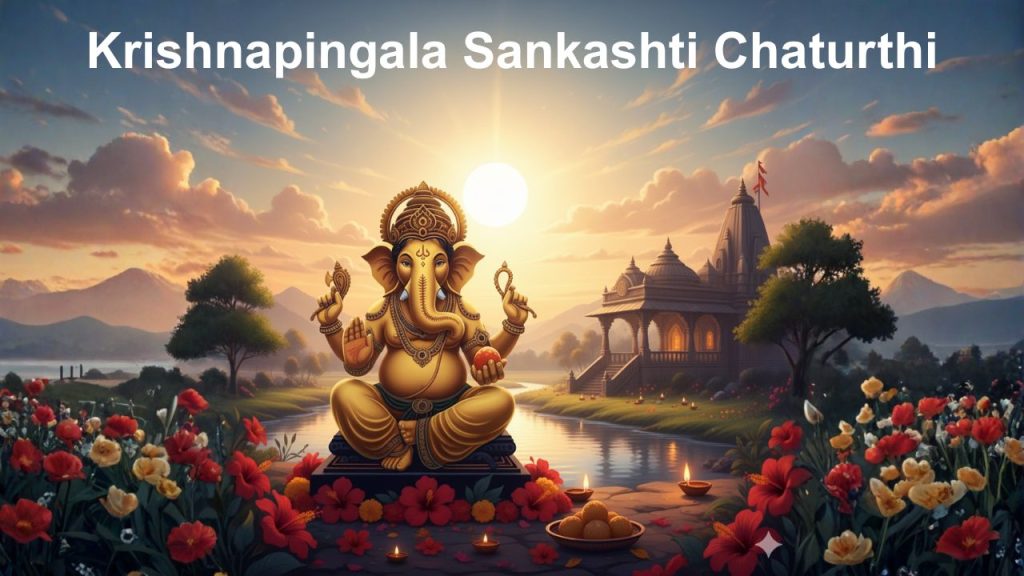
Krishnapingala Ganapati is one of Lord Ganesha’s rare and deeply esoteric forms. The name Krishnapingala itself carries layers of meaning. Krishna means dark, while Pingala refers to a reddish-brown or tawny hue. This unique form portrays Ganesha in a dark, powerful, radiant complexion that signifies profound cosmic energies.
Unlike the more popular forms where Ganesha appears cheerful and childlike, Krishnapingala Ganapati carries an intense energy. His appearance evokes the vast, unfathomable mysteries of the universe. The dark hue symbolizes absorbing all negativity, impurities, and karmic loads. He’s the embodiment of deep cleansing, both spiritually and emotionally.
In essence, Krishnapingala Ganapati isn’t just about removing superficial problems. He works at a much deeper karmic level, dissolving deeply rooted obstacles that block spiritual progress. Worshipping Him allows us to release long-held burdens, emotional baggage, and hidden negativities that often sabotage our growth.
Why This Day is Significant in Hindu Tradition
In Hindu tradition, every moment of worship has layers of spiritual meaning, but Krishnapingala Sankashti Chaturthi holds a particularly special place. This observance isn’t merely about asking Ganesha for help with exams, jobs, or business. It is about inner liberation. On this particular Sankashti Chaturthi, the energy of Krishnapingala Ganapati makes it an ideal day for self-purification, inner reflection, and the release of karmic burdens. Hindu scriptures emphasize that our most significant obstacles are often fear, ego, attachments, and ignorance. By connecting with Krishnapingala Ganapati, you invite divine assistance to conquer these inner demons.
Moreover, this tradition links closely to the universal principle of karma, the law of cause and effect. Every action, word, and thought leaves an imprint. Over time, these karmic imprints become obstacles that we carry through lifetimes. Observing Krishnapingala Sankashti Chaturthi helps you burn off this karma and move closer to spiritual freedom. For many Hindu families, this day is more than a ritual; it is a deeply personal spiritual journey that has been passed down through generations.
Occurrence in the Lunar Calendar
You might be curious about when Krishnapingala Sankashti Chaturthi falls exactly. Hindu festivals follow the lunar calendar, and Sankashti Chaturthi is observed on the fourth day (Chaturthi tithi) after the full moon (Purnima), during the waning phase (Krishna Paksha) of the moon. There are 12 Sankashti Chaturthi days in a year, each one ruled by a different form of Lord Ganesha. Krishnapingala Sankashti Chaturthi generally falls during the month of Ashwin or Bhadrapada as per the Hindu calendar, depending on regional calendars and traditions. Each observance brings unique blessings, but Krishnapingala’s occurrence is rare and highly auspicious.
Astrologically, the alignment of planets and the phase of the moon create a cosmic window for spiritual work on this day. It’s as if nature conspires to support your inner cleansing and transformation.
General Observances on Sankashti Chaturthi
The rituals on Sankashti Chaturthi, especially those associated with Krishnapingala Sankashti Chaturthi, are simple yet deeply symbolic. Here’s what typically happens:
- Fasting: Most devotees observe a full or partial fast, eating only fruits, water, or simple foods until the moon rises.
- Sankalp (Resolution): In the morning, devotees vow to observe the fast and perform puja with pure hearts.
- Ganapati Puja: Evening rituals involve decorating Ganesha’s idol with flowers, durva grass, and red hibiscus while chanting mantras.
- Moonrise Darshan: Special prayers are offered to conclude the fast after sighting the moon.
- Storytelling: Recitation of Sankashti Vrat Katha, the sacred tale related to that month’s Sankashti form, is essential.
- Offerings: Modaks (sweet dumplings), coconuts, bananas, and jaggery are offered as naivedya (sacred food).
These observances are not just ritualistic. They are designed to help you disconnect from worldly distractions, reflect inward, and build a direct bridge to the divine.
Legend and Mythology Associated with Krishnapingala Form
The Story of Krishnapingala Ganapati
Every divine form has a story that carries profound lessons, and Krishnapingala Ganapati is no different. According to ancient texts and oral traditions, the origin of Krishnapingala is rooted in the cosmic battle between light and darkness. Once, as the universe expanded, countless beings were created, both benevolent and malevolent. Among them, specific demonic forces accumulated immense dark karmic energies. Their presence disrupted cosmic balance and threatened both celestial beings and humans. Unable to withstand the growing negativity, the Devas (gods) approached Lord Shiva for help.
Realizing that these dark forces were not merely external but also the result of collective karmic imbalance, Lord Shiva invoked a powerful form of Ganesha. From his third eye emanated a radiant but dark-hued form, Krishnapingala Ganapati, charged with the ability to absorb these karmic toxins. Krishnapingala, with his glowing eyes, reddish-dark complexion, and fierce yet compassionate gaze, appeared and absorbed the karmic weight, neutralizing the malevolent beings. This divine act restored cosmic harmony and symbolized Ganesha’s supreme grace, absorbing our heaviest burdens and dissolving them through divine love and wisdom.
Connection with Lord Shiva and Parvati
Krishnapingala Ganapati’s birth is closely tied to Shiva and Parvati’s cosmic energies. As parents of Ganesha, Shiva embodies pure consciousness, while Parvati represents divine energy (Shakti). When imbalance threatens creation, solutions manifest through their unified energy.
In this case, Parvati’s nurturing essence allowed the compassionate side of Krishnapingala to emerge, while Shiva’s fierce cosmic fire empowered Him to face negativity without fear. This dual influence enables Krishnapingala Ganapati to combat evil and protect devotees simultaneously. His dark hue also reflects Shiva’s association with ash and Parvati’s connection to earthly elements, blending to create a form that embodies ultimate transformation.
Role in Removing Karmic Obstacles
We all carry burdens that aren’t always visible, emotional wounds, past-life debts, and generational karma. Over time, these become blocks in our lives, relationship difficulties, recurring financial problems, and unexplained anxieties. Krishnapingala Ganapati specializes in clearing these deeply rooted karmic obstacles. Unlike ordinary problem-solving, He goes to the root cause, dissolving the symptom and the karmic seed itself. When you sincerely worship Him, you’re inviting a deep, spiritual detox. This process isn’t always easy. Sometimes, challenges may intensify temporarily as old karmas surface before being released. But devotees experience profound freedom, peace, and renewed clarity through unwavering faith and practice.
Importance in Puranic Scriptures
While Krishnapingala Ganapati may not be as commonly mentioned in mainstream worship as Siddhivinayak or Ballaleshwar forms, references to Him do exist in ancient Tantric and Puranic texts, particularly those dealing with karmic purification and esoteric sadhanas. Texts such as the Ganesha Purana and Mudgala Purana allude to multiple forms of Ganesha, each with specific spiritual roles. Krishnapingala is recognized as a remover of deeply embedded karmic patterns, a role that no ordinary deity performs. His mention often appears with practices involving intense penance, meditation, and spiritual courage. By invoking Him, seekers embark on a path that resolves current life issues and clears the path to liberation (moksha).
Symbolism of the Dark-Complexioned (Pingala) Form
Why is Krishnapingala dark in complexion? The answer lies in profound spiritual symbolism.
- Absorption of Negativity: Like dark colors absorb light, Krishnapingala absorbs negativity and karmic impurities.
- Fearlessness: His appearance may be intimidating, but it reflects His ability to face the darkest forces without flinching.
- Transformation: The reddish tinge (Pingala) signifies transformation, turning darkness into light and ignorance into wisdom.
- Grounding Energy: His earthy tones symbolize stability, grounding, and balance, essential for gracefully navigating life’s challenges.
When you visualize or meditate upon Krishnapingala Ganapati, you’re not just seeing a form but engaging with a powerful spiritual force designed to cleanse and uplift you.
Spiritual Significance of Krishnapingala Sankashti Chaturthi
The Importance of Overcoming Inner Darkness
Let’s be real, often, our greatest battles aren’t fought in the outside world but within ourselves. This is why Krishnapingala Sankashti Chaturthi becomes such a spiritually significant occasion. We all carry inner darkness, fears, insecurities, anger, jealousy, guilt, and regrets. These inner obstacles quietly influence our actions, decisions, and overall well-being. Overcoming these internal shadows is one of the most challenging and transformative journeys you can ever undertake.
Krishnapingala Ganapati stands as the guiding light through this internal battlefield. His dark, powerful form reminds us that even the most profound darkness can be absorbed, transformed, and released. On this special Sankashti Chaturthi, devotees focus on introspection and self-cleansing. The rituals aren’t mere traditions but symbolic tools for facing one’s own emotional and spiritual hurdles. As you fast, chant, and meditate on this day, you tell your mind, “I am ready to confront what limits me.” This readiness allows divine grace to flow in and support your journey. Krishnapingala’s presence offers you the courage to face your demons and emerge lighter, freer, and more peaceful.
Connection with Karmic Cleansing
Have you ever felt like you’re carrying invisible baggage? Do specific struggles keep repeating despite your best efforts? That’s often the work of unresolved karmas, impressions from your past actions, and even previous lifetimes. Karma isn’t punishment; it’s simply the universal principle of cause and effect. What you sow is what you eventually reap. Over many lifetimes, we accumulate karmas that shape our experiences in this life.
Krishnapingala Sankashti Chaturthi is like a karmic reset button. On this day, when you sincerely worship Krishnapingala Ganapati, you request His divine intervention to burn away these old karmic patterns. The fasting, chanting, and pujas act like spiritual detergents, scrubbing away layers of accumulated karma. This doesn’t mean all your problems will vanish overnight. However, it does mean that karmic loads that would have taken many lifetimes to resolve can be significantly alleviated. Your path becomes smoother, your mind more peaceful, and your spiritual evolution faster.
Enhancing Spiritual Progress
Spiritual progress isn’t about escaping the world but navigating it with wisdom, compassion, and balance. However, as discussed, karmic baggage and inner darkness often slow our growth. Krishnapingala Sankashti Chaturthi provides a divine shortcut to accelerate your spiritual journey. On this day, when you practice self-discipline, engage in prayer, and open yourself to divine grace, you align with higher cosmic energies that amplify your spiritual evolution.
Many spiritual seekers report experiencing:
- Increased mental clarity
- Reduced emotional burdens
- Heightened intuition
- Deeper meditation experiences
- An unexplainable sense of inner peace
By participating wholeheartedly in this sacred observance, you’re not just performing rituals but actively sculpting your soul into its highest version.
Awakening Higher Wisdom and Consciousness
Have you noticed that sometimes, after deep prayer or meditation, your perspective shifts? Problems that once seemed huge suddenly feel manageable. That’s the work of higher consciousness awakening within you. Krishnapingala Ganapati governs this awakening. As He absorbs your lower energies, He simultaneously opens channels for divine wisdom. This elevated state of consciousness enables you to make better choices, handle challenges more gracefully, and experience life with greater joy and less suffering.
On Krishnapingala Sankashti Chaturthi, fasting, mantra chanting, and puja essentially tune your mind to higher frequencies. Like adjusting a radio station, you receive divine insights, intuitions, and inspirations that guide your life with extraordinary clarity.
Seeking Divine Protection and Grace
Let’s face it, life can be unpredictable. Obstacles can arise unexpectedly due to health issues, financial difficulties, relationship problems, or career setbacks. Having divine protection can be an immense source of strength during such times. Krishnapingala Ganapati isn’t just a remover of inner obstacles; He also offers powerful external protection. His fierce form protects against negative energies, evil eyes, spiritual attacks, and unseen dangers. On this Sankashti Chaturthi, devotees often pray for personal safety and protect their families, businesses, and homes. The grace of Krishnapingala resolves problems and fortifies spiritual armor, helping one face life with greater resilience and courage.
Astrological and Cosmic Importance
Influence of Moon Phases on the Human Psyche
You may wonder why the moon is so central to Sankashti Chaturthi. The moon profoundly influences your mind, emotions, and overall energy. Vedic wisdom states that the moon governs the mind and emotional body, known as manas. When the moon wanes (Krishna Paksha), your emotional energies turn inward, making it a potent time for self-reflection, inner cleansing, and spiritual work.
Krishnapingala Sankashti Chaturthi occurs during this lunar phase, enabling you to tap into the natural inclination toward introspection. The combined effect of the moon’s influence and Krishnapingala’s energy creates a powerful vortex for healing and transformation. Today, you may notice heightened emotions, vivid dreams, or even old memories surfacing. Don’t suppress them; they signal that deep karmic cleansing is underway.
Impact of Chaturthi Tithi in Astrology
Each tithi (lunar day) has its vibration and energy in Vedic astrology. Chaturthi tithi, ruled by Ganesha, is especially powerful for overcoming obstacles. Astrologically, Chaturthi is when the energies of detachment and purification peak. It breaks repetitive patterns and neutralizes planetary afflictions (doshas). On Krishnapingala Sankashti Chaturthi, this effect is magnified, offering an unparalleled opportunity to dissolve blockages that have resisted change for years. Astrologers often recommend performing Ganesha pujas on Chaturthi to strengthen the beneficial aspects of one’s birth chart and mitigate the malefic effects of planets like Rahu, Ketu, and Saturn.
Role of Planetary Alignments During Sankashti
The planetary alignments on Sankashti Chaturthi nights are often quite intense. As the moon wanes, it moves closer to the Sun’s gravitational pull, symbolizing a stripping away of illusions and ego. Combined with Krishnapingala’s cleansing force, these cosmic configurations act like a spiritual detox bath. The alignments amplify your prayers, making them more effective. Some advanced practitioners even use this night for powerful chanting, yantra worship, and deep meditation to realign their spiritual energies with universal forces.
Ideal Time for Penance and Devotion
Timing is everything in spiritual practice. And Sankashti Chaturthi, especially the Krishnapingala form, offers one of the most auspicious windows for sincere penance. Because the cosmic energies support internal work, this night is perfect for:
- Repentance and forgiveness rituals
- Surrendering bad habits or addictions
- Seeking emotional healing
- Setting spiritual intentions for growth
Your sincerity of devotion on this day has multiplied potency, making even small efforts yield significant spiritual returns.
Importance of Krishnapingala Sankashti in Mitigating Doshas
If you’re familiar with Vedic astrology, you know how planetary doshas can impact your life. Problems like delayed marriages, health issues, business failures, or chronic stress are often tied to doshas. Krishnapingala Sankashti Chaturthi acts as a spiritual remedy. Worshipping Krishnapingala Ganapati helps neutralize doshas like:
- Rahu-Ketu Dosha (shadow planet afflictions)
- Shani Dosha (Saturn-related delays and suffering)
- Pitru Dosha (ancestral karmic blocks)
- Karmic Debt (carry-forward karmas)
Through disciplined observance, you invite divine grace to restructure your karmic blueprint, leading to smoother life experiences.
Rituals and Pujas Performed
Morning Rituals and Sankalp
The day begins early. After bathing and wearing clean clothes, you approach your altar with devotion. You light a ghee lamp and incense, creating a sacred space of positivity and tranquility. Now comes the Sankalp, your sacred vow for the day’s fast and worship. This isn’t just a formality. In that moment, you mentally declare your intention to the divine. Whether seeking health, peace, or karmic relief, your Sankalp becomes your spiritual contract with Krishnapingala Ganapati. Many devotees also purify their home environment, sprinkling Ganga jal (holy water), burning camphor, and playing soft mantras. This physical cleanliness reflects the internal cleansing you undertake for the day.
Fasting Rules and Procedures
Fasting is central to Sankashti Chaturthi. You can choose the level of your fast based on your health and capacity:
- Nirjala (waterless fast): For advanced seekers.
- Phalahar (fruit and milk fast): Most commonly observed.
- Partial fast: Light, simple meals without grains or salt.
The purpose isn’t deprivation but purification. Fasting helps quiet the mind, reduces tamasic energies (characterized by lethargy and negativity), and heightens spiritual receptivity. Throughout the day, you chant, read Ganesha stories, or meditate whenever possible. Avoid distractions like TV, gossip, or arguments, and your entire day becomes a walking meditation toward spiritual cleansing.
Evening Ganapati Puja and Moon Sighting
As evening descends, you prepare for the main puja. An image or idol of Krishnapingala Ganapati is decorated with:
- Durva grass (21 blades, symbolizing control over 21 types of troubles)
- Red hibiscus flowers (Ganesha’s favorite)
- Sandal paste, turmeric, and kumkum
You chant powerful mantras like:
“Om Krishnapingalaye Namah”
“Om Gan Ganapataye Namah”
Once the moon rises, you perform Chandra Darshan (moon sighting) and offer water and naivedya (food offerings). Only after offering these prayers is the fast broken.
Offerings (Modaks, Durva Grass, Red Flowers)
Every offering holds deep meaning:
- Modaks: Symbol of sweet rewards for hard work and devotion.
- Durva Grass: Sign of victory over difficulties.
- Red Hibiscus: Represents pure love and vibrant energy.
- Coconut & Bananas: Symbols of surrender and abundance.
These simple items carry profound spiritual vibrations when offered with love and kindness.
Recitation of Sankashti Vrat Katha
The highlight of the evening is the reading of the Sankashti Vrat Katha, the sacred story associated with Krishnapingala Ganapati for that month. Listening to these stories connects you with ancient wisdom, filling your heart with faith and reaffirming your relationship with the divine. The story always ends with a moral lesson, reinforcing Ganesha’s role as not just a remover of obstacles but a guide for righteous living.
Benefits of Observing Krishnapingala Sankashti Chaturthi
When life feels like a never-ending maze of challenges, searching for a path that brings relief, hope, and clarity is a natural response. Krishnapingala Sankashti Chaturthi isn’t just a traditional observance; it’s a profoundly spiritual opportunity to realign with your higher self and clear the hurdles that hold you back. Whether battling personal struggles, seeking peace of mind, or simply wanting to feel more connected to something greater, this vrat offers a way forward.
Observing this sacred day with faith and discipline can invite powerful transformations. The most talked-about benefit is the removal of obstacles, both seen and unseen. Devotees believe that fasting on this day, accompanied by prayer and meditation on Lord Ganesha’s Krishnapingala form, dissolves mental blocks, neutralizes bad karma, and paves the way for smoother experiences in relationships, careers, and overall well-being.
Financial and professional prosperity is also widely believed to follow those who earnestly participate in this vrata. By offering sincere devotion, chanting mantras, and making symbolic offerings like durva grass and modaks, you align yourself with the divine energy that governs success and abundance. This isn’t just a mythological concept; it reflects a shift in mindset that empowers confidence and clarity. Another vital benefit is healing from ailments, whether emotional or physical. This form of Ganesha is especially associated with restoring balance within the body and mind. Fasting detoxifies not only your system but also your thought patterns.
Furthermore, this observance is known to bring harmony to family life. Practicing together fosters a culture of spiritual unity at home, helping resolve conflicts and nurturing emotional bonds. Above all, it’s a step toward spiritual upliftment and moksha (liberation). Through penance, introspection, and divine connection, you don’t just pray for relief, you grow into a more conscious, resilient, and peaceful version of yourself.
Symbolism of Krishnapingala Ganapati
Spiritual traditions often employ symbols with powerful, layered meanings that guide our understanding of life and its mysteries. Krishnapingala Ganapati is a radiant example of that symbolic richness. Every part of His form, His color, posture, vehicle, and accessories, carries a message to awaken your awareness and lead you toward a fuller, wiser existence.
The Dark Complexion – Transcendence of Ignorance
Krishnapingala Ganapati’s dark or bluish-black skin isn’t random; it mirrors the cosmic void, the space beyond material perception. This deep hue symbolizes the absorption of ignorance. When you meditate on this form, you’re invited to leave behind ego, illusion, and attachment, to transcend what you think you know and enter the realm of higher consciousness.
The Large Belly – Acceptance of All Karmas
Have you ever noticed how Ganesha’s round belly feels oddly comforting? It’s not just a depiction of abundance. It symbolizes the ability to absorb all experiences, both positive and negative. Life throws joy and sorrow, success and failure at us, but like Ganesha, we must absorb them gracefully. His belly is a metaphor for spiritual stamina and unconditional acceptance of one’s karmic journey.
The Broken Tusk – Sacrifice for a Higher Purpose
This is one of the most iconic aspects of Ganesha’s symbolism. The broken tusk symbolizes the willingness to make sacrifices. As the legend goes, he broke off to write the Mahabharata, symbolizing the importance of prioritizing dharma and knowledge over personal comfort. It’s a reminder that growth often requires giving up short-term pleasure for long-term wisdom.
The Mouse as Vehicle – Control Over Desires
Have you ever wondered why such a grand deity rides something as small as a mouse? It’s no accident. The mouse symbolizes desire, tiny yet overwhelming when uncontrolled. Ganesha riding shows us how to master our cravings, not by crushing them but by aligning them with purpose.
The Modak – Ultimate Bliss of Self-Realization
Finally, the sweet modak in His hand isn’t just a treat, it’s the reward of spiritual effort. Modak signifies the bliss that comes when you know your true self. It’s a sacred promise that divine sweetness awaits after every fast, prayer, and challenge.
Differences from Other Sankashti Chaturthi Observances
While all Sankashti Chaturthi observances are sacred, Krishnapingala Sankashti Chaturthi stands apart in many ways. It’s not just another monthly fast; it’s a powerful spiritual event infused with unique mantras, stories, and intentions. Here’s how it’s distinct:
Unique Attributes of Krishnapingala Sankashti
Unlike regular Sankashti Chaturthi, which might focus on well-known forms of Ganesha, this day is devoted to Krishnapingala, a rarely worshipped form. His very presence feels more esoteric and inward-focused. The rituals on this day are often steeped in deep self-inquiry and karmic cleansing rather than only external worship.
Differences in Mantras and Prayers
Devotees chant specific Krishnapingala mantras, which include seed syllables (bija mantras) and tantric intonations not commonly heard during regular Ganesha worship. These vibrations resonate more deeply in the subconscious, helping to unlock mental blocks and karmic residues. One of the most powerful mantras chanted is: “Om Krishnapingalaya Namah” – invoking his presence directly.
Distinctive Legends and Vrat Katha
Each Sankashti Chaturthi has a Vrat Katha (fasting story), but Krishnapingala’s tale involves cosmic battles, self-sacrifice, and the dissolution of deep-rooted ignorance. These stories don’t just entertain, they teach. They remind us that overcoming our darkness is the most significant victory.
Emphasis on Karmic Balance and Penance
Krishnapingala Sankashti asks for devotion and discipline. The vrat encourages sincere penance, including water-only fasts, introspective silence, and deep mantra japa. It’s about balancing your karmas, purifying intent, and becoming more attuned to your life’s spiritual rhythm.
Rare Form Not Widely Worshipped on Regular Chaturthi
Unlike Siddhivinayak or Ballaleshwar, this form isn’t part of mainstream rituals, which makes it even more special. Worshipping Krishnapingala is like connecting with a hidden facet of the divine that rarely appears but holds immense transformational power when it does.
Regional Observances and Popular Temples
Although Krishnapingala Ganapati may not be a household name everywhere, his spiritual presence is strong in several parts of India, particularly in Maharashtra, Karnataka, and Tamil Nadu. Devotees in these areas often come together to celebrate this unique form with great reverence and a sense of community spirit.
Popular Temples Where Krishnapingala Ganapati is Worshipped
While there isn’t a central stand-alone temple dedicated to Krishnapingala, this form is invoked in specific Ganesha temples, especially during Sankashti days. In Maharashtra, temples in Pune, Lenyadri, and Siddhatek include the form of Krishnapingala as part of their extended worship. Even within the Ashta Vinayaka circuit, His energy is subtle and meditative, especially at Mahaganapati, Ranjangaon.
Special Celebrations in Maharashtra, Karnataka, and Tamil Nadu
In towns like Kolhapur and Nashik, as well as parts of northern Karnataka, temples hold special aartis, bhajans, and night-long mantra japa sessions. In Tamil Nadu, temples in Chennai and Coimbatore include this observance in their Ganesha festivals, weaving it into local traditions.
Community Events and Collective Pujas
One of the most moving sights of the day is seeing entire families come together for collective fasting, storytelling, and prayer. In urban societies, community halls often organize group pujas, where children learn the vrat katha and elders chant mantras together. It’s more than a ritual; it becomes a shared spiritual journey.
Pilgrimages Associated With This Day
Some devotees mark this day by visiting multiple Ganesha temples, seeking blessings from different forms throughout the day. This mini-yatra, often done on foot or by bike, becomes a way to connect with the divine, nature, and community.
Importance in Ashta Vinayaka Yatra (Reference to Pingala Form)
The Ashta Vinayaka Yatra doesn’t explicitly list Krishnapingala Ganapati, but his qualities are echoed in the yatra’s more profound symbolism, especially at Ranjangaon’s Mahaganapati and Siddhatek’s Siddhivinayak. This illustrates the profound interconnectedness of the forms of Ganesha, even when they appear to be distinct.
The Timeless Relevance of Krishnapingala Sankashti Chaturthi
Let’s face it, modern life is loud, chaotic, and often overwhelming. Responsibilities, distractions, and worries pull us in a hundred directions. That’s precisely why Krishnapingala Sankashti Chaturthi matters today more than ever. This is not just a ritual from ancient scriptures; it’s a timeless spiritual tool that helps you pause, breathe, and reconnect with what truly matters. In a world of endless noise, Krishnapingala teaches you to look inward to remove external obstacles and those hiding in your heart, doubt, fear, anger, and confusion. Ganesha’s teachings are not bound by time or religion. They speak a universal truth: that every obstacle holds the seed of growth within it. His form reminds us that strength comes from softness, wisdom from sacrifice, and clarity from devotion.
As you observe this sacred day, consider it more than a fast. Think of it as a personal conversation with the divine, a reset button for your soul. Cultivate patience by holding your fast, nurture discipline through your prayers, and open your heart to the divine grace waiting to flood your life. You don’t need to be a saint or a sage to have this experience. You need faith, effort, and an open heart. This Krishnapingala Sankashti Chaturthi, don’t just light a lamp; be the light.