Understanding Sharad / Shardiya Navratri
Shardiya Navratri is one of the most awaited and widely celebrated festivals in the Hindu tradition. It marks nine days of deep devotion, spirituality, and cultural festivities dedicated to Goddess Durga and her nine divine forms. The word Navratri itself translates to “nine nights,” symbolizing a sacred period where individuals turn inward for spiritual reflection while also expressing joy through music, dance, and communal harmony.
What makes Shardiya Navratri truly special is its timing in the Hindu calendar. It falls during the Ashwin month (September–October), a time when the monsoon season recedes and nature begins to embrace the beauty of autumn. This seasonal shift mirrors the symbolic transition from darkness to light, from negativity to positivity, and from weakness to inner strength.
Unlike other Navratris observed throughout the year, such as Chaitra, Magha, or Ashadha, Shardiya Navratri holds a distinctive importance. It is considered the most significant Navratri due to its direct association with the slaying of the demon Mahishasura by the Goddess Durga, representing the ultimate victory of good over evil. Across India, it is observed with variations in rituals, practices, and cultural expressions. Yet, the underlying essence remains the same: reverence for the divine feminine power and a reminder of the strength within every individual.
Beyond rituals, Shardiya Navratri provides people with an opportunity to reconnect with their family, strengthen community bonds, and rejuvenate their spiritual energy. Whether through fasting, prayers, or joyful celebrations like Garba and Durga Puja, this festival continues to inspire millions to embrace faith, resilience, and unity.
Brief overview of Navratri as one of the most celebrated Hindu festivals
Navratri, in its essence, is more than just a religious festival; it is a grand celebration of devotion, discipline, and cultural identity. The nine nights are dedicated to honoring Goddess Durga, who is revered as the embodiment of divine energy, courage, and compassion. Each day of the festival represents a unique aspect of the Goddess, encouraging devotees to focus not only on prayers but also on personal transformation.
The popularity of Navratri stems from its ability to blend spirituality and festivity. People engage in fasting, prayers, and rituals to cleanse the mind and soul. At the same time, cultural expressions like Garba, Dandiya Raas, music, and community feasts make it a joyous occasion for all age groups. This dual aspect of devotion and celebration makes Navratri stand out among Hindu festivals.
Across India, Navratri takes different forms depending on the region. In Gujarat, it is celebrated with vibrant Garba nights where people dress in colorful attire and dance in circles, symbolizing the cycle of life. In West Bengal, the festival transforms into Durga Puja, where beautifully crafted idols of Goddess Durga are worshipped with grandeur. In North India, people observe fasts and organize Ram Leela performances, culminating in Dussehra, symbolizing the victory of Lord Rama over Ravana.
This adaptability and inclusiveness make Navratri more than a religious observance; it becomes a cultural identity marker that unites diverse communities under the same spirit of devotion and joy. The fact that Navratri continues to thrive in modern times, not only in India but also globally, demonstrates its universal appeal and timeless relevance.
Difference between Sharad / Shardiya Navratri and other Navratris (Chaitra, Magha, Ashadha)
Hindu traditions recognize four Navratris in a year, but not all carry the same level of significance. While Chaitra, Magha, and Ashadha Navratris have their own spiritual importance, Shardiya Navratri stands apart for both its scale and the intensity with which it is observed. Understanding these differences helps in appreciating why Shardiya Navratri is considered the most prominent among them.
Chaitra Navratri, observed in March or April, marks the beginning of the Hindu New Year in many parts of India. It is significant for those who worship Lord Rama, as Ram Navami falls during this period. The focus here often leans towards new beginnings, harvests, and seeking blessings for prosperity.
Magha Navratri, typically celebrated in January–February, is less widely observed compared to Shardiya or Chaitra Navratri. It is more popular among spiritual seekers and ascetics who dedicate their time to meditation, austerities, and inner growth.
Ashadha Navratri, which occurs around June–July during the monsoon season, is also known as “Gupt Navratri” (hidden Navratri), a practice primarily observed by saints and individuals deeply engaged in tantra or spiritual disciplines.
Sharad / Shardiya Navratri, in contrast, is celebrated with unmatched enthusiasm across India. It coincides with the harvest season, marking abundance and prosperity. Its mythological connection with Goddess Durga’s victory over Mahishasura adds to its prominence. Unlike the other Navratris, which are often observed quietly or regionally, Shardiya Navratri is a nationwide celebration that involves communities, families, and diverse cultural expressions.
This distinction highlights that while all Navratris emphasize devotion and self-discipline, Shardiya Navratri stands out as being both spiritually profound and culturally vibrant.
Timing of Sharad / Shardiya Navratri in the Hindu calendar (Ashwin month, September–October)
The timing of Shardiya Navratri carries both religious and natural significance. It is observed during the lunar month of Ashwin, which usually falls between late September and early October. This period is considered one of the most auspicious times of the year in Hindu tradition, often described as a season of balance and transition.
From a natural perspective, Shardiya Navratri comes right after the monsoon. The environment feels fresh, the skies clear up, and nature begins preparing for winter. Just as nature transitions from one phase to another, devotees use this period to transition spiritually, leaving behind negativity, cleansing the mind and body, and moving towards inner strength.
The placement of Shardiya Navratri in the calendar also aligns with the principle of cosmic balance. It is believed that during these nine days, the divine feminine energy, or Shakti, is at its most potent and accessible. Devotees tap into this energy through prayers, meditation, and rituals, seeking blessings for strength, health, and prosperity.
Culturally, the timing makes it an inclusive festival, as schools, businesses, and communities often plan around it. Families gather, communities organize large-scale events, and cities light up with celebrations. This is why Shardiya Navratri feels like more than a religious observance; it becomes a season of joy, devotion, and cultural bonding.
Universal appeal, celebrated across India with regional variations.
One of the most beautiful aspects of Shardiya Navratri is how it transcends regional boundaries while retaining its essence. Each part of India celebrates the festival with its unique customs, creating a rich tapestry of traditions that highlight the country’s cultural diversity.
In Gujarat, the nights come alive with Garba and Dandiya Raas. People, dressed in colorful attire, dance in circles to devotional songs, creating an atmosphere filled with energy and joy. In West Bengal, Shardiya Navratri merges into Durga Puja, one of the grandest celebrations where towering idols of Goddess Durga are worshipped, and elaborate pandals (temporary shrines) are set up.
Maharashtra observes Ghatsthapana, during which families dedicate a space in their homes to worship the Goddess for nine days. In North India, fasting and Ram Leela performances keep the spiritual and cultural spirits alive, while in Himachal Pradesh, Kullu Dussehra is celebrated with processions and rituals that attract global visitors.
This universal appeal lies in the way Shardiya Navratri adapts to local culture while preserving its spiritual message. No matter where it is celebrated, the underlying essence remains devotion to Goddess Durga and the celebration of good over evil. Even beyond India, the Indian diaspora has taken the festival across the globe.
Communities in the USA, UK, Canada, and other countries organize Garba nights, Durga Puja celebrations, and cultural gatherings, keeping the traditions alive far from home. This global recognition further strengthens Shardiya Navratri’s position as not just a religious festival but a cultural identity that connects people across borders.
Historical and Mythological Significance
Shardiya Navratri is rooted deeply in history and mythology, making it not only a religious observance but also a powerful reminder of timeless values. The most well-known narrative behind this festival is the story of Goddess Durga’s victory over the demon Mahishasura. This tale represents the triumph of divine energy over negativity, reinforcing the belief that truth and goodness will always prevail.
The festival also draws inspiration from the sacred scriptures, particularly the Devi Mahatmya, where the Goddess Durga is described as the supreme power that restores balance in the universe. These mythological connections are more than stories; they are symbolic teachings that remind people to confront their inner demons, such as ego, greed, and anger.
In addition to mythology, Shardiya Navratri reflects the historical evolution of devotion to feminine power in Indian society. The rituals, chants, and prayers highlight the reverence for the divine feminine, or Shakti, which is seen as the source of creation and sustenance. Over generations, communities have celebrated this festival as a way to pass on these teachings, ensuring that the values of courage, faith, and resilience remain alive.
Thus, Shardiya Navratri becomes a celebration of both mythology and life lessons. It inspires individuals not only to honor the Goddess externally but also to awaken strength, discipline, and positivity within themselves.
Story of Goddess Durga’s victory over Mahishasura
The heart of Shardiya Navratri lies in the legendary story of Goddess Durga slaying the buffalo demon Mahishasura. According to ancient scriptures, Mahishasura was granted a boon that no man or god could defeat him, which made him nearly invincible. Drunk with power, he unleashed destruction on heaven and earth, causing suffering everywhere. The gods, unable to stop him, turned to Goddess Durga, who was created as a divine force embodying the combined energies of all deities.
Durga engaged in a fierce battle with Mahishasura that lasted nine days and nights. On the tenth day, she finally defeated him, symbolizing the end of tyranny and the restoration of peace. This victory is celebrated as Vijayadashami or Dussehra.
Beyond being a thrilling myth, the story holds deep symbolic meaning. Mahishasura represents arrogance, ignorance, and destructive tendencies within human beings. Goddess Durga’s triumph shows the power of faith, courage, and righteousness in overcoming negativity. It’s a story that continues to resonate because it mirrors the struggles each person faces in their own lives, fighting against inner weaknesses to emerge stronger.
Every ritual observed during Shardiya Navratri, from fasting to prayers, serves as a way to remember this story and apply its lessons in daily life. It is not just a tale from the past, but a guide for the present and future, encouraging people to remain steadfast in the face of challenges and believe in the ultimate triumph of good.
Symbolism of good triumphing over evil
The central theme of Shardiya Navratri, where good triumphs over evil, extends far beyond mythology. It represents a universal truth that transcends time, culture, and faith. Evil is not always an external enemy; it can be the opposing forces within, such as greed, anger, fear, and ego. The festival teaches that by nurturing inner strength and devotion, these destructive forces can be conquered.
Every act of worship during Navratri is symbolic. Lighting a diya signifies the removal of darkness, fasting represents discipline and self-control, and chanting mantras invokes divine energy to dispel negativity. Collectively, these practices serve as reminders that no matter how powerful evil may appear, it cannot last forever. Goodness, truth, and justice always rise in the end.
This symbolism has inspired countless communities for centuries. The celebration of Dussehra at the end of Navratri, where effigies of Ravana are burned, serves as another way to reinforce this message. It visually depicts the destruction of evil and the victory of righteousness.
This symbolism is more relevant than ever. People face stress, confusion, and moral dilemmas on a daily basis. Shardiya Navratri encourages them to believe in perseverance and positivity. It assures them that challenges, no matter how overwhelming, can be overcome with faith and resilience.
Connection to Devi Mahatmya and other scriptures
The significance of Shardiya Navratri is also rooted in sacred texts, particularly the Devi Mahatmya, a section of the Markandeya Purana. This scripture glorifies Goddess Durga as the supreme power who conquers evil forces threatening cosmic balance. The recitation of Devi Mahatmya during Navratri is considered one of the most significant rituals, as it recounts her battles with demons such as Madhu-Kaitabh, Mahishasura, and Shumbha-Nishumbha.
These scriptures portray Durga not only as a warrior goddess but also as the embodiment of compassion, strength, and motherly protection. Devotees are reminded that the divine feminine is not just a destroyer of evil but also a nurturer who safeguards the universe.
Other texts, such as the Durga Saptashati and Chandi Patha, also emphasize her role as the ultimate source of power (Shakti). These readings are not mere rituals but are believed to purify the mind, energize the soul, and strengthen faith.
By engaging with these scriptures, devotees connect with centuries of spiritual wisdom. They gain a deeper understanding that Shardiya Navratri is not only about external celebrations but also about internal transformation. It teaches that true devotion lies in embodying the values of courage, discipline, and compassion in everyday life.
Spiritual lessons from the myths associated with the festival
The myths of Shardiya Navratri are not just stories; they are profound teachings that hold practical relevance for daily life. The central lesson is that challenges and adversities, no matter how strong, can be overcome through faith, courage, and persistence. Just as Goddess Durga fought tirelessly for nine nights, individuals are reminded to remain patient and determined in the face of difficulties.
Another vital lesson is recognizing inner strength. The creation of Durga from the energies of various gods symbolizes that strength does not always lie outside; it is already within. Shardiya Navratri encourages individuals to awaken that dormant energy to face their personal battles.
The myths also highlight the importance of balance. Durga is fierce in her fight against evil, yet compassionate as a mother protecting her children. This duality teaches the value of being strong yet kind, assertive yet gentle.
These spiritual lessons make Shardiya Navratri a festival of both reflection and celebration. They remind devotees that life is a constant journey of overcoming inner and outer struggles while staying true to the principles of goodness, courage, and compassion.
Nine Forms of Goddess Durga
One of the most unique aspects of Shardiya Navratri is the worship of the nine forms of Goddess Durga, each celebrated on a specific day. These forms, from Shailputri to Siddhidatri, represent different qualities and energies that guide devotees on their spiritual journey. Every day has its own rituals, colors, and offerings, making the nine nights a holistic path of devotion.
The worship of these nine forms signifies a gradual transformation of the devotee’s soul. Beginning with grounding and purity (Shailputri) and culminating in divine completeness (Siddhidatri), the journey mirrors personal growth and development. Each form inspires individuals to reflect on their lives, overcome weaknesses, and embrace divine qualities.
By honoring all nine forms, devotees experience a spiritual cleansing that aligns body, mind, and spirit. The colors and rituals add vibrancy, turning this spiritual process into a joyous celebration. This is why the nine forms of Goddess Durga are at the heart of the essence of Shardiya Navratri.
Day-wise worship of each form: Shailputri to Siddhidatri
Each day of Shardiya Navratri is dedicated to one form of Goddess Durga:
- Shailputri – The daughter of the mountains, symbolizing purity and strength.
- Brahmacharini – The Goddess of devotion and penance, inspiring discipline.
- Chandraghanta – The Goddess of bravery, representing calmness and courage.
- Kushmanda – Creator of the universe, symbolizing creativity and vitality.
- Skandamata – Nurturing mother, inspiring love and compassion.
- Katyayani – Fierce warrior, symbolizing strength and justice.
- Kaalratri – Destroyer of fear and negativity.
- Mahagauri – Symbol of purity, peace, and serenity.
- Siddhidatri – The Granter of Wisdom and Supernatural Powers.
Each form teaches a distinct lesson. Worshipping Shailputri grounds devotees, Brahmacharini inspires perseverance, and Chandraghanta gives courage. As the days progress, the journey moves from discipline to power, from destruction of negativity to spiritual fulfillment. By dedicating each day to one form, devotees are guided step by step through a process of self-improvement and spiritual awakening. It becomes not just a festival but a spiritual path of growth.
Qualities and symbolism of each Goddess form
Every form of Durga carries a symbolic meaning that enriches the festival:
- Shailputri embodies stability and courage, encouraging resilience.
- Brahmacharini symbolizes inner strength gained through discipline.
- Chandraghanta inspires fearlessness in facing challenges.
- Kushmanda reminds us of the creative energy that sustains life.
- Skandamata represents selfless love and responsibility.
- Katyayani symbolizes justice and the empowerment of women.
- Kaalratri destroys fear, teaching the importance of confronting darkness.
- Mahagauri embodies peace, demonstrating that purity leads to inner serenity.
- Siddhidatri bestows wisdom, symbolizing ultimate realization.
Together, these qualities represent the complete journey of human life. They teach that true strength lies in balance, being strong yet compassionate, disciplined yet joyful, fearless yet peaceful. By reflecting on these qualities, devotees not only honor the Goddess but also strive to embody these traits in their own lives.
Rituals, colors, and offerings associated with each day
Each day of Navratri is associated with its own set of rituals, offerings, and a specific symbolic color. For instance, red may symbolize strength, yellow devotion, green growth, and blue calmness. Devotees wear these colors while offering particular items, such as flowers, fruits, or sweets, that correspond to the Goddess of the day.
The rituals usually involve reciting specific mantras, lighting diyas, and offering prayers that align with the qualities of the Goddess. For example, white flowers may be delivered to Mahagauri, symbolizing purity, while jaggery may be provided to Kushmanda to invoke energy.
These rituals are not just symbolic acts but reminders of the values each Goddess represents. By wearing colors and making offerings, devotees align their energy with divine qualities, making the nine days an immersive spiritual experience.
Importance of devotion and discipline in honoring all nine forms
Worshipping all nine forms of Durga requires both dedication and discipline. It is not just about rituals, but about embracing the lessons each form teaches. The disciplines of fasting, rising early for prayers, and dedicating time to worship reflect a commitment. Devotion ensures that these practices are not mechanical but heartfelt.
Together, devotion and discipline transform Navratri into more than a festival; it becomes a personal journey. Devotees learn patience, self-control, and faith, all while feeling the presence of the divine in their daily lives. This blend of dedication and discipline is what makes honoring all nine forms so powerful.
Rituals and Traditions of Sharad / Shardiya Navratri
The rituals of Shardiya Navratri are deeply symbolic, blending spiritual discipline with cultural expressions. They begin with Ghatasthapana, marking the invocation of the Goddess, and continue with daily prayers, fasting, and offerings. Each ritual has its own meaning, teaching discipline, devotion, and reverence for divine energy.
Traditions like lighting diyas, decorating homes with flowers, and gathering for aarti create an atmosphere of purity and joy. On the tenth day, Vijayadashami or Dussehra, the rituals conclude, celebrating the ultimate triumph of good over evil. These customs not only honor the Goddess but also bring families and communities together. They act as a bridge between faith and culture, ensuring that the lessons of Shardiya Navratri remain alive for generations.
Ghatasthapana (Kalash Sthapana) and its meaning
Ghatasthapana marks the beginning of the Shardiya Navratri festival. A kalash (sacred pot) filled with water, topped with mango leaves and a coconut, is placed on a bed of soil where barley seeds are sown. This symbolizes the universe, fertility, and new beginnings. The kalash represents the Goddess herself, and by invoking her presence, devotees invite divine energy into their homes. The sprouting of barley during these nine days is seen as a sign of growth, prosperity, and blessings.
This ritual highlights the interconnectedness of life and nature. It shows that just as seeds sprout with care and nourishment, devotion and discipline nurture spiritual growth. Ghatasthapana is, therefore, both a symbolic and spiritual act of starting the festival with reverence and purity.
Daily prayers, fasting, and aarti rituals
Each day of Navratri involves specific prayers, often including recitation of Durga Saptashati or devotional songs. Fasting is an essential practice, observed either by abstaining from food completely or by consuming a simple satvik diet. This practice is not about denial but about self-control and purification.
Aarti rituals, performed with lamps, incense, and flowers, create an atmosphere of devotion and positivity. Families gather to sing hymns, reinforcing collective faith and unity. These practices transform daily life into an act of devotion. By combining discipline with prayer, devotees cleanse both body and soul, preparing themselves for divine blessings.
Use of flowers, diyas, and incense in puja
Flowers symbolize purity and devotion, diyas represent the removal of darkness, and incense spreads positivity and calmness. Together, they form essential parts of the Navratri puja.
Offering fresh flowers is seen as an act of respect, while lighting diyas signifies the illumination of wisdom. Incense purifies the environment, creating a sacred space for worship. These elements not only enhance rituals but also serve as reminders of spiritual truths: purity, light, and positivity. Their presence makes the worship more meaningful and immersive.
Concluding rituals on Vijayadashami
The tenth day, Vijayadashami, marks the end of Navratri. It celebrates the victory of Goddess Durga over Mahishasura and Lord Rama over Ravana. Rituals include immersing idols of Durga in water, symbolizing her return to the divine realm.
In many regions, effigies of Ravana are burned, visually representing the destruction of evil. Families exchange blessings, gifts, and sweets, celebrating joy and unity. Vijayadashami is not just the end of rituals; it is a beginning. It inspires individuals to carry forward the values of courage, discipline, and positivity into their everyday lives.
Spiritual Importance of Fasting
Fasting during Shardiya Navratri is one of the most meaningful practices, observed by millions with devotion. It is not simply about avoiding food but about purifying the body, mind, and soul. Through fasting, devotees practice self-discipline, align with spiritual energy, and express gratitude to the Goddess.
The diet followed during fasting, which consists of fruits, nuts, milk, and light meals, nourishes the body while calming the mind. This simplicity encourages mindfulness and detachment from excess.
Fasting also serves as a symbolic act of aligning oneself with divine energy. Just as the body rests and detoxifies, the mind also sheds negativity, making space for positivity and faith. In essence, fasting becomes a bridge between physical health and spiritual growth, making it a powerful practice during Navratri.
Fasting as a practice of self-purification
Fasting is often viewed as a means to cleanse the body of toxins, but its spiritual significance extends deeper. It is about purifying not only the body but also thoughts and actions. By observing restraint in food, speech, and behavior, devotees focus more on prayer and self-reflection.
This act of self-purification symbolizes letting go of negativity, anger, greed, and ego, and embracing virtues such as patience, humility, and compassion. It shifts the attention from material needs to spiritual aspirations. During Navratri, fasting serves as a reminder that real nourishment comes not only from food but also from faith and devotion. It purifies the soul, preparing it for divine blessings.
The connection between fasting and mental discipline
Fasting requires willpower and discipline, teaching the mind to control cravings and distractions. This strengthens focus, patience, and resilience. By practicing restraint, individuals learn to prioritize spiritual goals over temporary desires.
This mental discipline extends beyond Navratri. It helps in handling daily challenges with calmness and clarity. Fasting, therefore, becomes a training ground for the mind, where discipline in one area enhances discipline in others. In this way, fasting during Navratri is not just about food; it is about building the strength of character and clarity of thought.
Satvik diet during Navratri and its benefits
The satvik diet consumed during Navratri is simple, light, and pure. It typically includes fruits, milk, nuts, and preparations made with ingredients such as buckwheat, water chestnut flour, and rock salt. This diet is easy to digest, giving the body a break from heavy foods.
Physically, it detoxifies and rejuvenates the system. Mentally, it brings calmness and clarity. Spiritually, it aligns with purity and devotion, helping individuals stay focused on prayer and reflection. Thus, the satvik diet is not a restriction but a gift, offering health benefits while deepening the spiritual connection.
Symbolism of food choices in aligning body, mind, and spirit
The food choices during Navratri are deeply symbolic. Light, natural foods represent purity, connecting the body to the natural world. By avoiding onions, garlic, and other heavy items, devotees keep their minds calm and receptive to spiritual energy.
This alignment of body, mind, and spirit makes fasting a holistic practice. Food becomes not just nourishment but a medium of devotion. Each meal is an offering to the divine, a conscious act of gratitude and mindfulness. Through these symbolic choices, fasting transforms into a spiritual journey where every bite carries meaning and purpose.
Cultural Celebrations Across India
Shardiya Navratri is one of those rare festivals that transforms the entire country into a vibrant mosaic of traditions. What makes it extraordinary is how the same festival assumes distinct flavors in different states while retaining the same spiritual essence. Every region has its own unique way of expressing devotion to Goddess Durga, reflecting India’s cultural diversity.
In Gujarat, nights come alive with Garba and Dandiya Raas, where men and women, dressed in colorful attire, gather to dance in circles, symbolizing the eternal cycle of life. In West Bengal, Navratri coincides with Durga Puja, which is celebrated with magnificent idols, decorated pandals, and grand processions. Maharashtra observes Ghatsthapana and community celebrations, where people gather for prayers and cultural programs. Meanwhile, Himachal Pradesh hosts the famous Kullu Dussehra, drawing visitors from across the globe.
These varied celebrations demonstrate that Shardiya Navratri is not just a religious festival, but a cultural phenomenon. Each tradition, whether it’s dancing, fasting, or creating artistic displays, carries the same message: honoring divine power and celebrating the victory of good over evil. The diversity of practices makes the festival a beautiful reminder of India’s unity in diversity.
Gujarat’s Garba and Dandiya Raas traditions
In Gujarat, Shardiya Navratri is synonymous with Garba and Dandiya Raas, two traditional dances that have become global symbols of the festival. Every night during Navratri, open grounds and community halls are filled with people dressed in traditional attire, with women wearing vibrant chaniya cholis and men wearing colorful kediyas. The atmosphere is electrifying, with music, clapping, and rhythmic steps creating a spiritual yet joyous ambiance.
Garba involves dancing in circles around a centrally placed diya or image of Goddess Durga, symbolizing the cycle of life and the divine energy that sustains it. The dance movements are graceful yet powerful, reflecting both devotion and celebration. Dandiya Raas, performed with decorated sticks, represents the mock battle between Goddess Durga and Mahishasura, blending mythology with artistic expression.
These traditions are more than entertainment; they are acts of devotion expressed through movement and rhythm. They also serve as social gatherings that foster unity and joy among people. Today, Garba and Dandiya are not limited to Gujarat; they are celebrated across India and in Indian communities worldwide, making them iconic symbols of the Shardiya Navratri festival.
Bengal’s Durga Puja is a grand cultural festival.
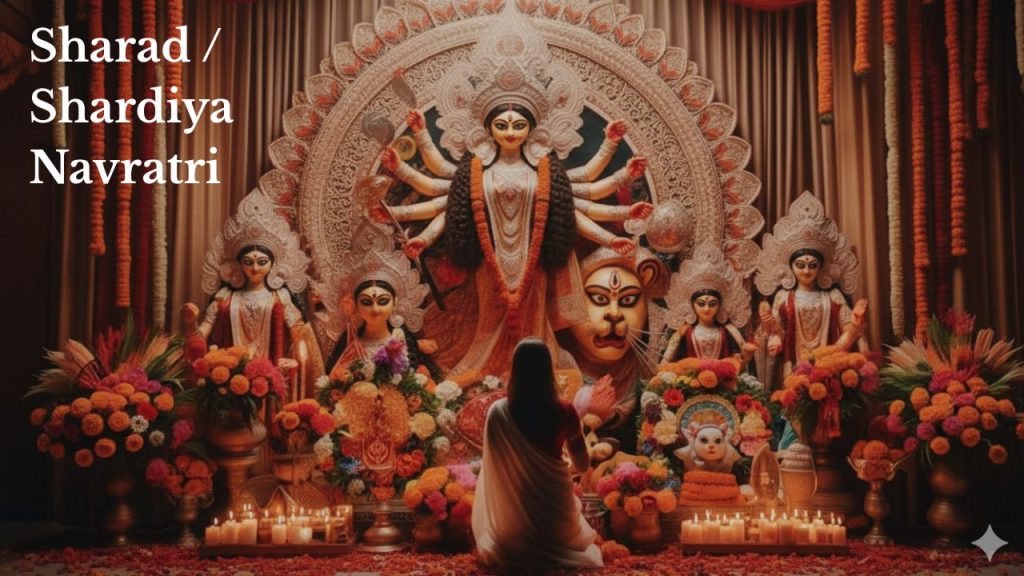
In West Bengal, Shardiya Navratri transforms into Durga Puja, one of the grandest cultural festivals in the world. The highlight is the creation of intricately crafted idols of Goddess Durga, often accompanied by her children, Lakshmi, Saraswati, Ganesha, and Kartikeya. These idols are placed in beautifully decorated pandals, each designed with creativity that ranges from traditional artistry to modern themes.
The festival is not only about worship, but also about community and the arts. Cultural performances, music, dances, and feasts are organized, turning every street into a celebration. Devotees perform rituals such as pushpanjali (offering flowers) and dhunuchi naach (a dance with incense), immersing themselves in deep devotion. On the final day, Vijaya Dashami, the idols are immersed in rivers, symbolizing the Goddess’s return to her divine abode.
Durga Puja in Bengal is more than a religious event; it is an explosion of creativity, devotion, and community spirit. It unites people of all ages and backgrounds, making it one of the most anticipated events of the year. Its cultural richness has even earned recognition on global platforms, highlighting its significance beyond borders.
Maharashtra’s community celebrations and Ghatsthapana
In Maharashtra, Navratri begins with Ghatsthapana, a ritual that involves installing a kalash filled with water, mango leaves, and a coconut, symbolizing the presence of the Goddess. Families dedicate nine days to daily prayers, fasting, and aarti, creating an atmosphere of devotion within homes.
Beyond personal worship, communities come together for large-scale celebrations. Temples and public spaces are decorated, devotional songs are sung, and cultural programs are held. Women play a central role during Navratri in Maharashtra, participating in rituals like haldi-kumkum, where married women exchange gifts, blessings, and tokens of goodwill.
These celebrations highlight not just devotion but also the importance of social harmony and shared traditions. Navratri in Maharashtra beautifully blends spirituality with cultural expression, fostering unity and mutual respect within communities.
Himachal Pradesh’s Kullu Dussehra and other regional customs
In Himachal Pradesh, the end of Shardiya Navratri marks the famous Kullu Dussehra, celebrated in the valley town of Kullu. Unlike most places where Dussehra is a one-day event, it lasts for a week here. It involves grand processions, traditional music, and the gathering of local deities carried in decorated palanquins.
This unique celebration reflects the deep-rooted connection between faith and local culture. Kullu Dussehra not only commemorates the victory of good over evil but also showcases Himachal’s rich heritage of rituals, music, and art.
Other regions in India, such as Andhra Pradesh and Tamil Nadu, observe Bommai Kolu or doll displays, while Karnataka celebrates with grand processions in Mysuru. These diverse customs illustrate how Shardiya Navratri incorporates regional flavors while preserving the central spirit of devotion.
Symbolism of Colors and Attire
Colors play a vital role in Shardiya Navratri, adding vibrancy and deeper meaning to the celebrations. Each of the nine days is associated with a specific color, symbolizing a quality of the Goddess worshiped that day. Devotees not only decorate their homes with these colors but also dress accordingly, creating an atmosphere of unity and devotion.
Wearing these colors is not just a tradition but a conscious act of aligning with divine energies. For example, red represents strength, blue symbolizes calmness, and yellow signifies devotion. These symbolic choices make the festival both visually enchanting and spiritually meaningful.
Attire during Navratri also reflects cultural richness. Women wear traditional sarees or chaniya cholis, while men don kurta-pajamas or kediyas. This emphasis on conventional clothing revives cultural heritage while adding elegance to the celebrations. Together, the symbolism of colors and attire turns Navratri into a festival that appeals to both the soul and the senses.
Role of wearing specific colors in devotion
Dressing in the color of the day is a symbolic gesture of respect and devotion. It shows a willingness to align with the energy of the Goddess being worshiped. This practice also fosters a sense of community, as people across regions and backgrounds unite by wearing the same color.
It serves as a daily reminder of the spiritual qualities one aims to cultivate. For example, wearing green inspires harmony, while red reinforces strength. This subtle yet powerful practice keeps devotion alive in daily life, even outside of rituals.
Connection between colors and cosmic energies
Colors are not chosen randomly; they are believed to resonate with cosmic vibrations. Each shade corresponds to an energy that influences emotions and consciousness. For instance, blue is linked with calmness and stability, while orange ignites enthusiasm.
By wearing these colors during Navratri, devotees align themselves with the cosmic rhythms, creating harmony between their inner selves and the universe. This practice highlights the holistic nature of the festival, where even colors serve as tools of spiritual connection.
Modern significance, unity, and vibrancy in communities
The practice of following Navratri colors has become a way of fostering unity and inclusiveness. Schools, offices, and communities often encourage people to dress in the color of the day, making the celebration more vibrant and collective. This shared practice spreads positivity, creates joy, and bridges cultural differences. It turns Navratri into not just a spiritual festival but also a celebration of community spirit, where vibrancy and unity go hand in hand.
Music, Dance, and Devotion
Music and dance are integral to Shardiya Navratri, transforming devotion into joyful expression. The beats of drums, the sound of dhol, and the chants of devotional songs create an atmosphere filled with energy and faith. Dance forms like Garba and Dandiya are not just entertainment; they are acts of worship where every movement honors the Goddess.
Bhajans and mantras sung during the festival elevate the spiritual mood, helping devotees immerse themselves fully in the celebration. Music and dance also bring people together, bridging social gaps and fostering inclusiveness. This unique blend of devotion and joy makes Navratri one of the most dynamic festivals, where spirituality is experienced not only through silence and prayer but also through rhythm and movement.
Spirituality expressed through Garba and Dandiya
Garba and Dandiya are more than cultural dances; they are spiritual experiences. Dancing in circles around a diya or idol represents the eternal cycle of life and the presence of the divine at its center. Each step and rhythm is a form of prayer, connecting the body and soul with holy energy.
Dandiya, symbolizing the battle between Durga and Mahishasura, transforms mythology into a form of art. With every strike of the sticks, devotees symbolically participate in the Goddess’s fight against negativity. These dances remind participants that devotion is not limited to stillness. Joyful movement, rhythm, and community participation are also ways of celebrating the divine.
Traditional songs, bhajans, and mantras
Music during Navratri plays a decisive role in setting the devotional tone. Traditional songs, bhajans, and mantras praise the Goddess and narrate her victories. The repetitive chanting of mantras like “Ya Devi Sarvabhuteshu” invokes divine energy, creating vibrations that uplift the mind and spirit. Bhajans sung collectively foster unity, while devotional songs during Garba nights blend rhythm with reverence. This combination of music and devotion elevates the festival, making it a deeply immersive experience.
Importance of rhythm and energy in collective celebrations
Rhythm in music and dance brings people into harmony with one another. Collective celebrations during Navratri create a powerful sense of unity, as thousands of people dance and sing together in unison to the same beat. This collective energy is uplifting, reminding individuals that devotion is amplified when shared with others. Rhythm connects not just people but also their intentions, aligning them with the divine in a joyous way.
Music and dance as forms of devotion and joy
Navratri demonstrates that devotion can be expressed through joy as much as through austerity. Music and dance allow devotees to celebrate life while honoring the Goddess. They transform worship into an inclusive, lively experience where spirituality and happiness coexist. This perspective makes Navratri appealing to people of all ages, ensuring that devotion feels both meaningful and enjoyable.
Sharad / Shardiya Navratri’s Social and Community Importance
Beyond spirituality, Shardiya Navratri plays a crucial role in strengthening social and community bonds. It brings people together through collective prayers, cultural events, and festive gatherings. Families reconnect, neighbors collaborate, and communities come together in celebration.
The inclusiveness of the festival ensures that everyone, regardless of background, can participate in some way. Shared meals, public dances, and communal rituals create a spirit of unity that transcends barriers. By fostering togetherness, Shardiya Navratri reinforces values of harmony, cooperation, and cultural pride. It reminds people that festivals are not just personal acts of devotion but also opportunities to nurture community ties.
Strengthening family and community bonds
Navratri offers families an opportunity to come together, share meals, and participate in rituals. It strengthens bonds by creating shared experiences of devotion and joy. Community gatherings, from Garba nights to Durga Puja pandals, further extend this sense of togetherness. These shared experiences remind individuals that spirituality is not an isolated practice; it flourishes in connection with others. Navratri, therefore, becomes a festival of relationships as much as of devotion.
Collective prayers and public celebrations
Public celebrations during Navratri, such as large-scale aartis and processions, amplify the spirit of devotion. Collective prayers create a powerful sense of energy, reminding participants that worship is stronger when done together. These gatherings also promote inclusiveness, enabling people from diverse backgrounds to participate. They transform individual devotion into a collective force of positivity and faith.
Social harmony and inclusiveness during festivities
Navratri brings people together, breaking down barriers of caste, class, and background. Garba nights, Durga Puja pandals, and community rituals are open to all, creating a culture of inclusiveness. This fosters social harmony, reminding everyone that devotion and joy are shared human experiences. Navratri thus becomes a festival of equality and unity, strengthening the social fabric.
Role in preserving cultural heritage across generations
By celebrating traditional rituals, dances, and songs, Navratri plays a key role in preserving cultural heritage. Younger generations learn about mythology, rituals, and values through participation in festivities. This transmission of tradition ensures that cultural identity remains alive and relevant. Navratri thus serves as both a celebration and an educational experience, keeping heritage vibrant across generations.
Relevance of Sharad / Shardiya Navratri in Modern Times
Shardiya Navratri holds a timeless relevance. It offers a pause from routine, encouraging people to reconnect with spirituality, culture, and community. The festival’s themes of resilience, unity, and positivity resonate strongly with modern challenges. Navratri provides balance, combining devotion with joy, rituals with cultural expression. It also connects individuals to their roots, offering a sense of identity and belonging in an increasingly globalized world.
The global recognition of Navratri, celebrated by Indian communities abroad, shows its universal appeal. It is no longer just a regional tradition but a cultural bridge connecting people across continents. In modern times, Shardiya Navratri reminds people to find strength within, celebrate togetherness, and honor traditions while embracing contemporary life. It proves that ancient festivals can still inspire and guide us.
Balance between spirituality and cultural festivities
Navratri strikes a unique balance by being both spiritual and festive. While fasting and prayers purify the soul, Garba, Dandiya, and Durga Puja celebrations add joy and vibrancy. This balance ensures that the festival appeals to both deeply religious individuals and those who cherish cultural experiences. It teaches that spirituality doesn’t have to be solemn; it can coexist with music, dance, and happiness. This makes Navratri relevant and engaging in modern life.
Lessons of resilience, positivity, and unity
The festival’s central message, good triumphs over evil, resonates in a world filled with challenges. It teaches resilience in the face of adversity, positivity amidst difficulties, and unity in diversity. By remembering the Goddess’s victory, individuals are inspired to face personal struggles with courage and faith. This makes Navratri a source of motivation beyond its rituals.
Revival of traditional practices in contemporary lifestyles
Modern celebrations of Navratri often blend tradition with innovation. Digital aartis, online Garba events, and eco-friendly idol immersions show how age-old practices are adapted to fit contemporary needs. This revival of traditions keeps them alive and accessible, ensuring that they remain relevant without losing their essence. It demonstrates how ancient wisdom can thrive even in modern contexts.
Global recognition and celebration by the Indian diaspora
Navratri is now celebrated worldwide, from Garba nights in the USA to Durga Puja pandals in the UK. The Indian diaspora has taken the festival across borders, making it a global cultural phenomenon.
These celebrations not only strengthen the cultural identity of Indians abroad but also introduce global audiences to the richness of Indian traditions. Navratri’s universal messages of devotion, unity, and joy make it appealing across cultures, ensuring its relevance far beyond India.