Significance of Panchami in Shukla Paksha
Meaning of “Panchami” in the Hindu lunar calendar
Panchami is the fifth day in the Hindu lunar calendar and holds profound significance in spiritual and cultural contexts. Each day in the lunar month is carefully observed, and Panchami is associated with divine blessings, spiritual growth, and auspicious beginnings. In simple terms, Panchami represents the number five, which is often linked to balance, harmony, and the five elements: earth, water, fire, air, and ether. Observing Panchami is considered highly favorable, especially for invoking divine energy and ensuring prosperity and wisdom in daily life. Across India, Panchami is observed with devotion, prayers, and rituals that strengthen both personal and communal spiritual practices.
Definition of Shukla Paksha (waxing moon phase)
Shukla Paksha is the waxing phase of the moon, beginning with the day after Amavasya (new moon) and culminating in the full moon or Purnima. This period is regarded as highly auspicious for performing religious rituals, initiating new projects, and engaging in spiritual activities. The energy of Shukla Paksha is considered positive, fostering growth, clarity, and prosperity. Panchami in Shukla Paksha benefits from this natural lunar energy, making it an ideal day for worship, meditation, and seeking knowledge. Devotees often align their prayers with the waxing moon, believing that the increasing moonlight amplifies spiritual and material blessings.
Placement of Panchami in the month of Pausha (December–January)
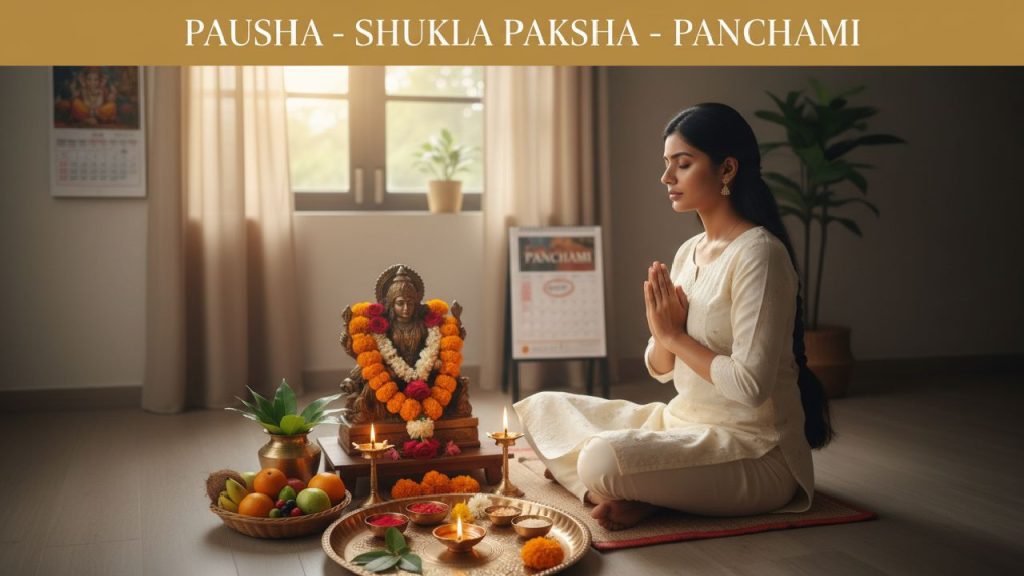
Panchami falls in the Shukla Paksha of Pausha, typically occurring between December and January. This period coincides with winter, a time of reflection, cleansing, and preparation for the year ahead. Pausha Panchami carries unique significance because it bridges the calm of winter with the spiritual energy of Shukla Paksha. Historically, communities have marked this day with ceremonies that honor knowledge, learning, and divine guidance, aligning their spiritual activities with seasonal and lunar cycles.
Overview of its spiritual and cultural significance
Spiritually, Panchami is celebrated for invoking wisdom and fostering devotion. The day encourages individuals to seek knowledge, perform acts of charity, and engage in self-discipline. Culturally, Panchami is woven into the fabric of Indian society through festivals, local rituals, and community gatherings. It serves as a reminder of the interconnectedness of nature, the lunar cycle, and human life. Celebrating Panchami is a way to honor tradition while nurturing personal growth and social harmony.
Connection to daily life and Hindu rituals
Panchami seamlessly integrates with daily life through religious observances, educational rituals, and family practices. Devotees often begin their day with prayers, pujas, or meditation, seeking blessings for prosperity and wisdom. The day also emphasizes respect for elders, teachers, and community leaders. Beyond spiritual practice, Panchami encourages mindfulness and ethical conduct, reminding individuals that every action, even in mundane routines, holds spiritual significance.
Understanding Shukla Paksha
Definition and duration of Shukla Paksha
Shukla Paksha, the bright fortnight of the lunar cycle, spans from the day after Amavasya to Purnima. This period is marked by the moon’s gradual increase in visibility, symbolizing growth, positivity, and enlightenment. Each day of Shukla Paksha carries unique energies, and Panchami, the fifth day, is particularly auspicious for rituals related to learning, prosperity, and spiritual advancement. The structured rhythm of Shukla Paksha enables devotees to align their personal and social activities with natural cycles, fostering harmony and balance in daily life.
Significance of waxing moon in Hindu tradition
In Hindu tradition, the waxing moon represents expansion, clarity, and spiritual ascent. Rituals performed during this phase are believed to yield better results, whether in personal development, education, or wealth creation. Panchami, occurring in Shukla Paksha, harnesses the positive energy of the growing moon, encouraging the pursuit of wisdom, learning, and self-improvement. Devotees often time their prayers and ceremonies to coincide with specific lunar phases to maximize spiritual and material benefits.
Difference between Shukla Paksha and Krishna Paksha
Shukla Paksha contrasts with Krishna Paksha, the waning moon phase that begins after Purnima and ends on Amavasya. While Shukla Paksha symbolizes growth, light, and positivity, Krishna Paksha is associated with reflection, introspection, and release. Observing Panchami in Shukla Paksha emphasizes action, learning, and accumulation of knowledge, whereas Krishna Paksha days focus on spiritual cleansing and letting go of negative energies. Understanding these distinctions allows devotees to plan rituals and spiritual practices effectively, aligning actions with lunar energy.
Impact of Shukla Paksha on religious observances
Religious observances during Shukla Paksha are often more fruitful and spiritually significant. Devotees perform pujas, meditation, and charitable acts, believing the growing moon amplifies their intentions. Panchami, situated within this phase, is ideal for rituals seeking wisdom, learning, and success. Many Hindu traditions emphasize starting new educational endeavors, purchasing auspicious items, or performing symbolic ceremonies during the Shukla Paksha to benefit from its positive influence.
Panchami’s Spiritual Significance
Worship of Goddess Saraswati and other deities
Panchami is intrinsically linked with Goddess Saraswati, the deity of knowledge, learning, and wisdom. Devotees offer prayers, flowers, and symbolic items to honor her, seeking guidance in educational and spiritual pursuits. Saraswati Puja often coincides with Panchami, especially in schools and cultural institutions, where children and adults alike engage in devotional activities. Beyond Saraswati, Panchami is also a day to honor other deities representing prosperity, wisdom, and protection, highlighting the interconnectedness of divine energies in everyday life.
Connection to knowledge, wisdom, and learning
Panchami encourages the pursuit of knowledge in both academic and spiritual realms. It is believed that prayers and observances on this day enhance mental clarity, critical thinking, and understanding of higher truths. Students, teachers, and scholars often perform rituals and study with devotion, seeking blessings for success and enlightenment. The day serves as a reminder that learning is a lifelong journey and that spiritual wisdom complements practical knowledge, helping individuals navigate life with insight and moral clarity.
Role in enhancing spiritual practices
The spiritual essence of Panchami lies in fostering devotion, discipline, and self-awareness. Meditation, chanting, and recitation of sacred texts performed on Panchami are believed to strengthen spiritual energies and deepen inner peace. Engaging in these practices encourages mindfulness, reduces stress, and cultivates a sense of purpose. Panchami serves as a spiritual checkpoint, reminding individuals to align thoughts, actions, and intentions with higher principles and universal truths.
Panchami is a day for self-reflection and devotion.
Panchami provides a dedicated opportunity for introspection, encouraging individuals to assess their actions, thoughts, and goals. Observing rituals and reflecting on personal growth fosters humility and gratitude. The day promotes devotion not only through external worship but also through internal alignment with values and ethical conduct. By combining ritualistic worship with self-reflection, Panchami strengthens the bond between individual spirituality and broader cultural traditions.
Mythological and Historical Context
Legends associated with Panchami
Several legends highlight the auspicious nature of Panchami. One popular story involves Goddess Saraswati bestowing wisdom upon her devotees on this day. Legends also link Panchami to victories of divine forces over negativity, emphasizing purification, protection, and the power of knowledge. These stories are passed down through generations, reinforcing the day’s importance in both mythological and cultural narratives. By understanding these legends, individuals gain a deeper appreciation for the spiritual energies and lessons embedded in Panchami.
Historical references in Hindu scriptures
Ancient Hindu scriptures, including the Puranas and Vedas, mention Panchami in connection with knowledge, ritual purity, and religious observances. Texts describe precise methods for worship, fasting, and community gatherings, highlighting Panchami as a day that combines personal devotion with social harmony. Historical references also indicate that kings and scholars observed Panchami with ceremonies honoring education, arts, and spiritual development, creating a legacy that continues today.
Importance in ancient Hindu society
In historical contexts, Panchami served as a focal point for community, learning, and spiritual alignment. Schools and gurukuls observed Saraswati Puja and educational rituals on this day, emphasizing moral, intellectual, and spiritual development. Festivals, fairs, and temple ceremonies coincided with Panchami, allowing society to reinforce cultural values, transmit knowledge, and foster ethical behavior. Its observance demonstrated the integration of spiritual practice into everyday life and community cohesion.
Stories emphasizing Panchami’s auspiciousness
Various folk tales and regional narratives celebrate Panchami’s auspicious qualities. Stories often highlight blessings received by devotees, such as enhanced learning, financial prosperity, or resolution of challenges. These narratives strengthen the cultural and spiritual significance of Panchami, illustrating the day as a bridge between devotion, practical benefits, and moral guidance. By celebrating these stories, communities preserve a sense of continuity, faith, and ethical living.
Rituals and Observances on Panchami
Standard pujas and offerings performed.
On Panchami, devotees perform specific pujas to honor Goddess Saraswati and other deities associated with wisdom and prosperity. Offerings often include flowers, fruits, sweets, and symbolic items like books and musical instruments. These rituals are conducted at homes, temples, and educational institutions, emphasizing both personal devotion and communal participation. Each step of the puja is performed with mindfulness, reinforcing spiritual intentions and aligning energies with auspicious cosmic forces.
Fasting traditions and their significance
Fasting on Panchami is a common practice, believed to purify the body, mind, and soul. Devotees may choose to abstain from certain foods or eat only light, sattvic meals. Fasting is not only an act of discipline but also a spiritual exercise, promoting self-control, focus, and devotion. It symbolizes sacrifice for higher learning, moral clarity, and alignment with divine energies, enhancing the effectiveness of prayers and meditation performed on this day.
Special prayers for prosperity and knowledge
Panchami is an ideal day for performing prayers seeking wisdom, success in education, and prosperity in personal and professional life. Devotees recite mantras, read sacred texts, and engage in devotional songs to attract positive energy. Special attention is given to education, career, and skill development, reflecting the belief that divine blessings facilitate practical achievements alongside spiritual growth.
Community gatherings and temple rituals
Temples and communities organize special events, including mass pujas, cultural programs, and charitable activities on Panchami. These gatherings foster a sense of unity, shared devotion, and social responsibility. Temple rituals often include collective chanting, processions, and educational activities for children and adults, reinforcing both spiritual learning and cultural continuity. Participation in community observances enhances personal devotion while strengthening social bonds.
Cultural and Social Importance
Panchami in regional festivals and fairs
Across India, Panchami is celebrated with distinct regional customs that reflect local culture and traditions. In West Bengal, it is closely associated with Saraswati Puja in schools and colleges, where students worship books, pens, and musical instruments. In Maharashtra, Pausha Panchami is celebrated with fairs and temple gatherings, bringing communities together in devotion and celebration. These festivals highlight the deep connection between Panchami and cultural identity, making the day not only spiritually significant but also socially vibrant. Communities preserve age-old rituals, folk songs, and artistic performances, ensuring that the cultural essence of Panchami continues through generations.
Influence on arts, music, and cultural practices
Panchami plays a vital role in promoting arts, music, and education. Traditional dances, musical recitals, and literary events often coincide with this day, as Goddess Saraswati is considered the divine source of creativity and knowledge. Artists, musicians, and writers perform special prayers before starting new works, believing that Panchami blessings enhance creativity and skill. The day encourages the continuation of artistic heritage, emphasizing that spiritual observances can inspire practical achievements and cultural enrichment.
Family and social gatherings on Panchami
Panchami encourages families to come together in devotion and learning. Rituals often involve collective prayers, meals, and the sharing of knowledge, fostering bonds across generations. Elders share stories, legends, and moral teachings with children, embedding cultural values and spiritual awareness in the younger generation. These gatherings also reinforce social cohesion, as neighbors and friends participate in communal celebrations, demonstrating the social harmony that Panchami rituals promote.
Celebrations in schools and educational institutions
Educational institutions take a central role in observing Panchami, particularly Saraswati Puja, which marks the day as one dedicated to learning and knowledge. Students and teachers actively participate in prayer ceremonies, classroom decorations, and educational activities. Schools often organize cultural programs, quiz competitions, and art exhibitions, blending devotion with education. This practice highlights Panchami’s enduring role in promoting both spiritual and intellectual growth in society.
Panchami in Education and Learning
Significance for students and scholars
For students and scholars, Panchami represents a day of divine inspiration and academic blessings. It is believed that worshiping Goddess Saraswati on this day enhances learning abilities, concentration, and wisdom. Students often begin new studies, prepare for examinations, or engage in creative pursuits, seeking divine support for success. Panchami serves as a reminder that knowledge is sacred and that disciplined learning, combined with devotion, leads to holistic development and long-term achievement.
Saraswati Puja and its rituals
Saraswati Puja is the central observance of Panchami, involving the ceremonial worship of books, musical instruments, and art supplies. Devotees perform rituals at home, in schools, and in temples, offering flowers, fruits, and prayers to seek the goddess’s blessings. The puja often begins with chanting sacred mantras, lighting lamps, and invoking the goddess’s guidance for learning and creativity. These rituals not only foster spiritual connection but also instill a disciplined approach to education and personal growth.
Offering prayers to enhance knowledge
On Panchami, prayers are directed towards enhancing intelligence, memory, and comprehension skills. Mantras and hymns dedicated to Goddess Saraswati are recited, creating an atmosphere of spiritual focus. This practice encourages individuals to respect knowledge and pursue it diligently. By dedicating time to reflection, meditation, and prayer, learners are believed to align their mental energies with divine wisdom, improving their ability to absorb, understand, and apply knowledge effectively.
Educational institutions’ role in observing Panchami
Schools and universities actively promote Panchami celebrations as a means of blending education with spirituality. They organize assemblies, cultural programs, and competitions to engage students in learning and devotion simultaneously. Teachers encourage discussions on mythology, history, and moral values associated with Panchami, creating an environment where knowledge is honored and shared. The observance of Panchami in educational institutions highlights the integration of spiritual and intellectual growth in contemporary learning environments.
Astrological and Lunar Implications
Influence of Panchami on human life according to astrology
In Vedic astrology, Panchami is considered highly favorable for initiating essential tasks, especially those related to learning, creativity, and prosperity. Astrologers often recommend performing rituals on this day to attract positive planetary influences, enhance mental clarity, and remove obstacles in personal and professional life. Panchami is believed to harmonize cosmic energies, aligning human efforts with celestial forces for maximum benefit.
Importance of lunar phases in determining auspicious timings
The waxing phase of the moon during Shukla Paksha amplifies the auspiciousness of Panchami. Lunar phases are central to Hindu timekeeping, as each phase carries distinct energy patterns. The fifth day in Shukla Paksha is considered ideal for spiritual and intellectual pursuits because the growing moon symbolizes expansion, enlightenment, and positive transformation. Observing rituals in alignment with the moon’s phase enhances the effectiveness of prayers, meditation, and ceremonial activities.
Panchami is a day for meditation and spiritual growth.
Panchami encourages focused meditation and self-reflection. Devotees often use this day to engage in mindful practices, chanting, and recitation of sacred texts. The energy of the waxing moon is believed to support concentration, inner peace, and spiritual insight. Incorporating meditation into Panchami rituals helps individuals connect with higher consciousness, fostering clarity, wisdom, and balanced decision-making in both personal and professional life.
Beliefs around luck, prosperity, and well-being
Panchami is also associated with enhancing prosperity, well-being, and overall luck. Devotees perform pujas and charitable acts, believing that such practices attract positive energy and blessings. By combining spiritual devotion with practical actions, individuals can harmonize material success with ethical and spiritual principles. Panchami thus serves as a holistic observance, promoting spiritual growth, personal development, and societal harmony.
Modern-Day Relevance of Panchami
How Panchami is observed in urban areas
In modern cities, Panchami continues to hold spiritual and cultural relevance. Urban communities celebrate Saraswati Puja in homes, schools, and cultural centers. Devotees adapt rituals to contemporary lifestyles while retaining traditional elements such as offerings, prayers, and educational ceremonies. The celebration may include digital participation through online prayers or virtual school events, ensuring that traditions remain accessible and meaningful despite modern challenges.
Digital and online celebrations
With increasing digital connectivity, Panchami celebrations have expanded online. Virtual Saraswati Puja events, webinars on spiritual teachings, and live-streamed temple rituals allow devotees to participate from anywhere. These adaptations demonstrate the resilience of tradition, enabling communities to maintain spiritual observances while embracing technology. Online platforms also facilitate the sharing of knowledge, folklore, and cultural stories associated with Panchami, broadening engagement and understanding.
Maintaining traditions in contemporary lifestyles
Panchami serves as a bridge between traditional values and modern life. Families balance work, education, and urban routines while observing rituals, teaching children the significance of devotion, and learning from one another. Incorporating symbolic gestures such as home altars, offerings, and prayers into daily life ensures that spiritual principles are maintained even amidst busy schedules. Modern observances highlight the adaptability of Panchami, preserving its essence while embracing contemporary practices.
Balancing spiritual and social aspects in modern life
Observing Panchami today emphasizes both personal devotion and community involvement. Social gatherings, educational activities, and cultural programs integrate spiritual values into practical life. By participating in Panchami rituals, individuals foster a sense of connectedness, ethical responsibility, and cultural awareness. This balance ensures that the day remains spiritually enriching and socially meaningful, reinforcing the timeless relevance of Panchami in modern life.
Divine Insights & Key Takeaways
Summary of Panchami’s spiritual, cultural, and social significance
Panchami in the Shukla Paksha of Pausha is a day rich with spiritual energy, cultural heritage, and social importance. From worshiping Goddess Saraswati to participating in community rituals, the day emphasizes learning, devotion, and harmony. Panchami represents a convergence of cosmic, social, and personal energies, encouraging individuals to engage in spiritual reflection, ethical living, and educational pursuits.
Encouragement to observe Panchami rituals
Observing Panchami rituals, whether through pujas, meditation, or community participation, fosters personal growth, mental clarity, and spiritual well-being. Devotees are encouraged to embrace the day as an opportunity to strengthen knowledge, wisdom, and moral values. Small acts, such as offering prayers or engaging in educational activities, contribute to meaningful spiritual alignment.
Reflection on the importance of connecting with traditions
Panchami reminds us of the value of connecting with cultural and spiritual traditions. Through storytelling, rituals, and communal practices, the day offers a chance to honor heritage while nurturing contemporary relevance. Observing Panchami encourages mindfulness, gratitude, and respect for knowledge, fostering continuity between past wisdom and present life.
Closing thoughts on the lasting value of Panchami in Pausha
Panchami’s significance extends beyond ritual observance; it is a reminder of the harmony between cosmic forces, personal growth, and social responsibility. Celebrating Panchami helps preserve spiritual, cultural, and intellectual traditions. By participating consciously in these practices, individuals can experience lasting benefits in knowledge, devotion, and a more holistic balance in life.