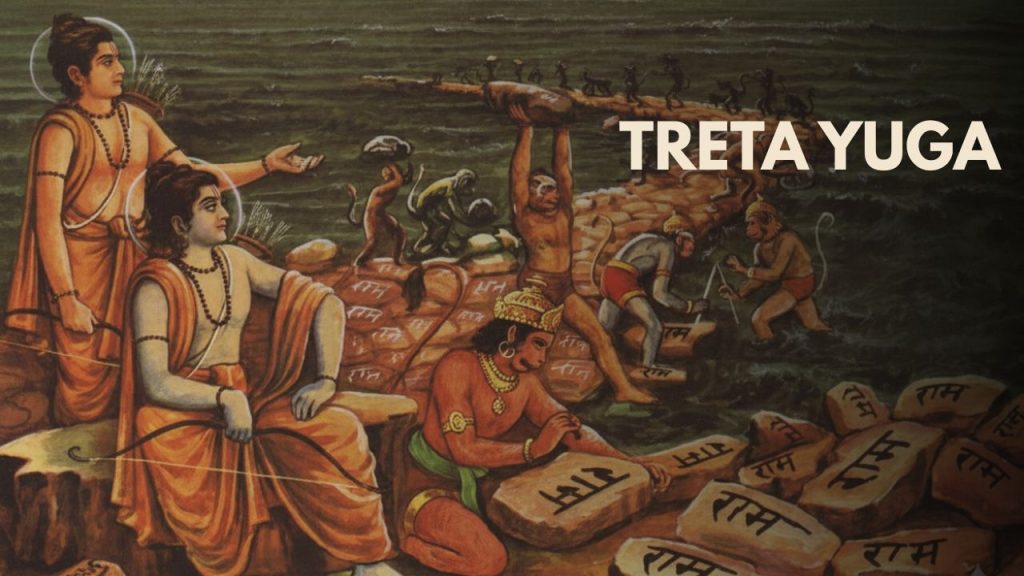
The Yugas, the great cycles of time in Hindu cosmology, offer profound insights into humanity’s evolution. These Yugas—Satya, Treta, Dvapara, and Kali—represent different phases in the world’s moral and spiritual development. Each Yuga has distinct characteristics, and the Treta Yuga holds a special place as a time of transition.
Treta Yuga: The Age of Rituals and the Advent of Epic Heroes
Satya Yuga the first and most virtuous era, is marked by purity, righteousness, and a deep c
onnection to the divine. As the cycle progresses, Treta Yuga emerges, signaling the first significant spiritual and moral integrity shift. The transition from Satya Yuga to Treta Yuga gradually erodes virtue, marking the beginning of a slow but steady decline from the purest state of human consciousness.
In Hindu cosmology, the Yugas follow a cyclical pattern, with each era growing progressively shorter and more materialistic. The Treta Yuga is the second Yuga in this cycle, and it lasts for a significant period, believed to be around 1.296 million years. In this age, dharma (righteousness) still plays an essential role but is no longer as absolute as in the Satya Yuga.
This blog post will explore Treta Yuga’s characteristics, key figures, events, and lessons. By understanding this age, we can better understand the cosmic progression and how it continues to influence our lives today.
What is Treta Yuga?
Treta Yuga often called “The Age of Three,” is a pivotal stage in the cosmic cycle. The word “Treta” literally translates to “three” in Sanskrit, symbolizing the reduction in the “legs” of Dharma, which is the foundation of righteous living. In Satya Yuga, Dharma is depicted as having four legs, representing purity, truth, self-control, and compassion. As we enter Treta Yuga, one of these legs diminishes, leaving Dharma to stand on only three. This subtle but significant decline signifies the start of moral degradation in human society.
The essence of Treta Yuga is a transition—away from the perfection of Satya Yuga and towards a world that begins to grapple with the emergence of desire, ego, and materialism. While humanity is still close to the divine, the purity that existed in the previous age becomes less attainable. Human beings begin to experience the early stages of ignorance and illusion, making pursuing spiritual truths more challenging.
Treta Yuga is significant in Hindu cosmology because it sets the stage for the appearance of some of human history’s most legendary heroes and epics. During this Yuga, the epic tale of Rama one of the most significant figures in Hindu tradition, unfolds. The Ramayana, the story of Rama’s life, is a timeless narrative that encapsulates the ideals of righteousness, devotion, and the cosmic battle between good and evil.
Treta Yuga can be seen as a mirror to our world—a reflection of the delicate balance between virtue and vice. While we have moved away from the ideals of the past, there is still hope and opportunity to restore order and righteousness. Treta Yuga’s heroes offer guidance on navigating the complex human experience.
The Role of Dharma in Treta Yuga
Dharma, which represents the moral and ethical order of the universe, plays a central role in the structure of Treta Yuga. However, in this era, it begins to decline in its fullness compared to the earlier Satya Yuga. In Satya Yuga, Dharma is said to be supported by four legs, ensuring the stability and harmony of the world. As the Treta Yuga begins, one of these legs diminishes, symbolizing the weakening of moral integrity and spiritual consciousness.
While Dharma still exists in Treta Yuga, it is now upheld by only three legs—truth, self-control, and compassion. This reduction signifies a shift from the absolute purity and virtuous behavior that defined Satya Yuga. It marks the beginning of a more complex and turbulent world where humans face the challenges of ego, materialism, and desire. These forces begin to cloud the once-clear understanding of what is right and wrong.
Despite this decline, the importance of Dharma is not lost in Treta Yuga. It remains the guiding force, but now it requires conscious effort from individuals and society to uphold it. The divine incarnations during this Yuga, particularly Lord Rama are born to restore Dharma when it is at risk of being overtaken by evil forces. Rama’s journey in the Ramayana symbolizes the relentless fight to restore Dharma even in an age of decline.
In Treta Yuga, the role of Dharma becomes even more personal and intricate. Individuals must grapple with their moral dilemmas, choosing between self-interest and the greater good. The Yuga teaches us that while Dharma may be compromised at times, it is always available as a compass to guide us back to righteousness.
Ultimately, the lesson from Treta Yuga is that while the world may seem to decline in virtue, the principles of Dharma still hold power. They are ever-present, waiting for individuals and society to reclaim them.
Length and Structure of Treta Yuga
Treta Yuga is a remarkable period in the grand cosmic cycle, lasting 1.296 million years according to traditional Hindu calculations. However, the length of each Yuga is measured not just in years but also in humanity’s spiritual quality and progression. In Treta Yuga, the divine order is still intact, but the inherent balance of the universe begins to shift.
One of the most notable aspects of the Yugas is their cyclical nature. Each Yuga represents a different stage of human evolution, both morally and spiritually. Treta Yuga is a crucial link between the purity of Satya Yuga and the moral decay that will characterize Dvapara Yuga. The length of this period allows for the flourishing of civilization and culture but also sets in motion the gradual decline that will become more pronounced in the next Yuga.
Throughout Treta Yuga, human beings experience a growing sense of self-awareness, which inevitably leads to the rise of material desires, ego-driven behavior, and an increasing disconnection from the divine. This gradual decline in spiritual and moral integrity is one of the most defining features of this period. Unlike Satya Yuga, where humans lived in perfect harmony with nature and the divine, Treta Yuga introduces the complexities of human nature, with both good and evil existing side by side.
The cycle of Yugas teaches that no period is static. There is always change, whether it’s the decline in virtue, the rise of heroes, or the reassertion of cosmic order through divine interventions. As Treta Yuga progresses, the seeds of humanity’s eventual decline begin to take root, setting the stage for Dvapara Yuga and, ultimately, Kali Yuga—the age of the most significant spiritual degradation.
Key Deities and Divine Manifestations in Treta Yuga
Treta Yuga is characterized by the manifestation of some of the most essential divine figures in Hinduism. Among these, Lord Vishnu’s incarnation as Rama stands out as the most significant, as it represents the divine intervention to restore order in the face of rising evil. Lord Vishnu incarnates in the human form of Rama to fight the demon king Ravana who symbolizes adharma (unrighteousness). Rama’s life and battle against Ravana form the essence of the Ramayana a central text in Hindu mythology that highlights the principles of virtue, duty, and justice.
Alongside Rama, Sita his devoted wife, plays a key role in Treta Yuga. Sita is not only a symbol of purity and strength but also represents the divine feminine. Her story emphasizes the importance of loyalty, sacrifice, and the deep bond between husband and wife. Sita’s unwavering faith in her husband, even during their trials in exile, teaches us the value of trust and devotion.
Although less prominently featured in Treta Yuga than in other Yugas, Lord Shiva is crucial in maintaining the cosmic balance. Shiva’s influence during this time is subtle but powerful, often depicted as the protector and destroyer of evil forces, ensuring the universe remains in equilibrium.
Additionally, the rise of rituals and sacrifices became more pronounced during this period. The Yajnas or sacrificial rituals guided by sages and priests, take on greater significance to appease the gods and maintain the balance of Dharma. While intended to connect humans with the divine, these rituals also reflect the growing reliance on external practices rather than inner spiritual awakening.
Key Mythological Events in Treta Yuga
Treta Yuga is most renowned for Ramayana the epic story of Lord Rama and is one of the greatest heroes in Hindu mythology. Rama’s journey from prince to exile and back again serves as a template for understanding how to live a righteous life amidst adversity, temptation, and moral challenges.
The Ramayana narrates how the demon king Ravana driven by arrogance and unchecked desire, kidnaps Sita Rama’s wife. This event sets in motion one of the most significant battles in Hindu mythology—the battle between good and evil. The abduction of Sita not only tests Rama’s patience and devotion but also his commitment to dharma (righteousness) and his duty as a husband, son, and ruler.
The Battle of Lanka the climactic confrontation between Rama and Ravana, is more than a physical war. It symbolizes the cosmic battle between good and evil, righteousness and unrighteousness. Throughout the battle, Rama’s allies, including the mighty Hanuman the vanar (monkey) god, display extraordinary strength, devotion, and courage. Hanuman’s unwavering devotion to Rama, his miraculous feats, and his role in finding Sita in Lanka embody the ideals of devotion, selflessness, and sacrifice, which are central to the narrative.
The fall of Ravana marks the restoration of dharma and cosmic order. Ravana’s arrogance, disregard for dharma, and abuse of power eventually led to his downfall. His defeat represents the victory of divine justice and the power of righteousness, reinforcing the age-old message that evil, no matter how powerful, will eventually be overcome.
The story of the Ramayana continues to be a source of spiritual guidance for millions. Its lessons on virtue, duty, devotion, and the importance of moral conduct are as relevant today as they were in ancient times. The Ramayana is not just a tale of divine intervention but also a reflection of the struggles we face in our own lives and how we can overcome them by adhering to dharma.
Human Characteristics and Moral Decline in Treta Yuga
In Treta Yuga, human beings experience a noticeable decline in their moral and spiritual stature. While the world is still governed by dharma, the purity and harmony of Satya Yuga are slowly fading away. Human beings begin to develop material desires, and the complexities of ego and self-interest take root. This decline is not sudden but gradual, signaling the beginning of a shift in human consciousness.
During this time, people begin to struggle with their inner conflicts. The virtues defining the previous Yuga—truth, nonviolence, and self-control—begin to lose prominence. As a result, society starts to experience the rise of greed, envy, and pride. These traits become more prominent, and people’s actions are increasingly driven by personal gain rather than the greater good.
Despite this moral decline, the essence of human nature remains essentially good. People are still capable of great acts of devotion, courage, and righteousness, as seen in the stories of Rama Sita and Hanuman. These figures represent honor, loyalty, and virtue ideals that inspire generations. However, their challenges are more complex, reflecting the evolving nature of human behavior as material desires take hold.
The human condition during Treta Yuga reminds us of each individual’s constant battle between good and evil. The path to spiritual liberation becomes more challenging, and pursuing self-realization requires more significant effort. The decline in virtue seen in this Yuga offers an important lesson: no matter how much the world changes, the core of human nature remains connected to dharma, waiting for individuals to rediscover their inherent goodness.
The Rise of Rituals and Religious Practices
In Treta Yuga, the importance of rituals and sacrifices, or Yajnas becomes more pronounced. These rituals were necessary for maintaining cosmic order and invoking the gods’ blessings. While the spiritual connection to the divine is still strong, people begin to rely more on external practices—such as sacrifices, offerings, and temple worship—rather than inner spiritual disciplines, marking the beginning of a more ritualistic approach to religion.
The Yajnas were elaborate ceremonies that involved offerings to fire, chants, and mantras designed to appease the gods. The role of priests and sages became more crucial in guiding society through these rites. They were seen as the intermediaries between humans and the divine, helping to ensure that the cosmic balance was maintained. As the Yugas progressed, the complexity of these rituals increased, and the emphasis on performing them with precision became even more vital.
Temples began to rise as centers of worship, and pilgrimages to sacred sites became more common. These practices, which emphasized devotion and adherence to ritual, were thought to provide protection, spiritual upliftment, and blessings. The sacred texts of the time also began to be compiled, laying the foundation for future philosophical and theological thought.
While the Yajnas and rituals were designed to maintain cosmic harmony, they also shifted away from the direct, experiential connection to the divine common in Satya Yuga. People began to place more faith in the external forms of worship rather than the inner spiritual practices that had defined the previous era. This shift would eventually evolve into more structured forms of religion in later Yugas. Still, the essence of ritual worship plays a significant role in Hindu spiritual practices today.
Treta Yuga’s Impact on Society and Governance
The transition from the idealistic Satya Yuga to the Treta Yuga also marks significant changes in human society and governance. During Satya Yuga, kings and rulers were embodiments of dharma—ruling with wisdom, fairness, and divine guidance. In Treta Yuga, however, the erosion of virtue begins to affect the structure of kingdoms and societies.
In Treta Yuga, the concept of divine kingship comes to the forefront. Rulers are seen not only as political leaders but as dharma protectors responsible for upholding justice and moral order in society. Lord Rama considered the ideal king, exemplifies the qualities of leadership that Treta Yuga values—righteousness, honor, and duty. He is both a warrior and a spiritual leader and his reign is marked by fairness and commitment to his people. His journey through exile and return to his kingdom underscores the responsibility that kings and rulers bear to protect the well-being of their subjects.
Governance in Treta Yuga was also more centralized. The rise of monarchies and kingdoms during this period brought an organized administration, justice, and law system. While the ideal of a ruler as a dharma protector remained strong, the growing moral and spiritual decline meant that some rulers, like Ravana, could not live up to their divine responsibilities. Ravana’s reign in Lanka is a perfect example of a king who, though immensely powerful, is ultimately undone by his inability to adhere to dharma.
The role of kings in Treta Yuga reminds us that leadership is not only about power but also about upholding moral integrity and divine principles. Like Ravana, rulers who failed to uphold dharma brought destruction upon themselves and their kingdoms. Thus, the governance structure in Treta Yuga emphasizes the importance of righteous leadership and the need for rulers to be moral exemplars.
The Concept of Virtue and Evil in Treta Yuga
The dynamic tension between virtue (dharma) and evil (adharma) forms a central theme in Treta Yuga. As the purity of Satya Yuga fades, the forces of good and evil manifest more distinctly in the world. While dharma still holds sway, the rise of ego, materialism and attachment leads to a shift in human behavior. It marks the beginning of a more complex struggle between good and evil, which continues to play out in the stories of Treta Yuga.
One of the key manifestations of evil in Treta Yuga is Ravana the demon king of Lanka. Ravana, though powerful, learned, and devout in his way, is blinded by his arrogance and greed. His abduction of Sita catalyzes the cosmic battle that unfolds in the Ramayana. Ravana’s character exemplifies how unchecked ego and attachment to material desires can lead even the most potent individuals astray. His downfall is a poignant reminder that evil can never permanently overpower righteousness, no matter how formidable.
In contrast, Rama the hero of the Ramayana, embodies dharma. His life, marked by sacrifice, devotion, and unwavering commitment to truth, is the ideal against which evil is measured. Through Rama’s actions, we learn that virtue is not always easy or immediate—it often requires great personal sacrifice. His exile, the long search for Sita, and the eventual war against Ravana represent the necessary struggles that one must face to restore cosmic order.
The cosmic battle between Rama and Ravana is not just a physical confrontation; it manifests the ongoing conflict within all human beings. The Ramayana teaches us that the forces of good and evil are constantly in flux and that personal virtue is required to tip the balance in favor of righteousness. The concept of karma is deeply tied to this struggle—virtuous or evil actions will eventually lead to consequences, shaping the destiny of individuals and societies alike.
In the larger scheme of things, the moral decline witnessed in Treta Yuga is not seen as a final victory for evil but rather as part of a cosmic cycle. Even though evil appears to gain ground, dharma ultimately triumphs, reinforcing the timeless lesson that righteousness will always prevail.
The Decline of Spiritual Powers in Treta Yuga
As Treta Yuga unfolds, one of the significant changes is the decline of spiritual and supernatural powers. In Satya Yuga, humans were deeply connected to the divine and could achieve remarkable feats through spiritual practices. This connection, however, weakens in Treta Yuga. The power of meditation, self-discipline, and direct divine connection becomes more challenging to attain, and human beings begin to rely more on external rituals, such as the Yajnas (sacrificial rites), to maintain their connection with the gods.
The characters of the Ramayana reflect the decline in spiritual potency. Despite being an incarnation of Lord Vishnu Rama faces many trials that test his physical and moral strength. His devotion to dharma, though unwavering, does not make his journey easy. Similarly, Sita’s purity and devotion to Rama are constantly tested, showing how even the most virtuous beings must endure significant challenges in a world where spiritual powers are diminished.
The decline in spiritual powers also mirrors the rise of materialism and the growing attachment to the physical world. As people look for divine intervention in their worldly affairs, their focus shifts from self-realization to the performance of external rituals and sacrifices. This shift marks a subtle but essential change in the relationship between humans and the divine. While rituals and external practices are still valuable and essential for maintaining dharma, they no longer provide the direct, unmediated experience of the divine that was possible in Satya Yuga.
In this context, the role of the priests, sages and spiritual teachers becomes more pronounced. They act as intermediaries between the divine and the human realm, guiding individuals in their spiritual practices. However, the increasing reliance on external rituals instead of inner spiritual development foreshadows the growing spiritual challenges in the future Yugas.
Despite the decline in spiritual powers, Treta Yuga teaches that pursuing spiritual growth and connection with the divine is still possible. The spiritual journey may be more complex and require more discipline, but the rewards of dharma, righteousness, and devotion remain accessible to those who seek them.
Treta Yuga and the Human Evolution
Treta Yuga marks a significant phase in the evolution of human consciousness. The purity and spiritual clarity of Satya Yuga are slowly replaced by more complex emotions, desires, and mental faculties. In Treta Yuga, humans become more aware of their individuality, and this growing sense of self leads to the development of ego, material desires and attachment.
This shift is seen in the way characters in the Ramayana evolve. Rama and his companions—such as Lakshmana, Hanuman and others—represent various aspects of human evolution. They embody virtues like loyalty, bravery, and devotion but also grapple with personal challenges, making them relatable to human beings of all ages. The emotional depth in the relationships between characters—such as Rama’s relationship with his father, his exile, and his unwavering love for Sita—reflects the growing complexity of human emotions and the intricate nature of personal identity.
Human evolution in this yuga includes the development of culture, language and knowledge. People begin to create more complex societies, develop governance systems, and establish traditions and rituals that will continue to shape future generations. Knowledge is increasingly passed down through the written word, with the Ramayana and other texts beginning to take shape as repositories of wisdom and moral guidance. In this sense, Treta Yuga bridges the highly spiritual age of Satya Yuga and the more materialistic age of Dvapara Yuga.
Human evolution in Treta Yuga teaches us that the human experience is a constant journey of growth and transformation. While the ideal state of purity may be lost, individuals can still evolve spiritually through devotion, righteousness, and moral courage. Despite their challenges, the characters of Treta Yuga show us that the human potential for growth and divine connection is ever-present, waiting to be realized.
Treta Yuga’s Relationship with Other Yugas
The Yugas are not isolated periods but are interconnected in a grand, cyclical process of cosmic evolution. Treta Yuga represents a bridge between the pure, spiritually vibrant Satya Yuga and the morally complex and spiritually challenging Dvapara Yuga. While Satya Yuga is characterized by truth, wisdom, and spiritual purity, Treta Yuga marks the beginning of a slow decline as human beings engage more deeply with material desires and ego.
In Treta Yuga, the decline in spiritual clarity is evident but still manageable. The people of this era are capable of great deeds of virtue and heroism, as seen in Rama’s life. However, the cosmic order starts to show signs of strain. The foundation of dharma is still strong, but the increasing complexity of human nature makes it harder to maintain balance.
Treta Yuga is thus a transition period—it prepares humanity for the challenges that will emerge in Dvapara Yuga, where spirituality is further obscured by ego, materialism, and technological advancement. The Ramayana as an epic of the Treta Yuga, teaches essential lessons about kings’ responsibilities, the importance of dharma, and the struggle between good and evil, all of which are crucial for the upcoming Yugas.
While Treta Yuga is a time of spiritual decline and opportunity, it provides valuable lessons that resonate across all the Yugas. Each Yuga is connected, forming a continuous cycle of cosmic evolution that teaches us the eternal principles of dharma, karma, and divine intervention.
The Importance of Family and Social Structure in Treta Yuga
Family and social structures in Treta Yuga are of immense importance, as they are viewed as essential for maintaining society’s moral fabric. The Ramayana is rich with depictions of family values and each member’s roles within the larger societal structure. Rama’s relationship with his father, King Dasharatha his brother Lakshmana and his wife, Sita illustrates the ideal family and social order dynamics.
The concept of dharma within the family unit is one of the key themes of the Ramayana. Rama’s willingness to exile himself to honor his father’s promise reflects the importance of respecting one’s duties and relationships. Similarly, despite adversity, Sita’s devotion to Rama underscores the strength of familial bonds and the importance of mutual respect and sacrifice within relationships.
Socially, Treta Yuga marks a time when kings and sages played pivotal roles in guiding and protecting the community. The role of the king is not just a political one but also a spiritual one, as the king is expected to uphold dharma and ensure the well-being of his people. The ideal ruler in Treta Yuga leads by example, like Rama, whose reign is marked by justice, fairness, and devotion to dharma.
Therefore, the family is not just a social unit but also a moral compass in Treta Yuga. The lessons from the Ramayana emphasize the importance of upholding dharma in all relationships—whether between parents and children, spouses, or rulers and their subjects. This theme continues to resonate today, as the concept of family and social responsibility remains central to many cultures worldwide.
The Role of Knowledge and Wisdom in Treta Yuga
In Treta Yuga, knowledge and wisdom are still revered, but how they are accessed and transmitted begins to evolve. This period marks the gradual transition from the profound, direct spiritual experiences of Satya Yuga to the more structured and formalized learning and teaching methods. The spiritual clarity of Satya Yuga, where humans could directly connect with the divine through meditation and insight, begins to fade, and knowledge becomes more codified.
Ancient texts, scriptures and philosophies began to be systematized during this time. The great epics, including the Ramayana, serve as stories and repositories of profound wisdom. These epics encapsulate ethical dilemmas, the nature of duty (dharma), and the cosmic law that governs all beings. The narratives of Rama, Sita and their companions are filled with lessons about the importance of self-control, moral integrity, and the pursuit of righteousness, all resonating across generations.
The sages and rishis of Treta Yuga play an essential role in preserving and transmitting this knowledge. They are the custodians of wisdom, using oral traditions and written scriptures to pass down spiritual teachings. As the human connection to the divine becomes more indirect, the role of these spiritual guides grows in importance. Their wisdom is not just academic but also practical—helping individuals navigate the complexities of life with a sense of higher purpose.
However, as spiritual powers begin to wane in the Treta Yuga, the pursuit of knowledge shifts toward rituals and scriptures rather than intuitive or meditative wisdom. The focus on external practices, such as performing Yajnas or worshipping at temples, becomes more prevalent, signalling the beginning of a shift toward formalized religion that will fully blossom in the later Yugas. Yet, wisdom still retains its significance, although it is now tied to both sacred knowledge and the performance of rituals.
The epics, especially the Ramayana, demonstrate how wisdom should be used in real-world situations. Rama’s actions throughout his life show that knowledge is not merely for intellectual understanding but is meant to be applied in everyday life to uphold dharma. The challenges Rama and his allies face provide practical examples of human nature’s complexities, showing how knowledge must be tempered with compassion, action, and responsibility.
While still revered in Treta Yuga, knowledge takes on a more practical, ritualistic form. It is passed down through structured teachings, preserving its sanctity but losing some of the direct, divine connection that characterized the previous era.
The Role of Karma in Treta Yuga
Karma, the principle of cause and effect, is a central theme in Treta Yuga. In this age, actions—whether righteous or sinful—begin to have more pronounced consequences, as the purity of Satya Yuga has given way to a world where moral clarity is more challenging to maintain. Understanding karma is key to understanding how individuals in Treta Yuga navigate their lives as their choices shape their present and future realities.
In Treta Yuga, the consequences of one’s actions are often manifest more immediately and tangibly than in the subsequent Yuga. The Ramayana is filled with examples of karma in action, as the lives of Rama, Sita, Ravana and others unfold in a complex web of actions and reactions. For instance, the tragic events in Ravana’s life—including his kidnapping of Sita—are seen as the fruits of his accumulated negative karma, resulting in the eventual destruction of his kingdom and his demise.
Rama’s life also demonstrates how karma works in the world of Treta Yuga. Though painful and unjust, his exile is not an arbitrary event but part of a larger cosmic plan. His suffering results from his father’s vow and the complex relationships between duty (dharma), destiny (karma), and free will. Despite the personal cost, Rama’s unwavering commitment to dharma is a model of how to respond to the karmic consequences of one’s actions.
The story of Hanuman is another powerful example of karma in Treta Yuga. Hanuman’s boundless devotion to Rama manifested through his heroic deeds, creates a positive karmic legacy that leads to divine blessings and eventual deification. His role as a symbol of devotion and loyalty reinforces the idea that positive karma can be cultivated through selfless service to others and dedication to higher principles.
Karma in Treta Yuga operates within the framework of cosmic justice. Actions driven by adharma (unrighteousness) lead to suffering and destruction, while actions based on dharma result in eventual reward and restoration of balance. Though more complicated in Treta Yuga, this law of karma continues to govern all beings’ lives, ensuring that the forces of good and evil remain in balance.
The events in Treta Yuga demonstrate how righteousness and unrighteousness shape individual lives and societies. Ultimately, the law of karma teaches that every action has a consequence and that dharma, while sometimes challenging to uphold, leads to lasting peace and justice.
The Symbolism of Rama’s Exile and Return
The exile of Rama is one of the most poignant and symbolic events in the Ramayana. It is a powerful metaphor for human trials and moral tests in Treta Yuga. Rama’s exile is not just a physical journey but a spiritual one, representing the challenges and hardships individuals must endure to realize their true purpose.
Rama’s exile, which results from his father Dasharatha’s vow to his wife Kaikeyi is a direct consequence of dharma. Rama’s acceptance of the exile without question highlights his unwavering commitment to his father’s word, illustrating the importance of loyalty, respect, and duty within family structures. His decision to leave the kingdom and go into the forest, despite being wronged, underscores his profound understanding of the nature of dharma. By honouring his father’s vow, Rama fulfills his duty and upholds the cosmic order.
The exile also represents the spiritual journey that each individual must undertake. Just as Rama must face trials and tribulations during his exile, so must every soul undergo a journey of suffering, self-discovery, and transformation. The forest where Rama spends much of his exile symbolizes the wilderness of the human mind, where the struggles of desire, ego, and moral conflict must be confronted and transcended.
Rama’s return to Ayodhya after defeating Ravana and rescuing Sita represents the triumph of dharma. His return is not merely the restoration of a king to his throne but the re-establishment of cosmic harmony. The journey from exile to return symbolizes the cyclical nature of life: We all experience periods of struggle and loss, but through perseverance and commitment to righteousness, we can ultimately return to a place of peace, balance, and divine grace.
Rama’s exile and eventual return also have more profound spiritual implications. The exile symbolizes the soul’s journey away from its divine origin, plunged into the material world to face life’s challenges. The return represents the soul’s eventual realization of its divine nature after navigating the challenges and hardships of existence. In this sense, Rama’s story is a universal tale of spiritual awakening, the soul’s journey from ignorance to enlightenment, and its eventual return to the divine source.
The Environmental and Cosmic Changes in Treta Yuga
Like the other Yugas, Treta Yuga is a time of cosmic change. As human consciousness declines, so too does the natural world. While the early part of Treta Yuga retains much of the harmony of Satya Yuga, the environmental imbalance begins to show. Human actions increasingly affect the world’s forests, rivers, and animals. This environmental decay mirrors the moral and spiritual decline within humanity.
In the Ramayana, the forest where Rama spends much of his exile symbolizes humans’ external and internal challenges. The deterioration of nature in Treta Yuga reflects the increasing difficulty of maintaining harmony between humanity and the natural world. The rise of material desires greed, and self-interest in Treta Yuga leads to a disconnection from the natural environment, causing imbalance and suffering.
At the cosmic level, the forces of dharma and adharma shape the universe’s fate. The decline of dharma in the Treta Yuga contributes to cosmic disharmony eventually corrected by the divine interventions of gods like Vishnu, who incarnate as Rama. The ultimate victory of dharma in the Ramayana restores balance to the human world and the cosmos, underscoring the interconnectedness of spiritual, moral, and environmental harmony.
The Legacy of Treta Yuga in Modern Spirituality
The stories and teachings of Treta Yuga continue to resonate deeply in modern spiritual practices. The Ramayana with its timeless lessons on dharma, devotion, and the struggle between good and evil, remains a central text in Hindu spirituality and beyond. Its characters, especially Rama, Sita and Hanuman serve as archetypes of virtue, devotion, and sacrifice, offering guidance to those seeking to live a righteous and meaningful life.
In contemporary spirituality, the lessons of Treta Yuga encourage us to balance material and spiritual pursuits. The rise of materialism and ego-driven desires in Treta Yuga serves as a cautionary tale for modern society, reminding us of the importance of humility, compassion, and responsibility. The practices of ritual worship, meditation, and the pursuit of knowledge that emerged in Treta Yuga continue to shape modern spiritual practices, especially in yoga, mantras and rituals.
The symbolism of Rama’s exile and return offers profound insights into human existence. It reminds us that hardship is often a necessary part of the spiritual journey and that perseverance and commitment to righteousness can overcome life’s challenges and ultimately find peace and fulfillment. Treta Yuga’s legacy, encapsulated in the stories of its great heroes and divine incarnations, continues to guide us toward a life of purpose, balance, and harmony.
Lessons from Treta Yuga for Today’s World (Continued)
As we reflect on the wisdom of Treta Yuga, we can draw meaningful parallels to our own lives. Despite living in an age dominated by technology, fast-paced living, and increasing materialism, the core lessons from Treta Yuga remain timeless. The decline in purity from Satya Yuga to Treta Yuga illustrates the dangers of forgetting one’s spiritual and ethical responsibilities in pursuing worldly desires. Today, we, too, find ourselves in a constant struggle to balance our material aspirations with spiritual growth and moral integrity.
Treta Yuga reminds us that dharma or righteous duty, is not just an abstract concept but a guiding principle that applies to every aspect of our lives. Whether it’s our role as family members, professionals, or citizens, dharma provides the compass that helps us make decisions that honor our integrity and the collective good. The examples of Rama and Sita who upheld their duties despite immense hardships, inspire us to maintain our commitment to righteousness, even when faced with personal sacrifice or adversity.
Karma the law of cause and effect, is also relevant today. In the world of Treta Yuga, every action had its consequences, as seen in the lives of figures like Ravana whose arrogance and adharma (unrighteousness) led to his downfall, and Hanuman whose unwavering devotion to Rama resulted in divine blessings and spiritual elevation. Similarly, our good and bad actions create ripples in the world around us. Understanding karma encourages us to act with mindfulness and responsibility, knowing that every choice we make contributes to the more extensive web of existence.
Moreover, the symbolism of Rama’s exile and his return to Ayodhya offers a vital life lesson: trials are inevitable but also transformative. The journey from exile to homecoming is a metaphor for the challenges we face on our paths. Just as Rama’s exile led him to greater self-realization and victory over evil, our hardships can lead us to profound growth and eventual triumph if faced with integrity, patience, and faith. The concept of exile, in this sense, mirrors the temporary disconnection from our higher selves that many of us feel in the material world. At the same time, the return symbolizes the ultimate reconnection with our true nature and divine purpose.
In our modern world, rituals and spiritual practices may seem less relevant in a society focused on tangible results and individual success. However, the rituals and sacrifices of Treta Yuga, as seen in the importance of Yajnas and temple worship, remind us of the spiritual nourishment that structured practices provide. Whether through prayer, meditation, or simple acts of kindness, rituals help anchor us in our spiritual purpose, reminding us of the deeper dimensions of life beyond our day-to-day existence.
By embracing Treta Yuga’s teachings, we are called to live with awareness and intention, understand the impact of our actions, and strive for balance in a world that often prioritizes material gain over spiritual wisdom. The pursuit of dharma, the understanding of karma, the commitment to personal and social responsibilities, and the power of spiritual practice are just a few lessons that Treta Yuga continues to impart to us.
Ultimately, Treta Yuga’s legacy calls us to know the cyclical nature of time and life. In recognizing the inherent ebb and flow of virtues and challenges, we gain insight into how to live purposefully, gracefully, and with an understanding of the broader cosmic order. The wisdom passed down through the ages from Treta Yuga gives us tools for personal growth and collective healing, encouraging us to create a society that values truth, compassion, and divine connection. By embodying the lessons of Treta Yuga, we can navigate our times of decline and resurgence, always returning to the principles of righteousness and virtue, just as Rama returned to his kingdom of Ayodhya.