Importance of Chaturdashi Shradh in Ashwin
Understanding about Chaturdashi Shradh
Chaturdashi Shradh is observed on the 14th day of Pitru Paksha during the Krishna Paksha of the Ashwin month in the Hindu lunar calendar. This sacred day holds immense significance in the tradition of honoring and remembering departed ancestors. Shradh rituals are deeply rooted in Hindu philosophy, which emphasizes the importance of repaying ancestral debts (Pitru Rin) as one of the key responsibilities of human life. By performing Shradh on this tithi, families express their gratitude, seek blessings, and ensure peace for the departed souls.
Chaturdashi Shradh has a unique place in Pitru Paksha, as it is primarily dedicated to those who passed away due to violent or untimely deaths. Rituals performed on this day are believed to bring peace and liberation to such souls, who may otherwise struggle to find solace. Along with spiritual purification, this practice strengthens the bond between the living and the departed, reminding families of their eternal connection.
The purpose of observing Chaturdashi Shradh goes beyond ritualistic practice—it embodies compassion, remembrance, and responsibility. It reflects the core values of Hindu tradition, where respect for ancestors is seen as a path to spiritual growth. This day also serves as a reminder that life is transient, urging individuals to live mindfully and carry forward the legacy of their forebears.
By performing these sacred duties, families not only uplift their ancestors but also invite harmony, prosperity, and protection into their lives. Chaturdashi Shradh is thus not merely a ritual but a heartfelt bridge connecting generations across the realms of existence.
Significance of the Chaturdashi Tithi
The 14th lunar day, known as Chaturdashi, carries profound spiritual symbolism in Hindu philosophy. It represents the penultimate stage before the completion of a lunar cycle, making it a time of transition, reflection, and spiritual cleansing. When this tithi falls during Pitru Paksha, it gains immense importance as Chaturdashi Shradh—a day exclusively dedicated to honoring those who left the world in unnatural or violent ways.
Scriptures highlight that souls who meet untimely ends often struggle to attain peace. The Chaturdashi tithi is seen as an auspicious opening, a spiritual gateway that allows such souls to receive offerings and prayers from their descendants. By performing Shradh on this day, families help their loved ones attain liberation from suffering, guiding them toward peace and higher realms.
The association of this tithi with liberation reflects the Hindu belief that life and death are part of a continuous cycle. Chaturdashi, standing on the threshold of Amavasya, symbolizes release from burdens and readiness for renewal. For those who passed away tragically, the rituals performed on this day act as a channel to remove obstacles from their spiritual journey.
The significance of Chaturdashi Shradh also extends to the living. Families observing these rites strengthen their karmic balance, remove Pitru Dosha, and seek divine blessings. It is believed that when ancestors are content, their descendants prosper in health, wealth, and harmony. Thus, the tithi is not only a mark of remembrance but also a profoundly spiritual day of healing, gratitude, and continuity of dharma.
Scriptural and Mythological References
The importance of Chaturdashi Shradh is firmly rooted in Hindu scriptures such as the Garuda Purana, Manusmriti, and Dharma Shastras. These texts emphasize the sacred duty of performing Shradh rituals during Pitru Paksha, specifically highlighting the role of Chaturdashi in bringing peace to restless souls. According to the Garuda Purana, rituals performed on this day help uplift the spirits of those who departed in unnatural ways, ensuring that they find refuge and peace in the afterlife.
In mythology, several references point to the significance of Shradh rituals as acts of compassion and duty. Stories narrate how even mighty kings and sages performed Shradh to honor their ancestors and overcome obstacles in life. For example, it is said that after his death, King Karna realized that he had not performed enough charitable acts for his ancestors. Through Shradh rituals, his soul was eventually uplifted and freed from the limitations of karma.
The concept of Pitru Rin (ancestral debt) also underlines the importance of Shradh. Hindu philosophy teaches that every individual is born with three debts—towards the gods, sages, and ancestors. By performing Shradh, this debt to the ancestors is fulfilled, ensuring spiritual progress for both the departed and the living.
Ancestors’ blessings, as described in scriptures, are essential for prosperity, peace, and continuity in families. When these duties are ignored, families may experience challenges, often attributed to Pitru Dosha. Chaturdashi Shradh is a sacred opportunity to remove these imbalances, restore harmony, and honor the eternal bond with forebears.
Timing and Calendar Placement
Chaturdashi Shradh is observed during the Krishna Paksha of the Ashwin month, aligning with the waning phase of the moon. The placement of this tithi is significant because the dark fortnight of Ashwin is dedicated exclusively to Pitru Paksha, a sacred period reserved for the remembrance of ancestors. Within this fortnight, each day corresponds to the lunar tithi of the ancestors’ passing, making Chaturdashi Shradh particularly important for those who departed on this specific day.
The timing of rituals is guided by muhurta (auspicious period), which astrologers and priests carefully calculate. According to Hindu belief, performing Shradh at the proper muhurta ensures that offerings reach the ancestors effectively. Generally, the rituals are conducted during midday, a time known as Kaal Bela, considered sacred for ancestral rites.
Unlike other tithis, Chaturdashi is especially associated with sudden or violent deaths, which distinguishes it from other Shradh observances. While every tithi in Pitru Paksha holds its own importance, Chaturdashi has a unique spiritual significance, as it addresses the specific needs of souls who may not have found peace due to the circumstances of their passing.
The alignment with lunar phases also enhances its significance. The waning moon symbolizes detachment, release, and the gradual journey toward new beginnings. By observing Shradh during this phase, families symbolically aid their ancestors in letting go of worldly attachments and moving toward spiritual elevation. Thus, timing and placement in the calendar are not merely ritualistic details but deeply tied to the essence of Chaturdashi Shradh.
Rituals and Observances of Chaturdashi Shradh
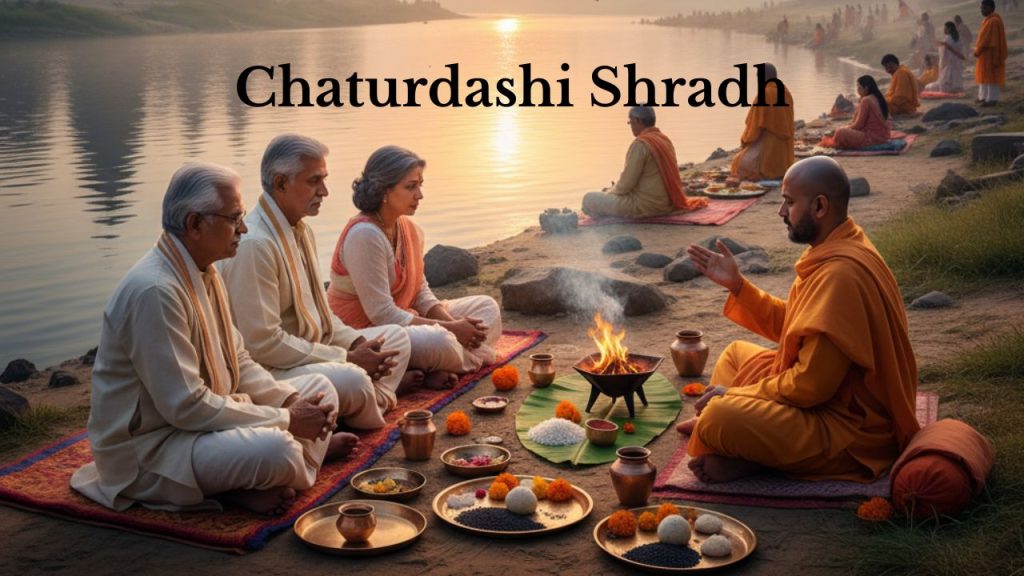
Chaturdashi Shradh involves a series of sacred rituals designed to honor ancestors, uplift their souls, and seek their blessings. Preparations begin with cleaning the home and creating a sacred atmosphere, often by lighting lamps and purifying the surroundings with holy water. Devotees maintain a spirit of reverence and simplicity throughout the day, focusing on remembrance and devotion.
The ritual of pind daan is central to Shradh. Rice balls mixed with sesame seeds, barley, and ghee are offered as symbols of nourishment for the departed souls. This act is believed to provide energy and peace to the ancestors, helping them progress on their spiritual journey. Along with pind daan, tarpan (water offerings with sesame) is performed to quench the thirst of departed souls and show respect.
Fasting is another vital observance on Chaturdashi Shradh. While some observe a complete fast, others consume a simple sattvic diet. The day emphasizes feeding Brahmins and offering food to the needy, as it is believed that serving the living ensures blessings from the departed. The food prepared is usually simple and free from onion, garlic, or meat, reflecting purity and devotion.
Chanting of sacred mantras, recitation of texts like the Garuda Purana, and prayers dedicated to ancestors are integral parts of the rituals. These spiritual practices amplify the effectiveness of Shradh, guiding souls toward peace. Charity and donations made in memory of ancestors—such as offering clothes, food, or money—are also considered highly meritorious.
By following these observances with sincerity and devotion, families not only fulfill their duties toward their ancestors but also invite harmony, protection, and prosperity into their lives. Chaturdashi Shradh thus becomes a powerful blend of ritual, remembrance, and spiritual connection.
Who Should Observe Chaturdashi Shradh
Chaturdashi Shradh is not a ritual for everyone—it is specifically meant for families whose loved ones passed away on the Chaturdashi tithi during Pitru Paksha. According to tradition, each lunar day of Pitru Paksha is dedicated to the ancestors who departed on that specific tithi, and Chaturdashi is no exception. Families whose relatives passed away on this day are especially encouraged to perform Shradh to ensure their souls find peace and liberation.
This observance is also deeply significant for those whose ancestors faced untimely or violent deaths. Scriptures describe such souls as restless and in need of special prayers to overcome their unfinished journey. By performing Chaturdashi Shradh, families extend compassion and guidance to these souls, offering them a sense of closure and peace.
The rituals also carry importance for those who suspect the presence of Pitru Dosha in their lives. Pitru Dosha is believed to arise when ancestral duties remain unfulfilled, often resulting in struggles such as health issues, financial instability, or family disharmony. Observing Chaturdashi Shradh can help remove such obstacles by ensuring that the ancestral lineage is honored with devotion and responsibility.
Even if the exact tithi of an ancestor’s death is unknown, families often perform Shradh during Pitru Paksha collectively, including Chaturdashi, to ensure that no soul is left without offerings. This inclusive practice reflects the essence of Shradh as an act of gratitude and responsibility, not merely a ritualistic duty. Ultimately, anyone who seeks to honor their forebears and strengthen the bond with their ancestral roots can find meaning in observing Chaturdashi Shradh.
Spiritual Benefits of Chaturdashi Shradh
Chaturdashi Shradh is not only about fulfilling religious obligations but also about unlocking profound spiritual benefits for both the departed and the living. One of the foremost benefits is the peace it brings to the souls of ancestors. Souls that may have departed untimely or under unfortunate circumstances often face difficulties in finding rest. Through rituals like pind daan and tarpan, families help them find solace and pave the way toward liberation (moksha).
Another benefit lies in the removal of Pitru Dosha, a condition believed to afflict families that have neglected their ancestral duties. Pitru Dosha can manifest as repeated struggles, delays, or difficulties in life. By sincerely performing Chaturdashi Shradh, families seek to resolve this karmic imbalance, bringing harmony and balance into their lives.
The blessings of contented ancestors are said to extend beyond the spiritual realm. Families often experience prosperity, health, and peace of mind when their ancestors are honored properly. This belief underscores the interconnection between generations, where honoring the past fosters stability in the present and guides the future.
On a deeper level, the act of Shradh reinforces gratitude, humility, and awareness of life’s impermanence. It reminds families that their existence is rooted in the sacrifices and blessings of those who came before them. By strengthening this connection, Chaturdashi Shradh becomes a spiritual bridge that binds generations together, creating a flow of blessings, protection, and harmony that sustains life’s journey.
Regional Practices and Traditions
Chaturdashi Shradh, while rooted in common principles, is observed with unique customs across different regions of India. In North India, especially in states like Uttar Pradesh and Bihar, families gather near sacred rivers such as the Ganga to perform pind daan and tarpan. Offering water and food in such holy locations is considered highly meritorious, as it ensures the offerings reach ancestors directly. Towns like Gaya and Varanasi are particularly renowned for these rituals, drawing thousands of devotees each year.
In South India, Shradh rituals often involve detailed ancestral worship conducted within homes, with elaborate food offerings prepared for both ancestors and Brahmins. Families place special emphasis on sattvic meals, symbolizing purity and devotion. South Indian traditions may also include recitations of Vedic chants that invoke peace and blessings for the departed souls.
In Maharashtra and Gujarat, Chaturdashi Shradh is observed with both household rituals and community gatherings. Temples often organize collective prayers, allowing families to join together in honoring ancestors. Food distribution to the needy is a common practice, reflecting the belief that serving humanity brings merit equal to serving the ancestors.
Sacred sites such as Haridwar, Prayagraj, and Rameswaram also hold special significance, where devotees perform Shradh with the guidance of priests. These locations, associated with spiritual liberation, are believed to amplify the impact of the rituals. Despite regional differences, the essence remains the same—showing gratitude, seeking blessings, and ensuring peace for the departed. This unity of purpose across diverse practices reflects the timeless importance of Chaturdashi Shradh in Indian tradition.
Common Misconceptions about Shradh
Despite their spiritual depth, Shradh rituals, including Chaturdashi Shradh, are often shrouded in misconceptions. One common belief is that Shradh is a superstition rooted in fear of ancestors’ souls. In reality, Shradh is an act of remembrance and gratitude, not fear. It is about honoring forebears who paved the way for future generations, ensuring their memory continues to guide and bless the living.
Another misconception is that Shradh is only about offering food to priests or Brahmins. While feeding Brahmins is part of the tradition, its deeper meaning lies in charity, compassion, and selflessness. Offering food represents nourishment and care for both ancestors and the living, symbolizing continuity of life and relationships.
Some also believe Shradh is irrelevant in modern times. However, the core values of remembrance, gratitude, and respect are timeless. Shradh provides a spiritual framework for connecting with the past while fostering values such as humility and responsibility in present generations. Far from being outdated, it offers lessons on how to live mindfully and honor heritage.
There is also the misconception that Shradh rituals are burdensome or complex. In truth, what matters most is sincerity and devotion. Even simple acts like offering water or lighting a lamp with faith can hold immense spiritual power. The rituals are not about grandeur but about intention, devotion, and love for those who came before us. By clearing these misconceptions, families can approach Chaturdashi Shradh with an open heart, understanding it as a sacred act of connection rather than superstition or obligation.
Relevance of Chaturdashi Shradh in Modern Life
Traditions often take a back seat; Chaturdashi Shradh serves as a gentle reminder of the importance of honoring roots and staying connected to one’s lineage. It is more than a ritual; it is an expression of gratitude, love, and remembrance for ancestors whose blessings continue to shape the present.
The relevance of Shradh in modern life lies in its ability to strengthen family bonds. When families come together to perform these rituals, they not only fulfill spiritual duties but also create shared moments of connection and unity. This collective act passes on cultural and spiritual values to younger generations, ensuring traditions remain alive.
Chaturdashi Shradh also encourages mindfulness about life and death. By remembering ancestors, individuals are reminded of life’s impermanence and the importance of living with humility, compassion, and gratitude. These values transcend religion, offering universal lessons that are meaningful in every age.
In a world often driven by material pursuits, Shradh rituals bring balance by emphasizing the spiritual and emotional aspects of life. They help individuals find peace, restore harmony, and cultivate a sense of responsibility toward both family and society.
Ultimately, Chaturdashi Shradh is not just about rituals performed once a year; it is about carrying forward a legacy of respect, gratitude, and connection. Its relevance lies in reminding us that honoring the past creates a foundation for a more meaningful and harmonious future.