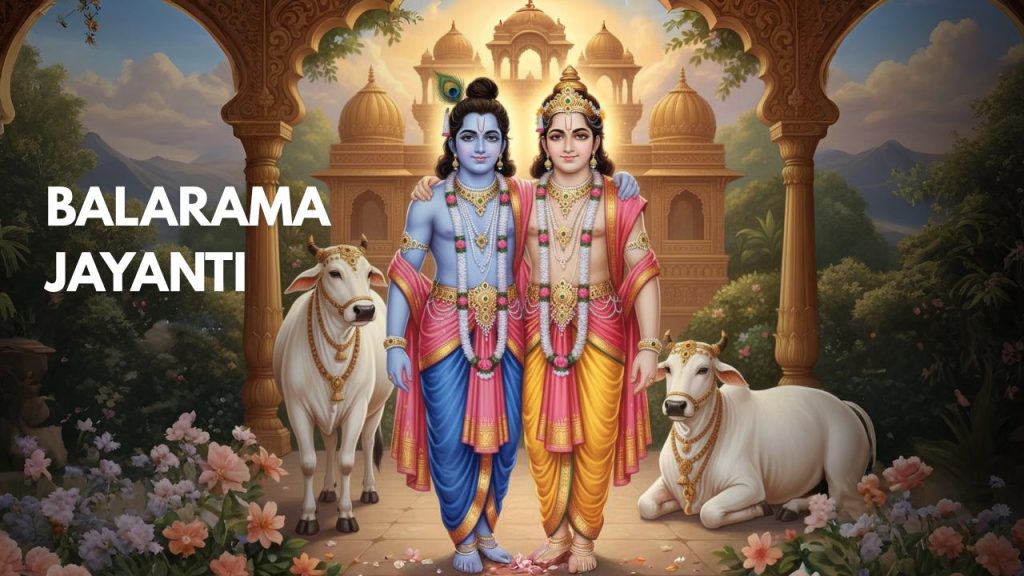
Significance of Balarama Jayanti
Balarama Jayanti is a sacred occasion that celebrates the divine birth of Lord Balarama, the elder brother of Lord Krishna. Revered as a symbol of strength, integrity, and agricultural prosperity, Lord Balarama occupies a vital place in Sanatana Dharma. While many devotees associate his birth celebration with Vaishakha month, there’s a unique and equally significant observance during the Krishna Paksha Tritiya of Bhadrapada, particularly recognized in certain traditions and regions across India.
This Bhadrapada observance holds profound spiritual and seasonal significance. It falls during the monsoon phase when the land is lush, crops are beginning to thrive, and the farming community offers gratitude to the divine. Unlike the Vaishakha version, which is more widely recognized in northern India, the Bhadrapada Balarama Jayanti is especially venerated in states like Odisha and parts of southern India, often integrated with local festivals and regional rituals. This reflects the beautiful diversity of Bharatiya spirituality.
In the Hindu lunisolar calendar, Balarama Jayanti’s timing aligns with lunar movements that hold rich astrological significance. The Krishna Paksha Tritiya, or the third day of the waning moon phase in Bhadrapada, is not just a symbolic date; it serves as a spiritual marker for strength, cleansing, and groundedness, all qualities represented by Lord Balarama. Ultimately, celebrating Balarama Jayanti during Bhadrapada invites us to reflect on the eternal values of strength without ego, simplicity amidst grandeur, and the profound beauty of divine service through dharma and devotion.
Mythological Background of Lord Balarama
The story of Lord Balarama’s birth is nothing short of miraculous. According to the Bhagavata Purana and other scriptures, Balarama was initially conceived in the womb of Devaki, the mother of Krishna. However, due to the tyrannical threats of King Kamsa, Devaki’s brother, the divine embryo was mystically transferred to the womb of Rohini, another wife of Vasudeva, through the intervention of divine yogic powers (Yogamaya). This extraordinary episode preserved his life and fulfilled the cosmic design for Krishna’s incarnation.
As the elder brother of Krishna, Balarama played a deeply affectionate and protective role in Krishna’s life. He wasn’t just a sibling but also a guide, friend, and moral compass, standing beside Krishna in both divine leelas (plays) and critical battles. Their bond exemplifies the purest form of brotherhood, rooted in mutual respect and spiritual connection.
More than just a historical or mythological figure, Balarama is venerated as a symbol of raw strength, responsibility, and agriculture. He’s often depicted with a plough (hala) in hand, signifying his deep connection to the earth and rural life. Farmers, particularly, consider him their divine patron.
In theological terms, Lord Balarama is also regarded as an incarnation of Adi Shesha, the great cosmic serpent who forms the resting couch of Lord Vishnu. This link signifies his eternal role as the support system of divinity, echoing his steadfastness, vastness, and cosmic importance in preserving dharma.
Significance of Balarama in Hindu Theology
Balarama isn’t just a mythological hero; he’s a spiritual archetype. As the embodiment of dharma (righteousness), he represents the power of discipline, moral integrity, and unwavering truth. His character reminds devotees that real strength lies not in dominance but in upholding ethical values even amid chaos.
His role in Krishna’s life is particularly unique. While Krishna symbolizes divine strategy and transcendental playfulness, Balarama complements him by offering structure, guidance, and balance. He’s often portrayed as Krishna’s guru, especially in martial arts and weaponry, imparting lessons that go beyond physical might into spiritual resilience. This highlights Balarama’s guru-like essence, not by teaching scriptures, but by embodying righteous action.
In Vaishnavite theology, Balarama is seen as Sankarshana, the first expansion of Lord Vishnu. As Sankarshana, he connects with the process of cosmic balance, drawing together spiritual energies and manifesting the will of the Divine in the material world.
This makes him a crucial pillar in the Pancha Tattva (five truths) and deeply revered in Gaudiya Vaishnavism as a facilitator of Krishna’s pastimes. Worshipping Balarama is an invitation to connect with one’s inner strength, clarity of conscience, and dedication to a higher path, a path of service, duty, and devotion.
Panchang and Astrological Relevance
The observance of Balarama Jayanti during Bhadrapada Krishna Paksha Tritiya is not arbitrary; it’s steeped in celestial significance. According to the Hindu Panchang (lunar calendar), the third day of the waning phase in Bhadrapada is said to possess unique vibrational energy. This tithi (lunar day) aligns with the waning moon, symbolizing introspection, surrender, and spiritual grounding.
Astrologically, this period is marked by a favorable alignment of planetary bodies, making it especially conducive for rituals that invoke inner strength, promote physical healing, and foster agricultural abundance. The placement of Mars (Mangala), a planet associated with vitality and power, often finds resonance with Balarama’s themes of courage and martial excellence.
Devotees consider this day an auspicious muhurta for performing rituals, particularly those related to land and farming. It’s believed that praying to Lord Balarama on this day blesses one with agricultural prosperity, healthy yields, and protection from natural disturbances. Farmers, in particular, offer their tools, seeds, and early harvests in gratitude and seek divine blessings for the next phase of cultivation.
Spiritually, this seasonal timing, during the post-monsoon transition, serves as a metaphor for spiritual tilling. Just as the land prepares for new growth, the soul gets ready to shed impurities and cultivate inner strength through devotion and dharmic action.
Rituals and Observances on Balarama Jayanti
The sacred day of Balarama Jayanti is observed with deep devotion and simple, meaningful rituals. Devotees begin the day with fasting, dedicating their thoughts and actions to the memory of Lord Balarama. This fast, known as upavasa, is often accompanied by silent prayers and japa (mantra chanting), helping the devotee remain spiritually aligned.
Offerings play a significant role. Since Balarama is fond of dairy and grains, devotees present milk, butter, curd, sugarcane juice, and rice as bhoga (sacred offerings). These are later shared as prasad. The simplicity of these offerings mirrors Balarama’s grounded personality and rural associations.
Scriptural recitations are also key to the celebration. Many households and temples recite the Balarama Sahasranama (a thousand names of Balarama), Baladeva Stuti, and passages from Srimad Bhagavatam that describe his divine pastimes. These readings infuse the atmosphere with spiritual energy and admiration for his character.
In temples like the Baladevjew Temple in Kendrapara, Odisha, grand festivities are held. Devotees decorate idols, perform aarti, and sing traditional kirtans dedicated to Balarama. Special annadanam (food offerings) and cultural performances celebrating his leelas attract hundreds of devotees. The rituals may vary by region, but they all share a familiar spirit, a heartfelt invocation of strength, discipline, and devotion, wrapped in simplicity and sincerity.
Cultural and Regional Celebrations
The charm of Balarama Jayanti lies in its diverse cultural expressions across Indian states. Each region celebrates the occasion with unique flavors, customs, and community spirit. In Odisha, especially around the Baladevjew Temple, Balarama is worshipped with unmatched grandeur. The Balabhadra Rath Yatra held earlier in the year is deeply connected to his legacy. During Balarama Jayanti, this association is revived through temple processions, folk songs, and devotional dances that narrate his stories.
Maharashtra observes the festival with quiet devotion. Many devotees in rural regions offer seasonal grains and perform special kirtans and bhajans in praise of Balarama’s strength and simplicity. In certain agricultural belts, farmers honor him as the patron of land and rain, praying for good monsoons and bountiful crops.
In Gujarat, especially among the Vaishnava communities, Balarama is revered as an avatar of Shesha Naga. Local temples conduct special darshan (viewings), and children enact scenes from his childhood, such as lifting the plough or defeating demons like Dhenukasura.
The Braj and Mathura regions, associated with Krishna’s leelas, also acknowledge Balarama’s contributions. Folk narratives portray him as a playful yet powerful protector of the land, and his tales are woven into the community’s larger Krishna tradition. Each of these regional variations showcases how Balarama’s values, strength, dharma, and simplicity continue to inspire across generations and geographies.
Symbolism of Plough and Agriculture
One of the most striking images of Lord Balarama is that of him holding a plough (hala). This symbol, while simple, carries profound meanings. As Haladhara, or the bearer of the plough, Balarama represents not just agricultural labor but also the sacred bond between humans and the earth.
In traditional Indian society, the act of tilling the land is revered. It symbolizes renewal, hard work, and purification. Just as ploughing prepares the land for new life, spiritual ploughing, through discipline, devotion, and ethical living, prepares the soul for enlightenment. Balarama’s association with the plough is a reminder that spiritual growth begins with inner cleansing.
This symbolism also promotes respect for nature and sustainable living. Balarama teaches that strength should serve creation, not dominate it. Farmers see him as their protector, a divine partner in their daily toil, ensuring that their work yields food, prosperity, and harmony with the environment. Moreover, worshipping Balarama is a form of reverence to Bhoomi Devi (Mother Earth). His plough is not a weapon of destruction, but a tool of nourishment and regeneration, highlighting the balance between effort and grace.
Balarama’s Role in the Mahabharata
Lord Balarama’s presence in the Mahabharata is both significant and unique. Unlike other divine figures who took an active side in the great war of Kurukshetra, Balarama chose neutrality, displaying a deeper understanding of dharma that transcends mere allegiance. His stance reflects profound wisdom, one that views both sides with clarity, detachment, and respect for individual karma.
Balarama’s contribution to the epic wasn’t through warfare but through imparting knowledge and discipline, especially in the realm of gada-yuddha, or mace fighting. He trained both Bhima and Duryodhana, ensuring fairness by equipping them equally. This decision demonstrates his commitment to righteousness, where even those with opposing moral views deserved equal guidance if they sought it sincerely. This impartial approach positions Balarama as a true guru, someone who teaches without bias.
A particularly memorable episode is his visit during the climactic duel between Bhima and Duryodhana, where Bhima delivers a decisive, though rule-breaking, blow to Duryodhana’s thigh. Balarama, angered at the violation of gada-yuddha principles, initially lashes out. But upon understanding Krishna’s subtle orchestration and the deeper necessity of that act for the restoration of dharma, he withdraws with composure. This moment demonstrates his mature restraint and reverence for cosmic justice, even when his emotions are stirred.
In essence, Balarama’s role in the Mahabharata provides a unique perspective on neutral wisdom, ethical training, and the ability to set aside personal preferences for the greater good. His presence serves as a guiding light for those who wish to uphold righteousness without becoming entangled in the complexities of right versus wrong.
Philosophical Teachings and Values
The teachings of Lord Balarama are not found in elaborate discourses or sermons. Instead, his life itself is a message, a philosophy embodied in action. He represents strength with restraint, power with purpose, and a deep-rooted connection to truth.
One of the most remarkable aspects of Balarama is his strength without aggression. Though incredibly powerful, he never sought domination. His power was always grounded in protecting dharma and supporting those in need. This teaches that real strength isn’t about overpowering others but about standing firm in righteousness and offering strength to the weak.
Balarama also exemplifies simplicity, truth, and righteousness. In an era where manipulation and deceit often dictate outcomes, his straightforward nature offers a refreshing reminder that honesty and clarity possess their inherent power. He never shied away from expressing his views, even if they went against popular sentiment, as seen in his rebukes to both Kauravas and Pandavas when necessary.
His most profound teaching lies in the concept of detachment. Despite being emotionally close to Krishna and aware of the injustices around him, Balarama refused to interfere in the Kurukshetra war. This wasn’t apathy but a conscious detachment, choosing peace over conflict, neutrality over bias. His path shows that one can love deeply and still rise above personal involvement when duty demands it.
Balarama’s philosophy offers a timeless roadmap for living: be strong but kind, be truthful yet firm, and above all, live with a clear conscience. In a world hungry for authentic leadership and grounded values, his life becomes a beacon for ethical living and inner discipline.
Contemporary Relevance and Legacy
In a conflict-ridden world, the legacy of Lord Balarama offers a refreshing return to values that nourish the soul and society. His life and teachings inspire not only spiritual seekers but also young people, farmers, leaders, and families who yearn for stability, moral clarity, and a sense of grounded strength.
Balarama’s emphasis on farming and sustainable living is particularly relevant now. As environmental concerns rise and the push for organic agriculture gains momentum, his connection with the plough and nature speaks volumes. Honoring Balarama is a reminder to reconnect with the soil, respect natural cycles, and live in ecological balance. Communities and organizations that promote traditional farming practices often draw inspiration from his example.
On a personal level, Balarama’s ideals of non-aggressive strength, ethical leadership, and neutrality in conflict are invaluable. Whether in relationships, professional decisions, or social justice movements, his model teaches that one can be firm without being violent, and detached without being indifferent. For youth navigating modern challenges, Balarama stands as a role model of courage with conscience, a blend of discipline and compassion.
Temples dedicated to Balarama, particularly in Odisha, Gujarat, and parts of the Braj region, continue to serve as centers of cultural education and community bonding. Festivals, processions, devotional music, and dramas keep his stories alive and relatable. His presence in art, literature, and even media has grown, with depictions in animated series, documentaries, and temple architecture drawing newer generations into his fold.
Balarama Jayanti, especially in the Bhadrapada month, thus serves as more than a ritual; it’s a living tradition that bridges ancient wisdom with modern relevance. Celebrating this divine hero reconnects us with the essence of dharma, the dignity of labor, and the beauty of a simple yet strong life rooted in truth.